A car usually stalls when the engine loses the fuel, air, ignition, electrical signal, or mechanical control needed to keep running.
For drivers in the United States, a car that stalls at a stoplight, while turning, or during highway traffic deserves attention because an unexpected loss of engine power can make steering and braking feel different. The cause can be something relatively simple, such as an intake air leak, weak battery connection, or fuel delivery problem, but it can also involve a sensor, ignition component, charging system, or internal engine problem.
The safest way to diagnose a stall is to start with the exact conditions under which it happens, then check for warning lights and stored diagnostic trouble codes before replacing parts. Modern vehicles use computer-controlled fuel, ignition, throttle, and emissions systems, so a systematic diagnosis is usually more useful than guessing which component failed.
A stalled car has an engine that has stopped running when it should still be operating. The engine may shut off suddenly, gradually lose RPM and die, or start normally and then stop within a few seconds. Stalling is different from a no-start condition because a stalled engine was already running before it stopped.
A gasoline engine needs the correct combination of air, fuel, ignition, compression, and electronic control to maintain combustion. A modern powertrain computer also depends on signals from sensors and stable electrical power. If one of those requirements disappears or becomes incorrect, engine speed can fall until combustion stops.
The first diagnostic question is not simply what part failed. It is when and how the engine stalls. That pattern can narrow the possible causes considerably.
Source: thedailyautomotive.com
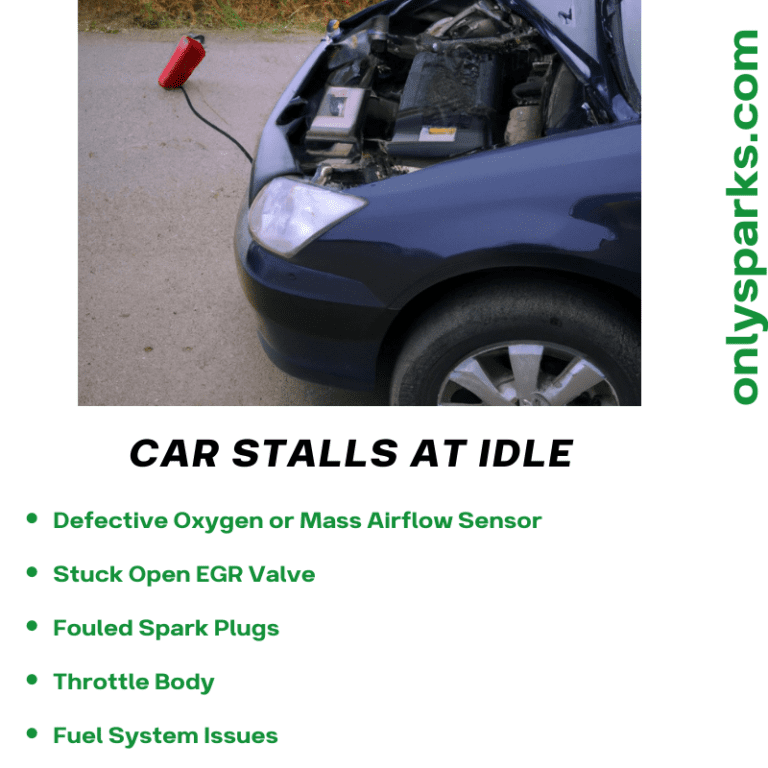
Stalls at idle
Look closely at idle airflow, vacuum leaks, throttle operation, fuel mixture, ignition quality, and engine-control inputs.
Stalls when accelerating
Fuel delivery, ignition under load, airflow measurement, throttle operation, and sensor signals become important areas to investigate.
Stalls when stopping
A problem controlling the transition back to idle can cause the engine speed to fall too far. Vacuum leaks, throttle or idle-control problems, and certain transmission-related issues can contribute.
Stalls when hot
Heat-sensitive electrical faults, fuel-pump problems, crankshaft or camshaft sensor faults, and other temperature-dependent failures become more relevant.
Why the Stalling Pattern Matters
A stall that happens every time the air conditioner is switched on is a different diagnostic clue from an engine that dies randomly after twenty minutes of driving. Likewise, an engine that cranks normally but will not restart immediately after a stall provides different information from one that restarts instantly.
Write down the conditions before testing anything. Record whether the engine was cold or warm, whether the car was moving or stopped, whether the transmission was in Park, Neutral, or Drive, whether the air conditioner was running, whether the tachometer dropped suddenly, and whether warning lights appeared.
Cold start
Consider intake leaks, mixture control, temperature sensor information, ignition quality, and fuel delivery.
Warm restart
Consider heat-sensitive sensors, fuel pressure, electrical connections, and ignition-control problems.
Only in Drive
Consider idle control, excessive engine load, and possible transmission or torque-converter-related problems.
The Most Common Reasons a Car Stalls
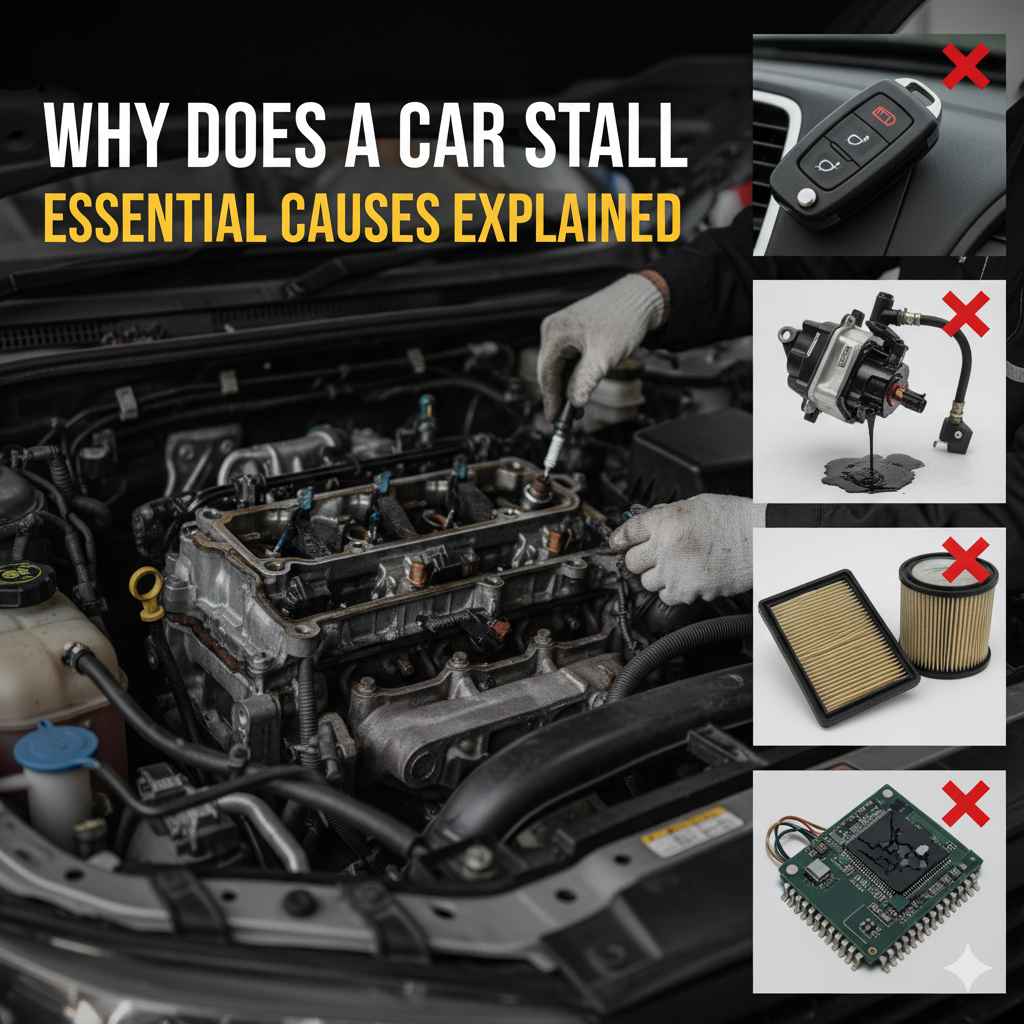
The major causes fall into a few practical groups: fuel delivery, air and idle control, ignition, electrical power, sensor or computer inputs, and mechanical problems. Several different faults can create nearly identical symptoms, which is why replacing the first suspected component is not a reliable diagnostic method.
Modern vehicles have many interacting systems. A weak fuel pump, for example, can cause a lean condition and misfire. A bad crankshaft position signal can interrupt the engine-control system’s understanding of engine speed. A vacuum leak can disturb the air-fuel mixture most noticeably at idle.
Source: autorepairperth.com.au
Fuel delivery problems
A weak fuel pump, restricted fuel supply, faulty fuel-pressure component, clogged injector, or contaminated fuel can reduce the fuel available for combustion.
Vacuum or intake leaks
Unmetered air entering through a damaged hose, intake connection, gasket, or related component can upset the air-fuel mixture and make an engine unstable at idle.
Dirty or faulty throttle control
A throttle body or idle-control problem can prevent the engine from receiving the airflow needed to maintain idle speed.
Ignition faults
Worn spark plugs, failing ignition coils, damaged ignition wiring, or other ignition faults can interrupt combustion and cause rough running or stalling.
Crankshaft or camshaft sensor faults
The engine computer relies on position signals to control combustion timing. An intermittent signal can cause difficult starting, sudden stalling, or a failure to restart.
Charging or electrical problems
Poor battery connections, charging-system faults, damaged grounds, or unstable electrical supply can disrupt vehicle electronics and engine operation.
Mechanical timing or compression problems
Timing-chain or timing-belt faults, low compression, or other internal engine problems can prevent normal combustion and may require professional testing.
A Simple Symptom-to-Cause Guide
Use symptoms to prioritize testing, not to declare a diagnosis. The same stall can have several possible causes, and the correct repair depends on what testing actually finds.
Starts and immediately dies
Investigate fuel delivery, immobilizer or security-system behavior, air-fuel control, sensor signals, and idle control.
Runs rough before stalling
Fuel mixture, ignition misfire, vacuum leaks, airflow measurement, and injector problems become important possibilities.
Dies instantly with no warning
Electrical power interruptions, crankshaft or camshaft position signals, ignition control, and fuel-pump electrical supply deserve attention.
Stalls mainly at low speed
Focus on idle control, throttle operation, vacuum leaks, fuel mixture, and loads placed on the engine.
How to Diagnose a Car That Keeps Stalling
The best diagnostic process moves from observation to electronic scanning, visual inspection, targeted testing, and only then repair. Start with checks that are safe, inexpensive, and capable of eliminating several possible causes at once.
Do not perform roadside testing in a traffic lane or around moving belts, fans, hot exhaust parts, or exposed electrical connections. If the vehicle is in an unsafe location, move it to a safe area only if it can be done without creating additional risk.
Source: plugspecs.com
Step 1: Record exactly when it stalls
Note engine temperature, vehicle speed, engine RPM, transmission position, outside conditions, electrical loads, and whether the engine restarts immediately.
Step 2: Check the dashboard
Look for the check-engine light and other warnings. Note whether a warning appears before the stall, during it, or after restarting.
Step 3: Scan for diagnostic trouble codes
Use a compatible OBD-II scanner on applicable vehicles. Record stored and pending codes and freeze-frame information when available before clearing anything.
Step 4: Inspect obvious physical problems
With the engine off and cool where appropriate, check for loose intake hoses, disconnected vacuum lines, damaged wiring, corroded battery connections, and obvious fluid or fuel leaks.
Step 5: Check the electrical foundation
A technician or knowledgeable DIYer can test battery condition, charging performance, grounds, and relevant power supplies. An electrical problem can imitate many other faults.
Step 6: Check fuel delivery when symptoms point there
Fuel-pressure and fuel-volume testing can determine whether the engine is receiving adequate fuel. Use the vehicle manufacturer’s specified test procedure because fuel-system designs differ.
Step 7: Evaluate air and idle control
Inspect intake plumbing and vacuum connections. Depending on the vehicle, diagnostic data can help evaluate throttle position, airflow, manifold pressure, and fuel trims.
Step 8: Test ignition and engine position signals
If the engine loses spark or the control module loses a reliable RPM signal during the stall, ignition components and crankshaft or camshaft position circuits may need targeted testing.
Step 9: Check mechanical condition when necessary
If fuel, air, ignition, and electronic causes are not supported by testing, compression, valve timing, and other mechanical checks may be necessary.
How to Use an OBD-II Scanner Correctly
For most 1996 and newer U.S. passenger vehicles, OBD-II provides a standardized way to access diagnostic information. A stored code is a valuable clue, but it does not automatically mean the named sensor or component is defective. For example, an airflow-related code can result from wiring, an intake leak, a sensor problem, or another condition that changes the measured signal.
Record the codes before clearing them. If the scanner provides freeze-frame data, save that information too. It can show operating conditions associated with the fault and may help reproduce an intermittent problem.
After a repair, codes and readiness information should be handled according to the vehicle and diagnostic procedure. Clearing codes simply to turn off a warning light does not repair the underlying fault.
Useful scanner information
Diagnostic trouble codes, pending codes, freeze-frame data, engine RPM, coolant temperature, throttle position, airflow or manifold-pressure data, and fuel-trim information can all provide clues when supported by the vehicle.
What a code cannot prove by itself
A code does not automatically prove that the named component must be replaced. The circuit, wiring, connectors, related systems, and operating conditions may also need testing.
What to Do When the Stall Cannot Be Reproduced
Intermittent stalling is difficult because the vehicle may behave normally during a short inspection. Recreate the conditions as safely as possible by documenting temperature, drive time, speed, fuel level, and whether the problem appears after a hot soak, during braking, or under a specific load.
A technician may need live scan data, electrical testing, fuel-pressure testing, or recording equipment while the vehicle is operating under the conditions that trigger the fault. Repeatedly replacing parts without capturing the failure can become expensive without producing a reliable repair.
Hot-only failure
Document how long the vehicle was driven and how long it sat before the restart attempt. Heat-related electrical and fuel problems can be intermittent.
Random failure
Record every occurrence and note whether the tachometer, warning lights, accessories, or other electrical systems changed at the same moment.
What Different Stalling Situations Can Tell You
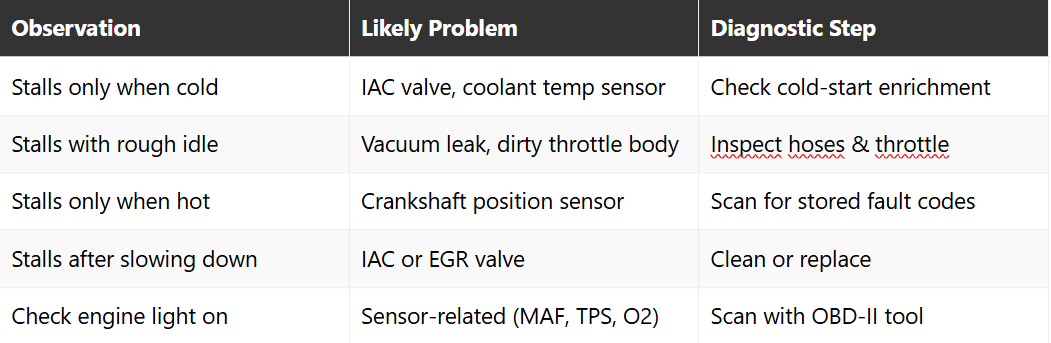
The situation surrounding the stall is one of the most useful diagnostic clues. Instead of asking only why the car stalls, compare what happens immediately before the engine shuts off.
The table below is a prioritization guide, not a diagnosis. Vehicle design, engine type, model year, and stored diagnostic information can change the correct testing sequence.
Source: onlymechanic.com
Stalls at a stoplight
Prioritize idle airflow and control, vacuum leaks, throttle operation, fuel mixture, ignition quality, and loads that appear when the engine returns to idle.
Stalls while turning
Consider whether the stall actually occurs during braking, low-speed operation, steering load, or another condition. Do not assume the steering system itself caused the stall.
Stalls when shifting into Drive or Reverse
Look at idle control and engine load. On some vehicles, transmission or torque-converter problems can also cause an engine to stall when drivetrain load is applied.
Stalls when accelerating
Check fuel delivery, ignition under load, throttle operation, airflow measurement, and sensor inputs before replacing parts.
Stalls after refueling
Consider fuel quality and fuel-system or evaporative-emissions-related issues, especially if the problem consistently begins immediately after filling the tank.
Stalls after the engine warms up
Heat-sensitive electrical faults, fuel delivery problems, and position-sensor failures can become more relevant.
Why a Car Can Stall Without a Check Engine Light
A missing check-engine light does not prove that the engine has no fault. Not every mechanical, electrical, or intermittent problem necessarily produces an emissions-related diagnostic trouble code, and a fault may not meet the conditions required to illuminate the malfunction indicator.
If the car stalls repeatedly but no code is stored, diagnosis should continue through symptom-based testing. Battery and charging checks, physical inspection, fuel testing, ignition testing, and monitoring live data may still reveal the problem.
No warning light
Do not dismiss a repeatable stall. Continue with systematic testing based on the circumstances.
Warning light appears
Scan the vehicle and preserve the diagnostic information before clearing codes.
Why Replacing a Sensor First Can Waste Money
Many engine-control components can produce overlapping symptoms. A vacuum leak, wiring problem, low fuel pressure, or incorrect electrical supply can sometimes produce symptoms that resemble a failed sensor.
Testing the circuit and operating conditions first helps separate the failed component from the conditions that merely make its readings look abnormal. This is especially important for intermittent stalling.
Better approach
Use the symptom pattern and diagnostic data to choose a test, then replace a component only when the evidence supports it.
Poor approach
Replacing several sensors because their names appear in online lists can create unnecessary expense and may leave the original fault untouched.
When a Stalling Problem Is Safe to Investigate and When to Stop Driving
A car that stalls once and restarts immediately still needs attention if the event cannot be explained, but repeated stalling during normal driving raises the safety concern substantially. Losing engine power in traffic can leave the vehicle difficult to maneuver and can create a collision hazard.
Do not continue normal driving simply because the engine restarts. If the vehicle repeatedly dies, stalls at highway speed, loses electrical power, overheats, produces heavy smoke, has a strong fuel smell, or shows another serious warning, move to a safe location if possible and arrange professional assistance.
Source: carxplorer.com
Stop driving and seek help
Use this approach when the vehicle repeatedly stalls, cannot restart reliably, has a strong fuel odor, overheats, has major fluid leakage, or loses power in a way that makes continued driving unsafe.
Avoid roadside component testing in traffic
Do not open the hood or perform electrical, fuel, or mechanical tests where you could be struck by traffic or exposed to hot or moving components.
Do not ignore fuel leaks
A visible fuel leak or strong gasoline odor requires immediate attention because fuel can create a fire hazard.
Use the vehicle manual
Manufacturer procedures, component locations, test specifications, and warnings vary by vehicle, so model-specific service information should control detailed repair work.
What a Professional Diagnostic Visit Should Accomplish
A useful diagnostic appointment should begin with your description of exactly when the stall occurs. The technician can then inspect the vehicle, scan available modules, review codes and data, and perform tests that can confirm or eliminate likely causes.
Ask what test supports the proposed repair. A clear diagnosis should connect the observed symptom to measurable evidence rather than simply listing several parts that could possibly cause a stall.
Bring your symptom history
Provide the engine temperature, driving conditions, restart behavior, warning lights, recent repairs, fuel changes, and approximate frequency of the stall.
Ask for diagnostic evidence
If a component is recommended for replacement, ask what test result, code, measurement, or observed failure supports that recommendation.
Common Diagnostic Mistakes to Avoid
The most expensive stalling diagnosis is often the one that starts by replacing parts instead of gathering evidence. A disciplined process can eliminate several possibilities before money is spent on components.
Avoid assuming that a single symptom has a single universal cause. Engine control systems differ by model year and design, and an older vehicle can have a completely different failure pattern from a newer vehicle with electronic throttle control and extensive computer monitoring.
Source: carxplorer.com
Mistake: blaming the battery for every stall
A weak battery can cause starting and electrical problems, but a vehicle that stalls after starting may have a different underlying fault. Test the battery and charging system instead of assuming.
Mistake: treating every trouble code as a failed part
A code describes a detected condition or circuit problem. Confirm the cause with appropriate testing before replacing the named component.
Mistake: clearing codes before recording them
Clearing codes can remove useful diagnostic information and may reset readiness monitors on applicable vehicles.
Mistake: ignoring recent repairs
A loose connector, hose, ground, or wiring connection disturbed during recent work can be relevant, especially when the stall began immediately afterward.
Mistake: overlooking maintenance condition
Worn ignition components, restricted filters where applicable, contaminated fuel, damaged hoses, and neglected service items can contribute to driveability problems.
Mistake: repeatedly testing an unsafe vehicle on public roads
If the engine can die without warning, do not use public traffic as a test environment. Professional diagnostic equipment or controlled testing is safer.
A Practical Diagnostic Decision Path
Start with the event itself: when did the engine stall, what was it doing, and did it restart? Next, determine whether diagnostic codes or warning lights provide a direction. Then inspect the basic air, fuel, ignition, and electrical systems before moving into specialized tests.
This approach prevents a common diagnostic error: jumping from a symptom directly to an expensive component without proving the connection.
Stall pattern identified
Write down the exact conditions and restart behavior.
Codes available
Record codes and freeze-frame information, then interpret them in the vehicle-specific context.
No useful codes
Continue with visual, electrical, fuel, air, ignition, and mechanical checks based on the symptom pattern.
Fault confirmed
Repair the confirmed cause, then verify that the original stalling condition no longer occurs.
Frequently Asked Questions
Q
Why does my car stall but start right back up?
A car that stalls and immediately restarts may have an intermittent fuel, ignition, sensor, electrical, or idle-control problem. The restart behavior is an important clue, but it does not identify the failed part by itself. Record whether the stall happens when the engine is hot, at idle, during acceleration, or after stopping.
Q
Can a bad battery cause a car to stall while driving?
A battery or charging-system problem can contribute to engine stalling if vehicle electrical power becomes unstable, but a healthy charging system normally supports the vehicle once the engine is running. Test the battery, alternator or other charging components, terminals, grounds, and relevant electrical connections instead of assuming the battery is the cause.
Q
Why does my car stall when I stop at a light?
Stalling as the vehicle returns to idle can involve vacuum leaks, throttle or idle-control problems, incorrect air-fuel control, ignition problems, sensor faults, or excessive engine load. If the engine runs normally while driving but dies as RPM falls toward idle, that pattern is especially useful during diagnosis.
Q
Can an OBD-II scanner tell me why my car stalls?
An OBD-II scanner can provide valuable diagnostic trouble codes and, depending on the vehicle and scanner, live data and freeze-frame information. It cannot always identify the failed component by itself. A code should be treated as evidence that guides further testing rather than as an automatic parts-replacement instruction.
Q
Should I keep driving a car that keeps stalling?
Repeated stalling is not something to ignore, particularly if it happens in traffic or at highway speed. If the vehicle loses power unpredictably, will not restart reliably, overheats, has a fuel smell or leak, or shows another serious warning, stop driving when it is safe to do so and arrange professional assistance.
✦ Wrapping Up
Conclusion
A car stalls when the engine can no longer maintain combustion and engine speed, but the reason can range from an air leak or idle-control problem to fuel delivery, ignition, sensor, electrical, transmission-related, or mechanical faults. The fastest route to the correct repair is to diagnose the conditions surrounding the stall instead of replacing parts based on a symptom list.
For most modern U.S. vehicles, start by documenting the stall, checking warning lights, scanning the OBD-II system, and inspecting basic air, fuel, ignition, and electrical conditions. If the problem is intermittent or the vehicle stalls while driving, professional testing may be necessary to capture the fault safely and accurately.
💡 Key Takeaway
Record exactly when the car stalls, scan for diagnostic codes before clearing them, inspect obvious air and electrical problems, and stop driving the vehicle if repeated stalling makes continued operation unsafe.