
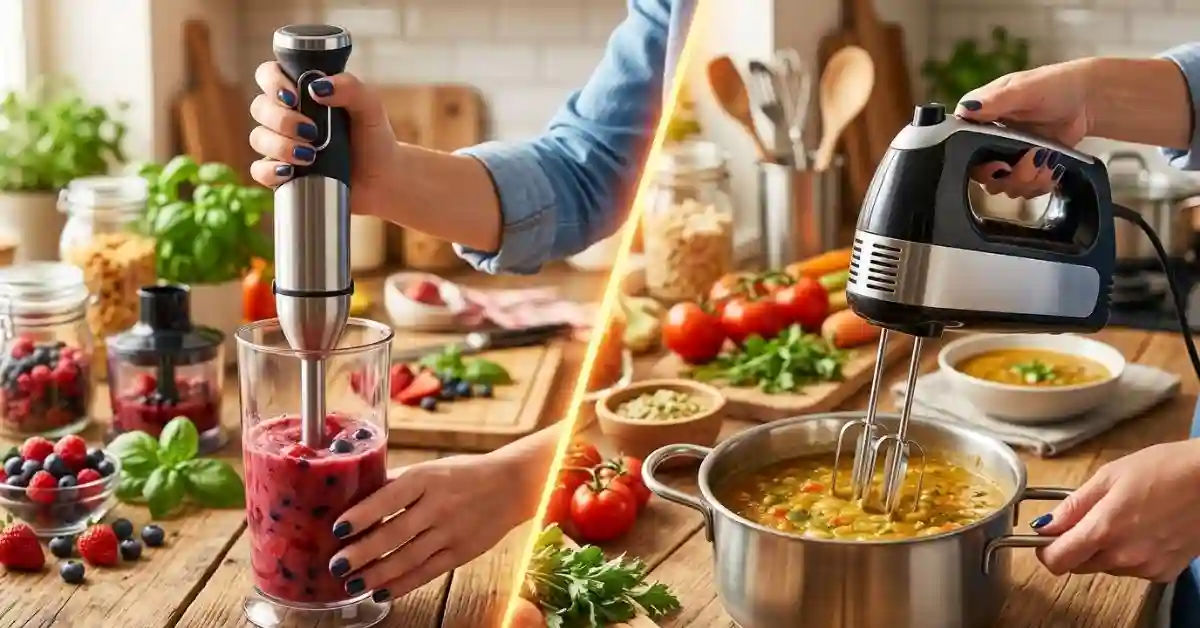
If you have seen the terms immersion blender and hand blender, you may wonder if they mean two different tools. I had the same question when I first looked at blender options. The names make it sound like there should be a clear difference.
The good news is that the answer is simple. In most cases, an immersion blender is the same as a hand blender. Both are handheld kitchen tools made to blend food right in a pot, bowl, or cup. The real differences often come from the brand, design, power, and extra attachments.
Is an Immersion Blender the Same as a Hand Blender?
Yes. An immersion blender and a hand blender are usually the same type of kitchen appliance. They both have a motor handle and a blending blade at the end.
The name changes by region and brand. You may also see names like stick blender, wand blender, or handheld blender.
| Name | Usually means | Main use |
| Immersion blender | Handheld blender | Blend food in a container |
| Hand blender | Handheld blender | Blend food in a container |
| Stick blender | Handheld blender | Blend soups, sauces, and drinks |
So, if a recipe calls for an immersion blender and you own a hand blender, you can usually use it.
Why Are There So Many Names?
The word “immersion” describes how the blender works. You place the blending end into the food before turning it on.
“Hand blender” points to the way you hold the tool. “Stick blender” comes from its long, slim shape.
These names sound different, but they often describe the same basic appliance.
What Does an Immersion Blender Actually Do?
An immersion blender uses a small motor to spin blades at the bottom of the unit. You place those blades into the food and move the tool as needed.
This design makes it useful for foods that are already in a pot or bowl. You do not need to move the food into a large blender jar first.
| Food | Why a hand blender works well |
| Soup | Blends right in the pot |
| Tomato sauce | Smooths sauce with little mess |
| Smoothies | Works well for small batches |
| Baby food | Helps make soft foods smooth |
| Mashed foods | Can break down soft ingredients |
One thing I find easy to overlook is the size of the blending head. A small head may work well for a cup or small bowl but take longer in a large pot.
That is why the basic design matters more than the name on the box.
Immersion Blender vs Hand Blender: Is There Any Real Difference?
For most buyers, there is no major difference between an immersion blender and a hand blender.
Still, two products with these names can feel very different. One may have a strong motor, while another may be made for light tasks. Some models also include a whisk, food processor bowl, or measuring cup.
| Comparison | Basic model | More advanced model |
| Motor | Lower power | Higher power |
| Speed | One or two speeds | Several speed levels |
| Attachments | Few or none | Whisk or chopper |
| Best for | Simple blending | More kitchen tasks |
So, do not choose a blender just because the package says “immersion” or “hand.”
Look at the motor power, speed control, blade design, grip, shaft, and attachments instead.
Is a Stick Blender Also the Same Thing?
In most cases, yes. A stick blender is another common name for an immersion blender.
The slim shape is what gives it the “stick” name. It is designed to go straight into the food you want to blend.
This makes a stick blender different from a countertop blender, which uses a separate jar.
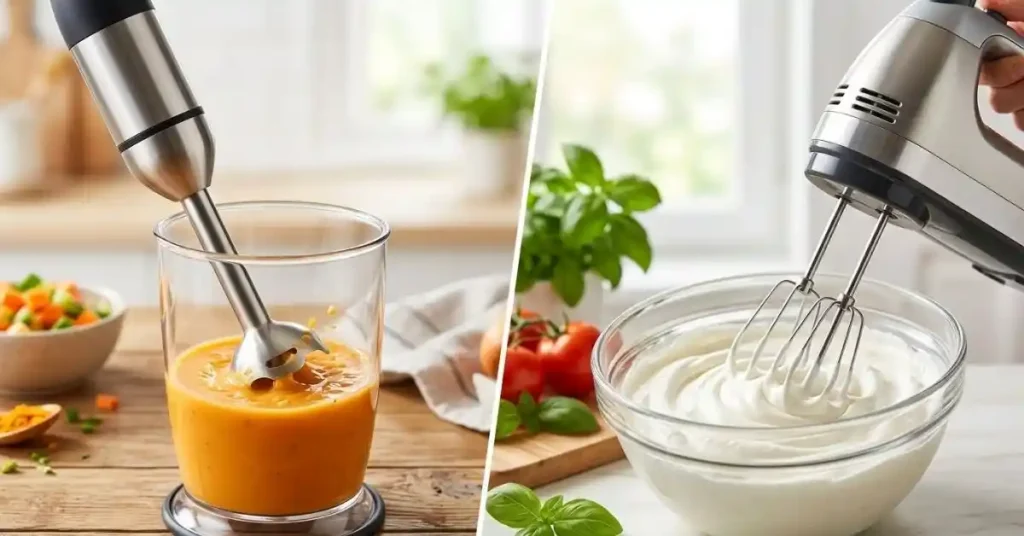
When Is a Hand Blender Better Than a Countertop Blender?
A hand blender can be a better choice when you want to blend food without moving it to another container.
This is especially handy for soup. You can cook the soup in a pot, let it cool as needed, then blend it in the same pot.
| Situation | Better choice |
| Blending soup in a pot | Immersion blender |
| Large frozen drink batch | Countertop blender |
| Small sauce batch | Immersion blender |
| Very smooth ice blend | Countertop blender |
| Quick cleanup | Immersion blender |
The biggest benefit is less transferring. With a countertop blender, you often need to ladle hot soup into the blender jar. That adds work and another item to wash.
But a countertop blender can still win for some jobs. It usually handles large batches and hard ingredients better.
What Can You Make With an Immersion Blender?
An immersion blender can handle many everyday foods. It is not just a soup tool.
I think this is where many people get more value from a hand blender than they expect. Once you have one, you may start using it for small jobs that feel annoying with a full-size blender.
Soups and Sauces
This is one of the best uses for an immersion blender. You can blend cooked vegetables, beans, or tomato sauce right in the cooking pot.
For chunky soup, use short pulses. For a smooth soup, move the blender slowly through the pot.
Smoothies and Drinks
A hand blender can work well for a small smoothie. A tall cup helps keep the food around the blade.
It may not be the best choice for large amounts of ice or very hard frozen food. That is where a full-size blender can have an edge.
Dips and Soft Foods
You can also use an immersion blender for soft dips, cooked vegetables, and some dressings.
The key is to match the tool to the food. A handheld blender is great for soft ingredients but is not a magic solution for every tough ingredient.
What Mistakes Should You Avoid With a Hand Blender?
The most common mistake is turning the blender on before the blade is fully covered by food.
That can cause splashing. With hot food, this can be a bigger problem, so take extra care.
| Mistake | Better approach |
| Starting above the food | Put the blade into the food first |
| Moving too fast | Use slow, steady movements |
| Filling a narrow cup too much | Leave room for the food to move |
| Blending hard foods | Check the model’s limits first |
Another mistake is lifting the blade out while it is still running. I prefer to stop the motor first, then lift the tool.
It sounds like a small habit, but it helps keep the kitchen cleaner.
Can You Use an Immersion Blender in a Hot Pot?
Many immersion blenders are designed for use with soups and other warm foods. Still, you should always check the instructions for your model.
Do not assume every hand blender has the same heat limit.
| Before blending hot food | Why it matters |
| Check the manual | Heat limits can vary |
| Keep the blade submerged | Helps reduce splashes |
| Use slow movements | Gives you more control |
| Avoid overfilling | Leaves room for movement |
If your pot has a delicate nonstick surface, check the blender design too. A metal blending shaft may scratch some cookware if handled roughly.
Does More Power Mean a Better Immersion Blender?
Not always.
A stronger motor can help with thicker foods and larger amounts. But power is only one part of the design.
A blender with a comfortable grip and good speed control can be easier to use than a very powerful model with poor control.
| Feature | Why it matters |
| Motor power | Helps with thick foods |
| Speed control | Gives better blending control |
| Blade guard | Helps reduce splashes |
| Comfortable grip | Makes longer use easier |
| Removable shaft | Can make cleaning easier |
For simple soups and sauces, you may not need the most powerful model.
If you often blend thick mixtures, though, spending more on a stronger design may make sense.
Immersion Blender or Food Processor: Which One Fits Better?
These tools can overlap, but they are not the same.
An immersion blender is mainly for blending. A food processor is better suited to chopping, slicing, shredding, and mixing, depending on its attachments.
That difference becomes important when you plan meals.
| Task | Better fit |
| Pureeing soup | Immersion blender |
| Chopping vegetables | Food processor |
| Making smooth sauce | Immersion blender |
| Shredding cheese | Food processor |
| Small soft-food blend | Immersion blender |
If your main goal is smooth food, a hand blender may be all you need.
If you want one machine for many prep jobs, a food processor may be more useful.
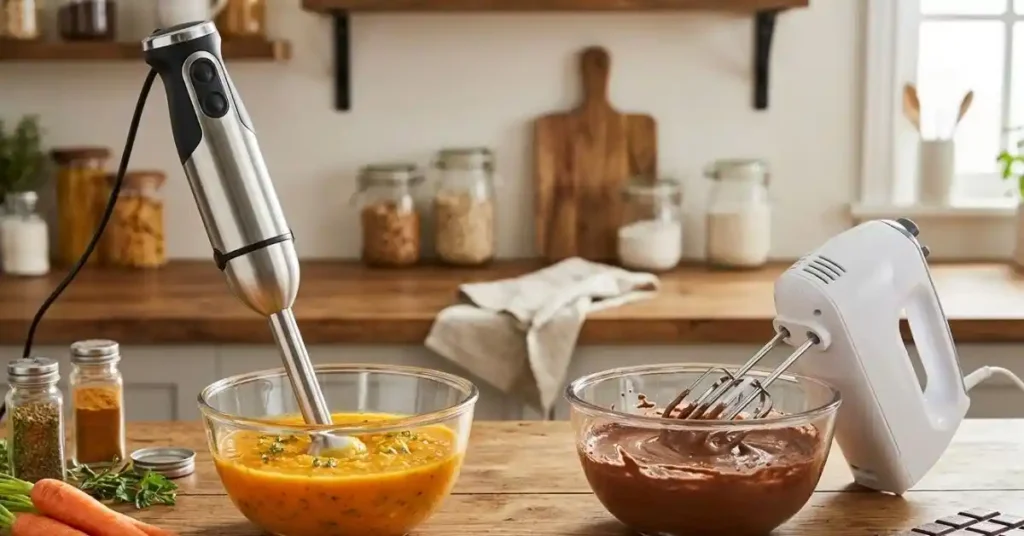
How Do I Choose the Right Hand Blender?
Start with the food you make most often. Do not start with the longest feature list.
If you mostly make soup, sauce, or small batches, a simple immersion blender can do the job. If you want more control, look for multiple speeds.
Look at the Blade and Guard
The blade sits inside a guard at the end of the shaft. The guard helps keep food around the blade and can help reduce splashing.
The shape also affects how easy it is to move through thick food.
Think About Cleaning
Cleaning is one of the small details that can change how often you use a kitchen tool.
A removable blending shaft can make cleaning easier. Some models also have dishwasher-safe parts, but you should check the care instructions first.
Check the Attachments
Some hand blenders come with useful extras. A whisk can help with light mixing. A small chopper can handle some prep work.
But attachments add cost and storage needs. If you will never use them, a basic model may be the smarter choice.
Common Myths About Immersion and Hand Blenders
The names cause a few easy misunderstandings.
| Myth | Reality |
| They are two different machines | They are usually the same type |
| A stronger motor is always better | It depends on the food |
| Every model can crush ice | Check the product instructions |
| A hand blender replaces a food processor | Each tool has different strengths |
One thing worth remembering is that product names are not always precise. A brand may call its model a hand blender while another calls a similar model an immersion blender.
That is why I would compare the actual features instead of the name.
So, Is an Immersion Blender the Same as a Hand Blender?
Yes, in most cases, an immersion blender is the same as a hand blender. Both terms usually refer to a handheld blender with a motor and blade at the end.
The difference is mostly in the name. What really matters is how the specific model performs.
If you want a tool for soups, sauces, small smoothies, and soft foods, an immersion blender can be very handy. If you need to crush lots of ice or blend large batches, a countertop blender may still be the better fit.
The biggest lesson is simple: do not get stuck on the label. Check the power, speeds, blade design, cleaning method, attachments, and the foods you plan to blend. That will tell you far more than whether the box says “hand blender” or “immersion blender.”
Final Thoughts
So, is an immersion blender the same as a hand blender? Usually, yes. They are two common names for the same basic kitchen tool.
For everyday blending, the real choice is not between those two names. It is between different models and features. Choose based on how you cook, how much you blend, and how easy the tool is to clean.
If you mainly want quick soups, sauces, and small batches without dirtying a large blender jar, a good hand blender can be a very practical addition to the kitchen.
FAQs
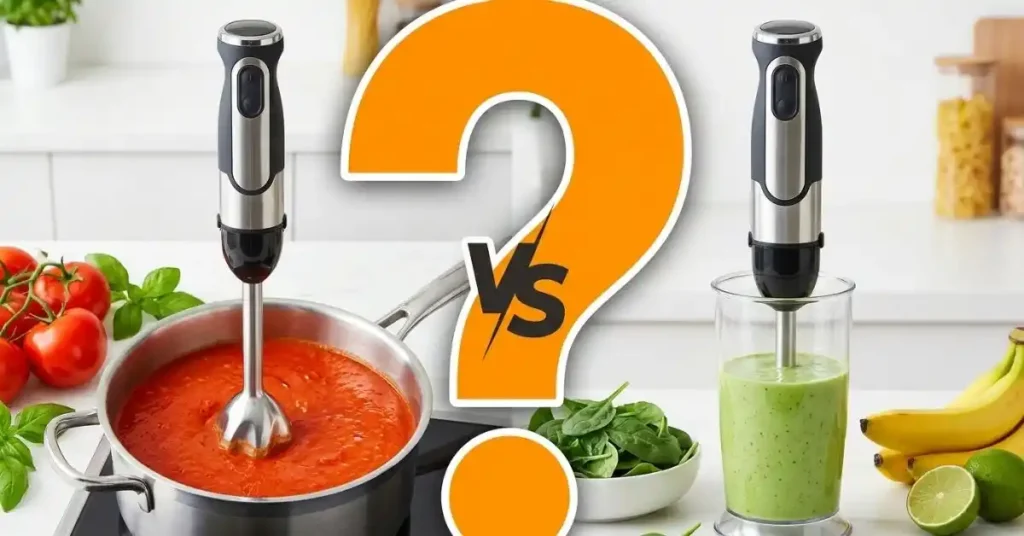
Is an immersion blender the same as a hand blender?
Yes. An immersion blender is usually the same as a hand blender. Both are handheld tools made to blend food in a pot, bowl, or cup.
Why is it called an immersion blender?
It is called an immersion blender because the blade goes into the food while you blend. “Hand blender” and “stick blender” are common names too.
Can I use a hand blender for soup?
Yes. A hand blender works well for many soups. Blend slowly and keep the blade covered to help reduce splashes, especially with hot soup.
Is an immersion blender better than a countertop blender?
It depends on the job. An immersion blender is great for soups and small batches. A countertop blender is often better for ice and large batches.
Can an immersion blender replace a food processor?
Not fully. An immersion blender is best for blending and pureeing. A food processor is better for tasks like chopping, slicing, and shredding.
To Get More About Home, Home and Kitchen Product You Can Visit Our Site. If You Found our Posts Helpful Leave a Comment Below