
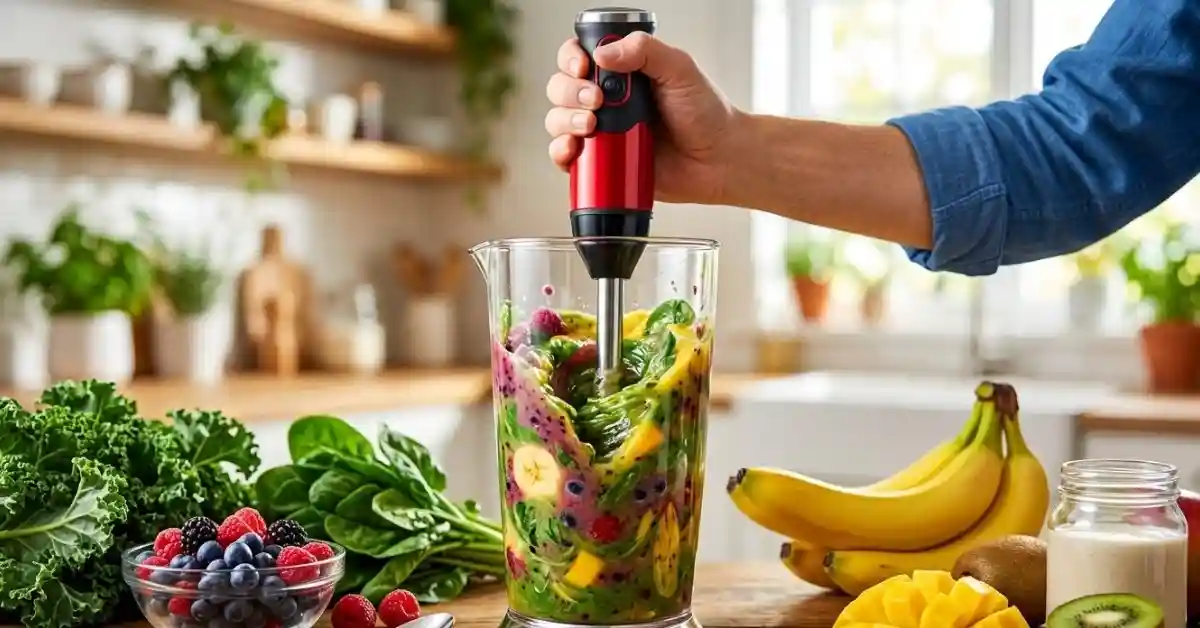
If you already have an immersion blender in your kitchen, you may wonder, can you use an immersion blender for smoothies? Yes, you can. In fact, it can make a quick smoothie without taking out a full-size blender.
But there is a catch. An immersion blender does not handle every smoothie the same way. Soft fruit, yogurt, milk, and other easy ingredients blend quite well. Frozen fruit, ice, nuts, and thick mixtures can be much harder.
I learned that the real trick is not just the blender. It is how you prepare the ingredients, how much liquid you use, and what you put in the container. Once you understand those limits, an immersion blender can be a very handy smoothie tool.
Can You Use an Immersion Blender for Smoothies?
Yes, an immersion blender can make smoothies. It works best with soft or thawed fruit and enough liquid to help the blades move freely.
Unlike a countertop blender, an immersion blender sits directly inside the container. Its small blade spins at high speed and pulls nearby food toward it.
| Smoothie ingredient | Immersion blender result |
| Banana | Very easy |
| Soft berries | Easy |
| Yogurt | Easy |
| Frozen fruit | Possible, but harder |
| Ice cubes | Often difficult |
This makes an immersion blender great for a simple breakfast smoothie. It is also useful when you only want one serving and do not want to clean a large blender jar.
The biggest issue is power and blade coverage. A countertop blender can move a larger amount of food around the jar. An immersion blender works in a smaller area, so thick or hard ingredients can stop the mixture from moving.
Why an Immersion Blender Works Well for Some Smoothies
The best smoothie for an immersion blender is soft, fairly thin, and made in a narrow container.
That combination lets the blade stay in contact with the ingredients. It also reduces splashing, which is one of those small kitchen problems that becomes annoying very fast.
Soft fruit is the easiest place to start
Bananas, ripe mangoes, peaches, strawberries, and similar soft fruits are good choices.
I would cut larger pieces before blending. Small pieces are easier for the blade to break down, and the motor does not have to work as hard.
| Good choice | Why it works |
| Ripe banana | Soft and easy to mash |
| Fresh berries | Small and tender |
| Ripe mango | Soft flesh blends easily |
| Yogurt | Adds body and blends smoothly |
A banana smoothie with milk or yogurt is about as simple as it gets.
Liquid makes a big difference
This is one lesson that is easy to overlook. If the mixture is too thick, the blade may spin without moving the food well.
Milk, oat milk, almond milk, regular yogurt, or fruit juice can help.
Start with a small amount of liquid. You can always add more. It is much harder to fix a smoothie that has become too thin.
What Kind of Smoothies Can You Make With an Immersion Blender?
You can make many everyday smoothies with one. The key is to choose ingredients that match its limits.
For a quick breakfast, try banana, milk, yogurt, and a little peanut butter. For a fruit smoothie, use berries, banana, and milk or juice.
| Smoothie type | How well it suits an immersion blender |
| Banana and yogurt | Excellent |
| Strawberry and banana | Very good |
| Mango and yogurt | Very good |
| Green smoothie | Good with soft greens |
| Thick frozen smoothie | More difficult |
Green smoothies need a little more care. Spinach and other tender greens usually work better than tough stems or large leafy pieces.
If you want a very smooth drink, chop the greens first. That small step can make a noticeable difference.
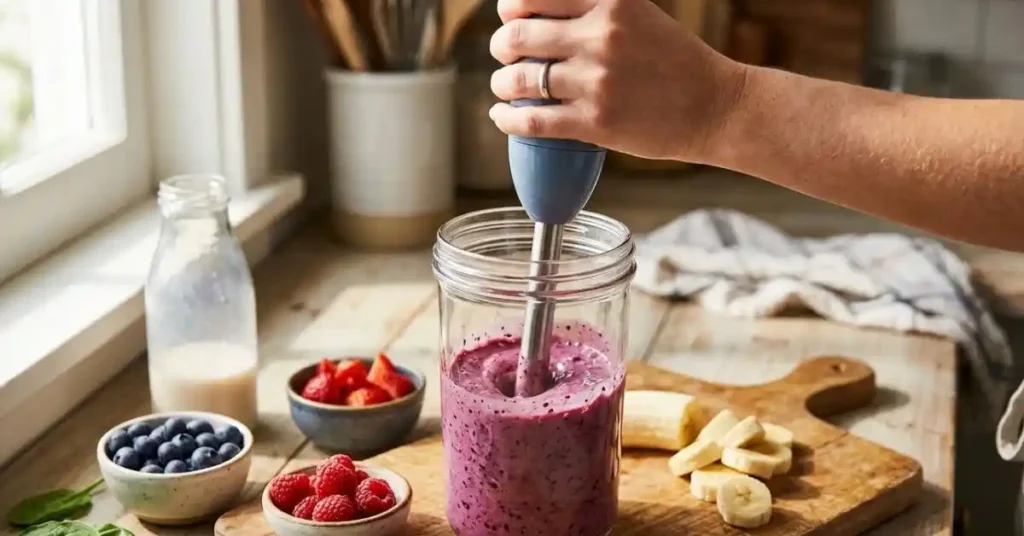
Can an Immersion Blender Crush Ice and Frozen Fruit?
This is where I would set realistic expectations.
An immersion blender may handle small amounts of soft frozen fruit, but it is not the tool I would choose for a smoothie packed with hard frozen chunks or ice.
Hard ingredients place more stress on the motor and blade. Some immersion blenders may also have instructions that tell you not to use them with ice or certain frozen foods.
| Ingredient | My practical approach |
| Thawed frozen berries | Use with enough liquid |
| Small frozen fruit pieces | Use cautiously |
| Large frozen fruit chunks | Let them soften first |
| Ice cubes | Use a blender designed for ice |
Always check the instructions for your specific immersion blender before using hard or frozen ingredients.
If your goal is an extra-thick, icy smoothie, a countertop blender is usually the better tool.
How to Use an Immersion Blender for a Smoothie
The process is simple, but a few small habits make it much easier.
1. Choose the right container
A tall, narrow container works better than a wide bowl.
The immersion blender should sit below the surface of the mixture. This helps keep the ingredients contained and reduces splashing.
| Container | What I would expect |
| Tall narrow cup | Best choice |
| Large mixing bowl | More splashing |
| Shallow bowl | Poor blade coverage |
Do not fill the container to the top. Leave enough room for the ingredients to move.
2. Add liquid first
Adding milk, juice, or another liquid first helps the blade get moving.
Then add softer ingredients such as banana, berries, or yogurt.
3. Add fruit in small pieces
Do not drop a whole apple or large chunk of mango into the container and expect the small blade to do all the work.
Cut larger ingredients into smaller pieces first.
4. Keep the blade under the surface
Start the blender while the blade is below the mixture.
Move it slowly up and down. You can also move it around the container so the blade reaches different areas.
5. Stop before overworking the motor
If the mixture stops moving, turn the blender off.
Add a little more liquid or move the ingredients around. Do not keep forcing the motor through a thick mass.
Common Immersion Blender Smoothie Mistakes
Most problems are not caused by the idea of using an immersion blender. They come from using the wrong technique.
Mistake 1: Using too little liquid
A very thick mixture can sit around the blade instead of flowing toward it.
Better approach: Add a little liquid and blend again.
Mistake 2: Using large frozen chunks
Hard chunks can make blending slow and uneven.
Better approach: Let frozen fruit soften slightly or cut it into smaller pieces when appropriate.
Mistake 3: Choosing a wide container
A wide container gives the mixture more room to spread away from the small blade.
Better approach: Use a tall container that is only moderately wider than the blending head.
Mistake 4: Lifting the blender too quickly
This can create a messy splash.
Better approach: Keep the blade submerged and move it slowly.
| Mistake | Better approach |
| Too little liquid | Add liquid gradually |
| Large fruit pieces | Cut them smaller |
| Wide container | Use a tall container |
| Fast up-and-down motion | Move slowly |
| Forcing thick food | Stop and loosen the mixture |
These sound like small details, but they make the process much less frustrating.
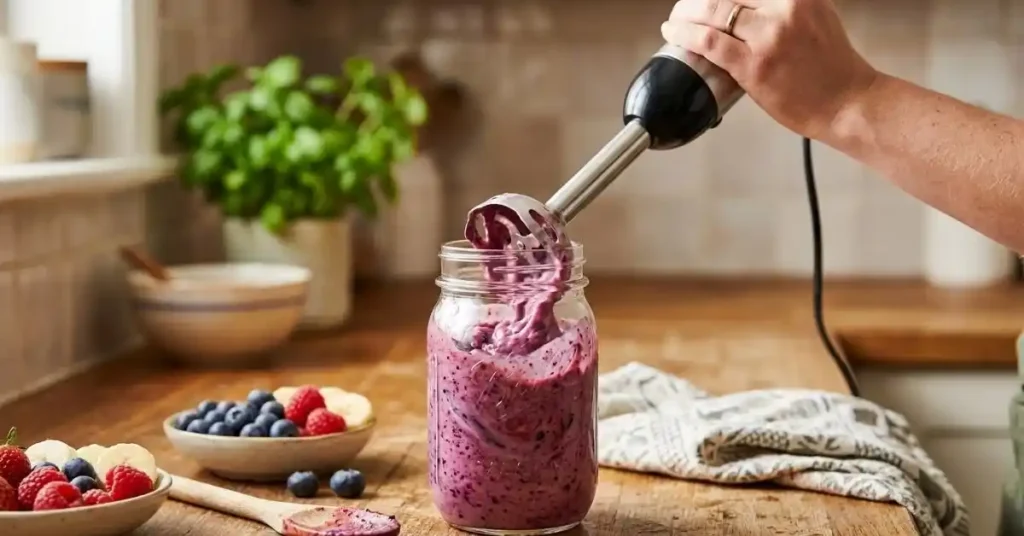
Immersion Blender vs. Regular Blender for Smoothies
An immersion blender is convenient, but a regular countertop blender has clear advantages for certain smoothies.
The right choice depends on what you make most often.
| Comparison | Immersion blender | Countertop blender |
| One serving | Excellent | Good |
| Cleanup | Easy | More parts |
| Soft fruit | Very good | Excellent |
| Ice | Limited | Usually better |
| Large batches | Poor fit | Better |
For a single soft-fruit smoothie, I would happily reach for an immersion blender.
For several servings, lots of frozen fruit, ice, or very thick blends, a countertop blender makes more sense.
The immersion blender wins on convenience. The regular blender wins when you need more power and better circulation.
How to Make an Immersion Blender Smoothie Smoother
If your smoothie comes out with small fruit pieces, do not assume the blender is bad.
Texture often comes down to preparation.
Start with ripe fruit. Cut large pieces into smaller ones. Use enough liquid. Then blend slowly while moving the blender around the container.
You can also blend the liquid and soft ingredients first. Add thicker ingredients gradually instead of putting everything into the container at once.
| Texture problem | Likely reason | Simple fix |
| Small fruit pieces | Pieces are too large | Cut fruit smaller |
| Very thick texture | Not enough liquid | Add liquid |
| Uneven blend | Poor movement | Move blender slowly |
| Foamy top | Too much air | Keep blade submerged |
One thing I would not do is keep blending for a long time just because the smoothie is not perfect. If the ingredients are not moving, more blending may not solve the problem.
Changing the mixture is often more useful.
Are Immersion Blenders Good for Protein Smoothies?
Yes. An immersion blender can work well for many simple protein smoothies.
Protein powder usually blends more easily when there is enough liquid. Milk, water, or a milk alternative can provide the base.
Banana or yogurt can add thickness and flavor.
The main thing to watch is peanut butter, seeds, ice, and other dense ingredients. They can make the mixture harder to blend.
If you use a very thick recipe, start with more liquid than you think you need. You can always make it thicker later.
Can You Use an Immersion Blender in a Smoothie Cup?
You can, as long as the cup is suitable for the blender and leaves enough room for movement.
I prefer a tall, sturdy container. A very narrow cup can make it hard to move the blender. A very wide cup can make blending less efficient.
Also, check the blender’s instructions. Some models come with a blending beaker that is designed for this exact job.
The goal is simple: keep the blade covered, give the ingredients some room to move, and avoid overfilling the container.
When Should You Not Use an Immersion Blender for Smoothies?
There are times when I would skip the immersion blender altogether.
If I wanted a very thick smoothie bowl, a drink loaded with ice, or a large batch for several people, I would use a full-size blender.
An immersion blender is a convenience tool. It is not automatically a replacement for every blender.
| Situation | Better choice |
| Quick single smoothie | Immersion blender |
| Soft fresh fruit | Immersion blender |
| Large family batch | Countertop blender |
| Lots of ice | Countertop blender |
| Very thick smoothie bowl | Countertop blender |
Knowing when not to use your immersion blender is just as useful as knowing when to use it.
Is an Immersion Blender Worth Using for Smoothies?
If you already own one, absolutely give it a try.
For simple smoothies, it can save time and dishes. You can blend directly in a suitable cup instead of setting up a large blender.
Just keep your expectations realistic. It will not necessarily produce the same result as a powerful countertop blender, especially with hard or frozen ingredients.
The biggest lesson is that smoothie texture depends on more than motor power. Ingredient size, liquid level, container shape, and blending technique all matter.
Final Thoughts
So, can you use an immersion blender for smoothies? Yes. It is a practical choice for soft-fruit smoothies, yogurt blends, and quick single servings. It works best when the ingredients are small, soft, and surrounded by enough liquid.
I would think of an immersion blender as the quick and easy option, not the universal smoothie machine. Use it for simple blends, prepare the ingredients well, and switch to a countertop blender when ice, hard frozen fruit, thick mixtures, or large batches become the main job.
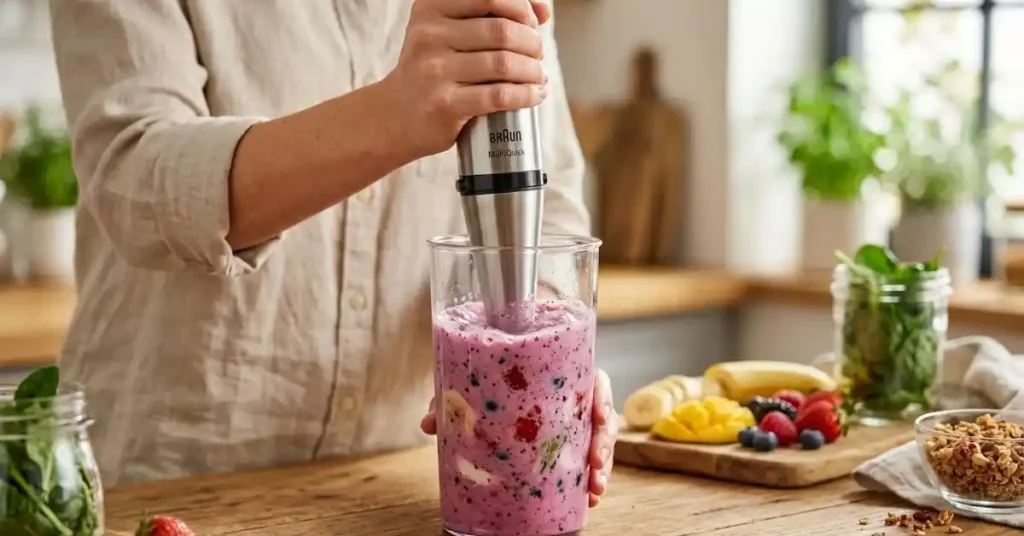
FAQs
Can you use an immersion blender for smoothies?
Yes. An immersion blender works well for soft fruit, yogurt, and milk. It is best for small, quick smoothies with no hard ice.
Can an immersion blender crush ice for smoothies?
Most immersion blenders are not made for hard ice. Check the user guide first. For ice-heavy smoothies, a strong countertop blender is a better pick.
Can you use frozen fruit with an immersion blender?
Yes, but frozen fruit can be hard to blend. Let large chunks soften a bit and add enough liquid to help the blades move well.
What is the best cup for an immersion blender smoothie?
A tall, narrow cup works best. It helps keep the mix near the blade and cuts down on splashes while you blend.
Is an immersion blender better than a regular blender for smoothies?
An immersion blender is handy for one soft smoothie and easy cleanup. A regular blender is better for ice, thick mixes, or large batches.
To Get More About Home, Home and Kitchen Product You Can Visit Our Site. If You Found our Posts Helpful Leave a Comment Below