
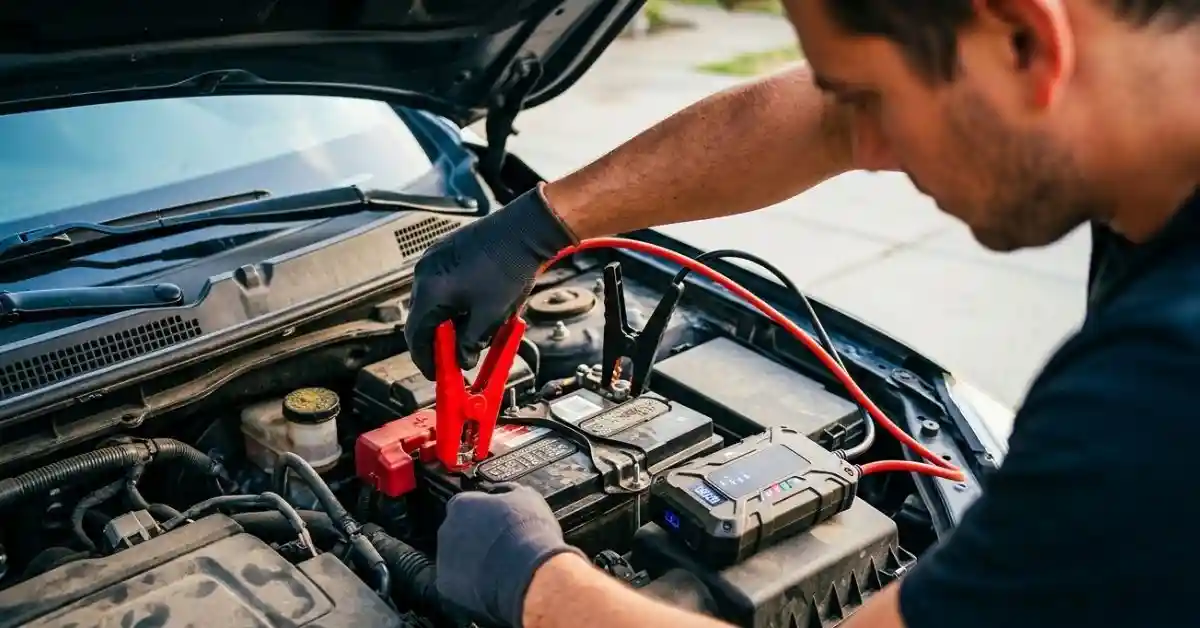
A dead car battery always seems to pick the worst time to quit. I learned that the hard way. You can have a jump starter in the trunk for months, then suddenly need it in a parking lot, driveway, or on a cold morning.
Learning how to use a battery jump starter is much easier than it first looks. The key is getting the cable order right, using the correct connection points, and knowing when the battery is too far gone to jump.
How to Use a Battery Jump Starter Step by Step
The basic process is simple, but I never rush the first few steps. A few seconds of checking can prevent a bad connection or a spark in the wrong place.
Before you connect anything, turn the car off and put it in Park. For a manual car, use Neutral and set the parking brake. Turn off the lights, radio, fan, and other electrical loads.
| Step | What to do |
| 1 | Check the battery and jump starter |
| 2 | Turn off the car and accessories |
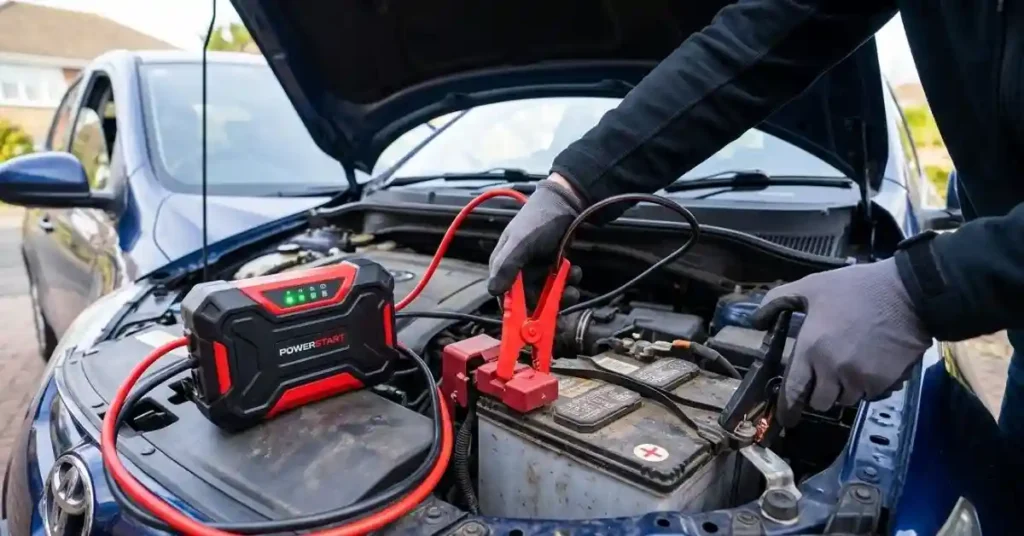
| 3 | Connect red to positive |
| 4 | Connect black to negative or ground |
| 5 | Turn on the jump starter |
| 6 | Start the car |
| 7 | Remove the clamps in reverse order |
Check the Jump Starter Before You Connect It
First, check the jump starter’s charge level. I prefer to start with a well-charged unit rather than assume it has enough power.
Look at the battery too. Do not try to jump a battery that is cracked, leaking, badly swollen, or frozen.
Also check the jump starter cables. The clamps should be clean and free of damage.
Connect the Red Clamp First
Find the positive (+) battery terminal. It often has a red cover or a plus sign.
Attach the red clamp firmly to the positive terminal.
Then connect the black clamp. Depending on the vehicle and jump starter instructions, this may go to the negative (-) battery terminal or a clean, unpainted metal ground point on the engine or chassis.
| Clamp | Normal connection |
| Red | Positive (+) terminal |
| Black | Negative (-) or suitable ground |
Make sure the clamps cannot touch each other. This is one of those small details that is easy to forget when you’re standing beside a dead car.
Where Should the Black Clamp Go?
This part confused me at first because some vehicles have a battery that is easy to reach, while others use remote jump points.
The safest choice is always the connection point listed in the vehicle owner’s manual. Some cars have a dedicated negative jump post or ground point.
Negative Terminal vs Ground Point
If the manual allows it, the black clamp can go to the negative battery terminal. Some vehicles recommend a solid, unpainted metal ground point instead.
A ground point can be a sturdy metal part of the engine or chassis designed for this purpose.
| Situation | Best approach |
| Manual gives a ground point | Use that point |
| Battery negative terminal is approved | Use the negative terminal |
| Unsure | Check the vehicle manual |
Do not clamp onto painted metal, thin sheet metal, moving parts, fuel lines, or random bolts. A poor ground can stop the jump starter from working.
How to Start the Car With a Battery Jump Starter
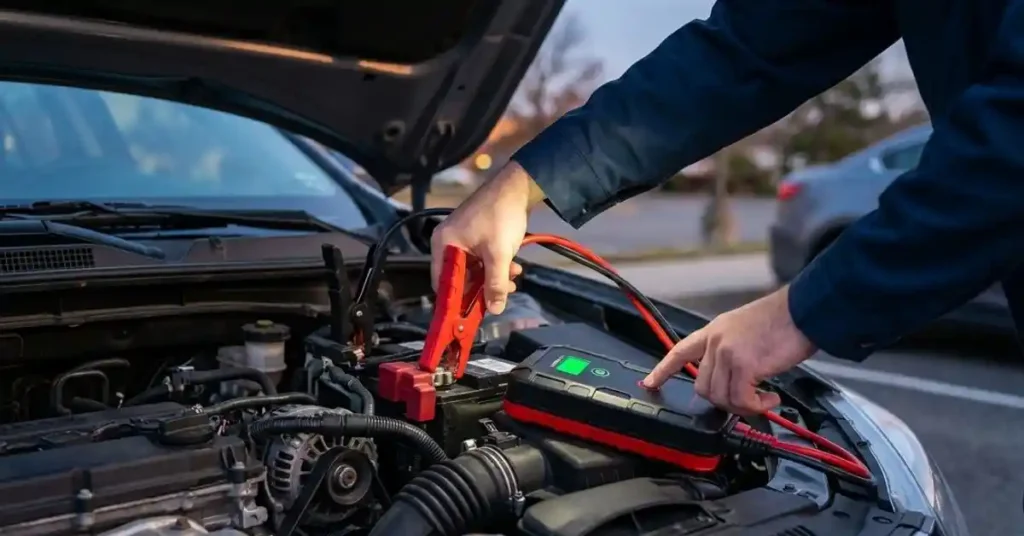
Once the clamps are secure, switch on the jump starter if its instructions require it. Some models detect the battery automatically. Others have a manual power or boost button.
Wait a moment, then try starting the car.
Do not hold the key or start button for a long time. Give the starter a short attempt.
If the engine does not start, wait a little before trying again.
What If the Car Does Not Start?
This is where I learned that “dead battery” does not always mean “needs more power.”
Check the clamps first. A loose clamp or dirty terminal can prevent enough current from reaching the starter.
| Symptom | What I would check |
| No response | Clamp connection and jump starter power |
| Clicking sound | Battery condition and clamp contact |
| Engine turns slowly | Jump starter charge and battery condition |
| Engine turns normally but will not start | Possible non-battery problem |
If the engine cranks normally but will not run, the battery may not be the real problem. The issue could involve fuel, ignition, sensors, or another part of the vehicle.
Do not keep trying to jump it over and over.
When a Battery Jump Starter Should Not Be Used
A jump starter is useful, but it is not a cure for every battery problem.
I would stop and get help if the battery looks damaged or if I notice signs of a serious electrical fault.
Never ignore a battery that is swollen, cracked, leaking, smoking, or unusually hot.
Watch for These Warning Signs
| Warning sign | What to do |
| Cracked battery case | Do not jump it |
| Battery is leaking | Do not jump it |
| Strong burning smell | Stop and inspect safely |
| Swollen battery | Do not jump it |
| Damaged cables | Do not use them |
A frozen lead-acid battery can also be dangerous to jump. If you suspect the battery has frozen, do not try to force a jump.
Common Battery Jump Starter Mistakes I Would Avoid
Most mistakes are not complicated. They happen because people are cold, rushed, tired, or standing beside a car that suddenly will not start.
I’ve found that having a simple routine helps more than trying to remember everything under stress.
Connecting the Clamps in the Wrong Order
The red clamp goes to positive. The black clamp goes to the approved negative or ground point.
Never reverse the polarity.
Connecting positive and negative incorrectly can damage electrical parts and create sparks.
Letting the Clamps Touch
This sounds obvious until you are working in a dark driveway.
Keep the clamps apart while connecting them. Once they are attached, make sure they are stable and cannot slip into each other.
Using a Weak Jump Starter
A tiny jump starter may work well for a small car but struggle with a large engine.
| Vehicle type | What matters most |
| Small car | Adequate starting current |
| Large SUV | Higher starting demand |
| Truck | Strong jump-start capacity |
Do not choose a jump starter based only on its advertised battery size. The unit must be suitable for the vehicle and engine.
How Long Should You Leave a Battery Jump Starter Connected?
Usually, you do not need to leave a portable jump starter connected for several minutes like you might with another running vehicle.
The jump starter is designed to provide a strong burst of power for starting.
After the car starts, follow the jump starter’s instructions for removing the clamps. In many setups, you switch the jump starter off first.
Remove the Clamps in Reverse Order
Once the engine is running and the jump starter is switched off, remove the clamps carefully.
A common sequence is:
- Remove the black clamp.
- Remove the red clamp.
- Store the cables safely.
- Follow the jump starter’s instructions for charging it again.
The important thing is to prevent the clamps from touching each other or another electrical connection.
Should You Drive After Using a Battery Jump Starter?
Starting the car does not mean the battery is fully charged.
The alternator may recharge the battery while you drive, but the result depends on the vehicle, battery, charging system, and how deeply the battery was discharged.
I would not treat a successful jump as proof that the battery is healthy.
A Jump Start Is a Temporary Fix
If your battery keeps going flat, find the cause.
| Repeat problem | Possible reason |
| Dead after sitting overnight | Electrical drain or weak battery |
| Dies after short trips | Battery may not recharge well |
| Needs frequent jumps | Aging battery or charging fault |
A battery that needs repeated jump starts deserves attention. Otherwise, you may end up carrying a jump starter everywhere and still wondering when the car will fail next.
What If the Jump Starter Says “Reverse Polarity”?
Do not panic, but do not ignore it either.
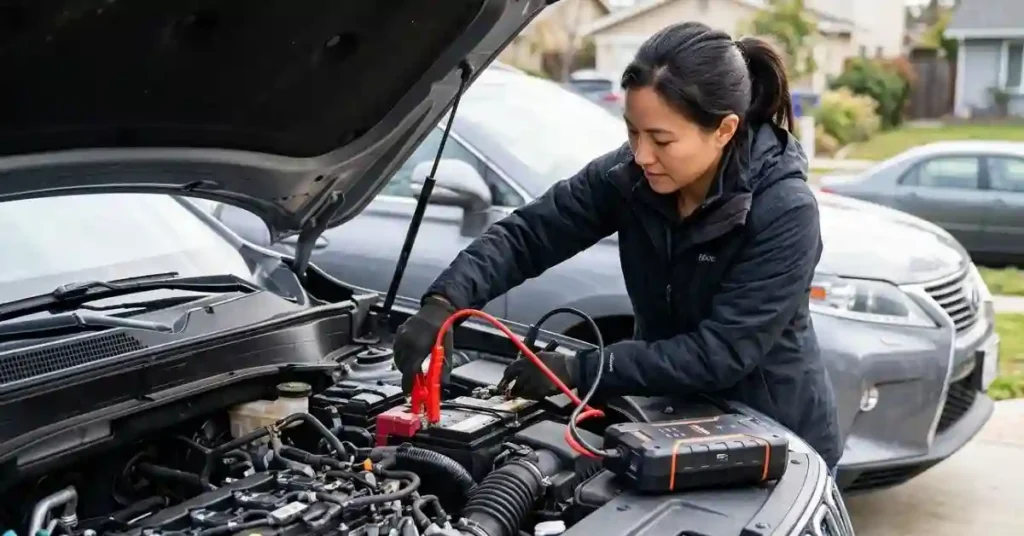
Many modern jump starters have safety systems that detect an incorrect connection. If the unit warns about reverse polarity, switch everything off and check the clamps.
The red clamp should be on positive. The black clamp should be on the approved negative or ground point.
Check the Battery Labels, Not Just the Cable Colors
Colors help, but labels are better.
Look for the + and − symbols on the battery or jump points. Some batteries may have covers that hide the terminals.
If you cannot clearly identify the terminals, stop and check the owner’s manual.
Can You Use a Battery Jump Starter on a Completely Dead Battery?
Sometimes, yes.
A very low battery can still accept a jump from a suitable portable starter. But a battery with severe internal damage may not respond.
Some jump starters have a special manual override or force-start mode for batteries whose voltage is too low for automatic detection.
This is one feature I would treat with extra care. Only use it when the jump starter manual specifically tells you how to do it.
| Battery condition | Likely approach |
| Low but healthy | Normal jump-start process |
| Very low voltage | Check for special low-voltage procedure |
| Damaged battery | Do not jump |
| Unknown condition | Inspect before proceeding |
Battery Jump Starter vs Traditional Jumper Cables
A portable jump starter and traditional jumper cables solve the same basic problem in different ways.
With jumper cables, you normally need another vehicle with a healthy battery. A portable jump starter carries its own power.
Which One Is Easier?
For me, the portable unit wins on convenience because I do not need another car nearby.
| Feature | Portable jump starter | Jumper cables |
| Needs another vehicle | No | Usually yes |
| Easy to store | Yes | Yes |
| Works alone | Yes | No |
| Needs charging | Yes | No |
That does not make jumper cables useless. I still think it is smart to keep a good set in the vehicle.
How to Keep a Jump Starter Ready for an Emergency
The biggest lesson I learned is simple: owning a jump starter is not enough.
You need a jump starter that is charged and ready when the battery dies.
Check its charge from time to time. Follow the maker’s storage instructions. Avoid leaving it in extreme heat or cold unless it is designed for those conditions.
Make a Small Emergency Kit
I like keeping a few basic items together rather than searching for them during a problem.
- Portable jump starter
- Jumper cables
- Flashlight
- Work gloves
- Tire pressure gauge
- Basic roadside safety items
A flashlight is especially useful. Battery problems have a strange habit of showing up after sunset.
What I Learned About Using a Battery Jump Starter
The biggest lesson is that how to use a battery jump starter is less about memorizing a complicated process and more about following the same safe routine every time.
Check the battery. Check the jump starter. Connect positive correctly. Connect the approved negative or ground point. Start the car. Then remove the clamps carefully.
I also stopped assuming that every no-start problem is a dead battery. A jump starter can get you moving again, but repeated battery failure may point to a weak battery, charging problem, or electrical drain. Use the jump starter as a helpful emergency tool, not as a permanent fix.
FAQs About How to Use a Battery Jump Starter
1. How do you use a battery jump starter?
Connect red to positive and black to the approved ground or negative point. Turn on the jump starter, then start the car. Remove the clamps with care.
2. How long should you leave a battery jump starter on?
A portable jump starter gives a quick burst of power. Try to start the car soon after you connect it. Follow your unit’s guide for the exact steps.
3. Can a battery jump starter start a completely dead car battery?
Yes, it may start a very low battery if the battery is still sound. A cracked, swollen, or leaking battery should not be jump-started.
4. Where does the black clamp go on a jump starter?
The black clamp goes to the negative terminal or a safe ground point. Check your car manual first, as some cars use a set ground point.
5. What should you do after using a battery jump starter?
Start the car, then remove the clamps as your jump starter guide says. Charge the jump starter again so it is ready for the next need.
To Get More About Home, Car Tools Product You Can Visit Our Site. If You Found our Posts Helpful Leave a Comment Below