

Choosing a car battery looks simple until you stand in front of a shelf full of batteries that all look almost the same. I learned that the biggest mistake is picking one by price or brand alone. The right battery must fit the car, meet its power needs, and match how you drive.
In this guide, I’ll walk through how to choose the right car battery without getting lost in battery jargon. I’ll cover group size, CCA, reserve capacity, battery type, climate, driving habits, warranty, and a few easy mistakes that can cost you money.
How to Choose the Right Car Battery Starts With Fit
Before looking at CCA or battery brands, I always start with fit. A battery can have great specs and still be wrong for your car if the size or terminal layout does not match.
The safest starting point is the owner’s manual or a reliable vehicle-specific battery finder. AAA also recommends checking the battery size and ratings required for your vehicle before buying.
Check the Battery Group Size First
The group size tells you the battery’s physical size and terminal layout. Common sizes include Group 24, 35, 48/H6, 49/H8, and others.
This is one area where I would not guess. Two batteries can look close in size but have different terminal positions or mounting points.
| Check | Why It Matters |
| Group size | Controls physical fit |
| Terminal position | Keeps cables in the right place |
| Hold-down design | Keeps the battery secure |
A loose battery can move around while you drive. That can damage the battery or its cables. The wrong terminal position can also make installation unsafe or impossible.
Match the Voltage and Battery Type
Most conventional passenger cars use a 12-volt battery system, but the battery technology still matters.
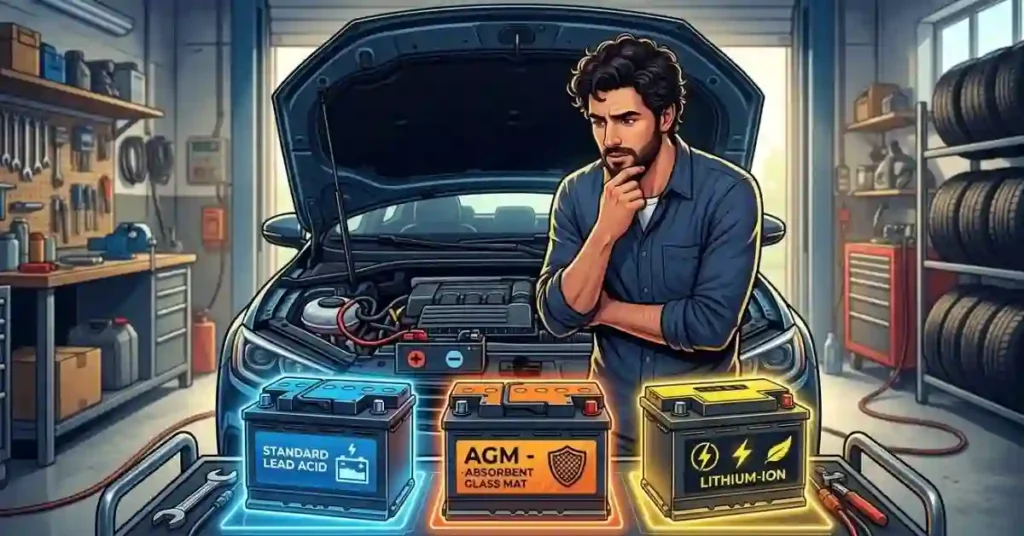
A standard flooded lead-acid battery may be correct for one car. Another car may need AGM or EFB technology. AAA notes that AGM batteries are sealed lead-acid batteries, while EFB batteries are often used in vehicles with stop-start systems.
So, don’t treat AGM as a simple upgrade for every vehicle. The car’s design matters.
How Much CCA Do You Really Need?
CCA means Cold Cranking Amps. It measures how much starting power a battery can provide in cold conditions.
CCA is tested at 0°F (-17.8°C) for 30 seconds under a defined voltage limit.
For most drivers, the simple rule is this: meet or exceed the vehicle maker’s recommended CCA.
More CCA Is Not Automatically Better
This was one of the things I had to rethink when comparing batteries. A larger CCA number looks impressive on a label, but that number alone does not make a battery the right choice.
If your car calls for a certain battery size and CCA range, start there.
A higher-rated battery can work in some applications, but it still needs to fit correctly and match the vehicle’s charging system and battery requirements. AAA says you should not buy a battery with lower specifications than the original, while a battery with higher specifications can be suitable.
| CCA Situation | What I Would Do |
| Below vehicle requirement | Avoid it |
| Meets required CCA | Good starting point |
| Higher CCA and correct fit | Consider it |
If you live somewhere with very cold winters, CCA becomes even more important because cold reduces available battery power while making the engine harder to crank.
Don’t Ignore Reserve Capacity
CCA gets most of the attention, but reserve capacity, or RC, is another useful number.
Reserve capacity tells you how long a fully charged battery can provide a set amount of power before its voltage drops below a specified level. It matters when the charging system is not supplying power.
Think of CCA as starting strength and RC as backup endurance.
When Reserve Capacity Matters Most
RC can be useful if your car has many electrical loads or if you spend time using accessories while the engine is off.
It can also give you a little more breathing room if something goes wrong with the charging system.
| Rating | Main Job |
| CCA | Helps start the engine |
| RC | Provides backup electrical power |
| Ah | Measures stored electrical capacity |
I would not ignore RC just because the car starts easily. Starting the engine is only one job a battery performs.
Choose the Battery Type Your Car Was Designed For
Battery technology can be confusing because flooded, AGM, and EFB batteries can all look similar from the outside.
The important point is not which type sounds more advanced. It is which type your vehicle requires.
Flooded Lead-Acid Batteries
Traditional flooded batteries are common and often cost less than AGM options.
They can be a sensible choice when the vehicle was designed for that battery type and does not have unusually high electrical demands.
AGM Batteries
AGM stands for Absorbed Glass Mat. These batteries use an internal mat to hold the electrolyte.
AGM batteries are often used in vehicles with higher electrical demands and some start-stop systems.
They can also offer strong vibration resistance and maintenance-free operation. But the higher price may not make sense if your vehicle does not call for AGM.
EFB Batteries
EFB stands for Enhanced Flooded Battery.
They are designed to handle more charge and discharge cycles than a basic flooded battery. They are commonly found in vehicles with stop-start systems.
If your car came with EFB, I would not casually replace it with a basic flooded battery just to save money.
| Battery Type | Common Use |
| Flooded | Conventional vehicles |
| EFB | Some start-stop vehicles |
| AGM | Higher electrical demand and some start-stop systems |

Your Driving Habits Can Change the Best Choice
This is an easy part to overlook. Two people can own the same car but have very different battery needs.
Someone who drives 30 minutes every day is not using a battery in the same way as someone who starts the car once a week and takes short trips.
Short Trips Can Be Hard on a Battery
A short drive may not give the charging system enough time to replace the energy used during starting and while running electrical systems.
This is one reason I pay attention to driving patterns when thinking about battery life. A battery is not working in isolation. The alternator and driving routine matter too.
AAA says car batteries typically last around three to five years, but use and environmental conditions can change that.
Cars That Sit for Long Periods Need Extra Attention
A car that sits for weeks can slowly lose battery charge because modern vehicles still use some power while parked.
If your car spends more time parked than driven, battery maintenance becomes more important than simply buying the most expensive battery.
Hot Weather Matters Too
People often connect battery problems with freezing weather. Heat deserves just as much attention.
High temperatures can speed up battery wear. Driving conditions, engine-bay heat, charging behavior, and battery quality can all affect service life.
For example, Interstate lists different battery lines for different climate conditions, with some models specifically positioned for hot to moderate climates.
This matters in warm regions where a battery may face high under-hood temperatures for much of the year.
| Driving Condition | What to Consider |
| Very cold climate | Strong CCA |
| Hot climate | Heat-resistant design and warranty |
| Frequent short trips | Charging and battery condition |
| Long periods parked | Charge maintenance |
Don’t Buy a Battery Based Only on Price
I understand the temptation. You see two batteries that fit the car, and one costs much less.
But price is only one part of the cost.
A cheaper battery may still be perfectly suitable. A more expensive one may offer a longer warranty, different construction, or higher ratings. The trick is to compare the things that actually matter for your vehicle.
Compare the Warranty, Not Just the Sticker Price
Warranty terms can vary a lot between battery lines.
For example, Interstate currently lists automotive batteries with different free-replacement periods depending on the product line.
I like to look at warranty coverage after confirming fit and specifications.
| Compare | Why It Helps |
| Free replacement period | Protects against early failure |
| Battery specifications | Confirms proper performance |
| Price | Shows the upfront cost |
A long warranty does not guarantee a battery will last that long. Read the actual warranty terms before treating it as a promise.
The Biggest Car Battery Buying Mistakes I Would Avoid
After digging into battery specs, one lesson stands out: most bad choices come from focusing on one number.
A battery is a system. Fit, chemistry, starting power, capacity, climate, driving pattern, and warranty all matter.
Mistake 1: Buying by CCA Alone
A huge CCA number looks great.
But if the battery does not fit, has the wrong terminal layout, or uses the wrong battery technology, that CCA number does not help much.
Mistake 2: Assuming Every Battery With the Same Size Is Equal
Two batteries with the same group size can have different CCA, reserve capacity, warranty terms, and technology.
Interstate’s battery listings show how the same general group-size category can come with different ratings.
Mistake 3: Replacing AGM With a Basic Battery
This can be a bad shortcut when the vehicle was designed for AGM.
If the original battery is AGM, check the vehicle requirements before switching technology.
Mistake 4: Ignoring the Battery’s Age
A battery sitting on a store shelf is not necessarily the same as a freshly made battery.
When buying, I like to check the date code or production information when available. If the battery has been sitting for a long time, I would ask the seller about its storage and charging condition.
Mistake 5: Blaming the Battery for Every Starting Problem
A weak start does not always mean the battery is bad.
The alternator, starter, cables, terminals, and electrical system can also cause starting trouble.
| Symptom | Possible Cause |
| Slow cranking | Battery, cables, or starter |
| Battery keeps dying | Charging issue or parasitic drain |
| Lights dim while driving | Charging system problem |
That last point is important. Replacing a battery will not fix an alternator problem.

A Simple Way to Choose the Right Car Battery
When I want to narrow down battery choices without overthinking it, I use a simple order.
First, confirm the vehicle. Then confirm the battery group size and required battery type. After that, compare CCA, reserve capacity, warranty, and price.
My Battery-Selection Checklist
Use this order before buying:
- Check the owner’s manual.
- Confirm the battery group size.
- Confirm the terminal layout.
- Confirm the required battery type.
- Match or exceed the required CCA.
- Compare reserve capacity if listed.
- Consider your climate.
- Think about your normal driving pattern.
- Compare warranty terms.
- Check the battery’s age or date code.
This approach saves me from getting distracted by flashy labels.
The best battery is not always the one with the biggest numbers. It is the one that meets the vehicle’s needs and fits the way the car is actually used.
What If You Are Unsure Which Battery Fits?
If the old battery label is hard to read, don’t guess.
Use the vehicle’s year, make, model, engine, and trim to look up the correct battery. A reputable battery seller or automotive parts store can also check compatibility.
AAA recommends starting with the battery that came with the car and checking its size and ratings.
Check More Than One Source
If two battery finders give different results, stop before buying.
Check the owner’s manual and verify the required specifications. It is much easier to spend five minutes checking than to deal with a battery that does not fit.
| If You Know… | Check Next |
| Old battery group size | CCA and battery type |
| Vehicle model | Manufacturer requirements |
| Battery type | Correct replacement technology |
My Practical Take on Choosing a Car Battery
The biggest lesson for me is that how to choose the right car battery is less about finding a magic brand and more about matching the battery to the vehicle.
Start with fit. Then check battery type, CCA, reserve capacity, climate, driving habits, and warranty. Do not let one impressive number make the whole decision for you.
I would also avoid changing battery technology just because the newer option sounds better. A battery that matches the car’s original design and electrical needs is usually a much more sensible place to start.
If you take five minutes to check the manual and compare the right specifications, buying a car battery becomes much less confusing. You do not need to memorize every battery term. You just need to know which ones matter for your car.
FAQs
1. How do I choose the right car battery?
Check your car manual for the right battery size, type, and CCA. Then compare fit, power, warranty, and price before you buy.
2. What CCA should a car battery have?
Choose a car battery with the CCA your car maker lists. A higher CCA can work if the size and battery type also match your car.
3. How do I know what battery size my car needs?
Check the old battery or your car manual for the group size. The new battery must also have the right terminal layout and hold-down fit.
4. Is AGM better than a regular car battery?
AGM is made for high power needs and some stop-start cars. But use AGM only when your car calls for it or supports it.
5. How long does a car battery usually last?
A car battery often lasts about three to five years. Heat, cold, short trips, and long idle times can change its life.
To Get More About Home, Car Tools Product You Can Visit Our Site. If You Found our Posts Helpful Leave a Comment Below