
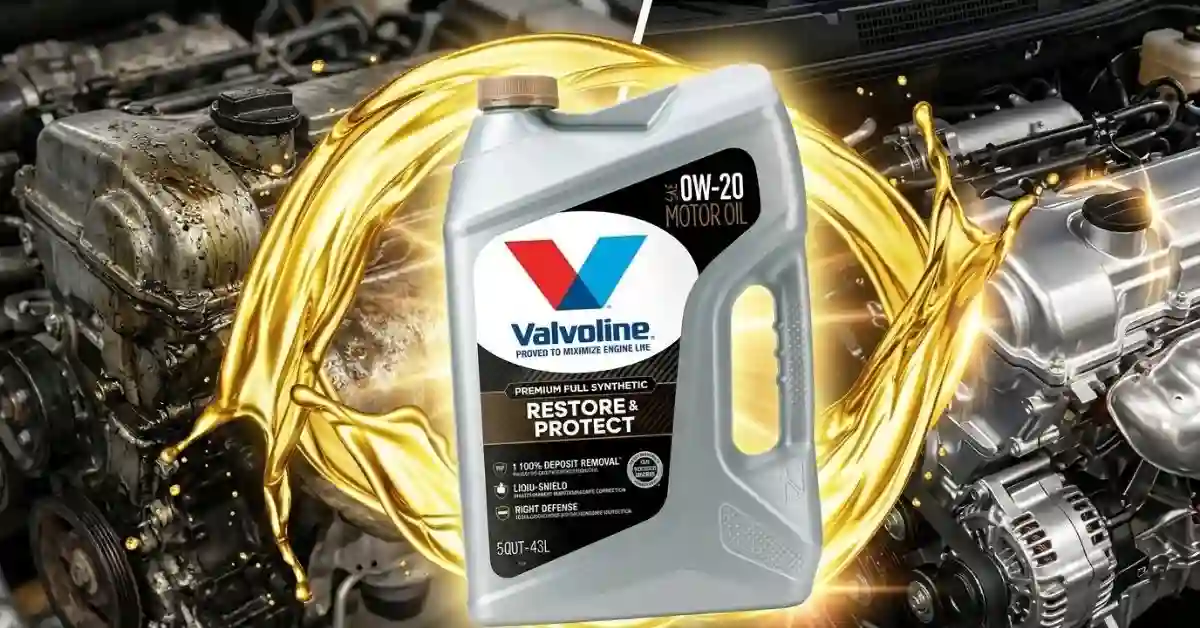
When I first looked into the Valvoline Restore and Protect Oil Review topic, the thing that caught my attention was not the “full synthetic” label. There are plenty of full synthetic oils. What makes this one interesting is Valvoline’s claim that it can actively remove piston deposits while also helping stop new deposits from forming.
That sounds impressive, but it also raises some fair questions. Does the oil really clean an engine? How long does it take? Is it good for an older car? And, most important, should you use it instead of a normal full synthetic? I dug into those questions because the marketing claims are easy to notice, while the small details are much easier to miss.
What Is Valvoline Restore and Protect Oil?
Valvoline Restore & Protect is a premium full synthetic motor oil made for gasoline engines. The 5W-30 version is designed around two main technologies: Active Clean Technology and Liqui-Shield Technology. Valvoline says Active Clean helps remove piston deposits, while Liqui-Shield helps prevent new deposits from forming with continued use.
That makes this oil a little different from the way I normally think about motor oil. Most people buy oil mainly for lubrication and wear protection. Restore & Protect adds engine cleanliness to that job.
| Product detail | What I found |
| Oil type | Full synthetic |
| Viscosity | SAE 5W-30 |
| Main focus | Deposit removal and prevention |
| Intended engines | Most gasoline engines |
| Key technologies | Active Clean and Liqui-Shield |
The important part is that this is still motor oil, not a separate engine flush or cleaning chemical. Valvoline specifically says Restore & Protect is a fully formulated motor oil and is meant to work during normal oil-change intervals.
What Makes Restore and Protect Different?
The main difference is the way Valvoline positions the oil. Instead of only trying to prevent deposits, it is designed to deal with deposits that are already present.
How Active Clean Technology Works
According to Valvoline, Active Clean Technology chemically breaks down deposits into very small pieces. Those particles stay suspended in the oil and can leave the engine when the oil is changed. Valvoline says its testing showed no negative effect on oil-filter performance from this process.
That explanation cleared up one thing I initially wondered about: where does all that removed material actually go?
It does not simply vanish. The idea is that the oil gradually carries the broken-down material out during regular oil changes.
What Liqui-Shield Is Supposed to Do
Liqui-Shield takes the other side of the job. After deposits are removed, Valvoline says the technology helps prevent future deposits from forming with continued use.
So the basic idea is simple:
| Technology | Main job |
| Active Clean | Helps remove existing piston deposits |
| Liqui-Shield | Helps defend against future deposits |
| Full synthetic formula | Lubricates and protects engine parts |
I like this approach because it explains why Valvoline recommends consistency. This is not an oil that you pour in once and expect to transform an old engine overnight.
Does Valvoline Restore and Protect Really Remove Deposits?
This is probably the biggest question behind any Valvoline Restore and Protect Oil Review.
Valvoline states that Restore & Protect can remove up to 100% of piston deposits when used as directed for four or more consecutive oil changes at standard maintenance intervals. The claim is based on adapted Sequence IIIH testing.
There is an important detail here: “up to 100%” does not mean every engine will lose 100% of its deposits after four oil changes.
I think that distinction matters.
The result comes from controlled testing. Real engines have different mileage, driving habits, temperatures, maintenance histories, fuel quality, oil-change intervals, and mechanical conditions.
| Claim | What it really means |
| Up to 100% deposit removal | A maximum result from specified testing |
| Four or more oil changes | Continuous use is part of the claim |
| Factory-clean pistons | A stated testing outcome, not a promise for every engine |
So I would treat the claim as evidence that the formulation has a deposit-cleaning purpose, not as a guarantee that your engine will look brand new.
How Long Does Restore and Protect Take to Work?
This is where expectations can easily go wrong.
Valvoline’s current guidance ties the “up to 100%” deposit-removal claim to four or more consecutive oil changes at normal service intervals.
That means I would not buy this oil expecting dramatic results after one oil change.
A single oil change may begin the process, but the product’s bigger cleaning claim is based on repeated use.
Why Four Oil Changes Matter
Think of it more like gradual cleaning than an engine flush.
If deposits have built up for years, it makes sense that removing them through regular oil circulation would take time. Trying to rush the process by extending the oil-change interval would also defeat the point.
| Usage pattern | Reasonable expectation |
| One oil change | Starts using the formulation |
| Several consecutive changes | More time for deposit control |
| Four or more changes | Matches Valvoline’s stated deposit-removal testing claim |
| Continued regular use | Helps defend against new buildup |
The lesson I took from the research is simple: consistency matters more than a one-time switch.
Is Valvoline Restore and Protect Good for High-Mileage Engines?
Yes, provided the oil’s viscosity and specifications match the vehicle.
Valvoline says Restore & Protect is formulated for vehicles across a wide mileage range, including high-mileage engines. Its product information specifically says the oil can be used from a vehicle’s first oil change through high-mileage applications.
But there is an important distinction between a dirty engine and a worn-out engine.
Oil can help control deposits. It cannot rebuild worn piston rings, repair damaged bearings, replace a failed seal, or fix mechanical damage.
Restore and Protect vs. High-Mileage Oil
This was one of the areas I wanted to understand better because “high mileage” and “deposit cleaning” are not the same thing.
Valvoline’s own comparison explains that MaxLife High Mileage is aimed at older vehicles with concerns such as oil leaks and consumption, using seal conditioners and additional detergents. Restore & Protect has a different focus: removing piston deposits and preventing future buildup.
| If your main concern is… | The product focus makes more sense |
| Piston deposits | Restore & Protect |
| Oil leaks or seal concerns | High-mileage formulation |
| General everyday protection | Advanced Full Synthetic |
| Deposit removal and prevention | Restore & Protect |
That does not mean one oil is universally better. It means the reason you are buying the oil matters.
What Specifications Does the 5W-30 Meet?
Specifications are one of the first things I would check before buying any motor oil.
The current Valvoline product page lists the 5W-30 Restore & Protect as meeting requirements for ILSAC GF-7A, API SQ, API SP, API SN with SN PLUS, Resource Conserving, and earlier applicable API and ILSAC gasoline categories. It also lists Ford WSS-M2C961-A1 and Chrysler MS-6395.
| Specification | Listed by Valvoline? |
| API SQ | Yes |
| ILSAC GF-7A | Yes |
| Ford WSS-M2C961-A1 | Yes |
| Chrysler MS-6395 | Yes |
This is also where I would avoid a common mistake: do not choose oil based only on the 5W-30 number.
Your owner’s manual may call for a particular viscosity plus a specific manufacturer approval or specification.
Is 5W-30 Right for Your Car?
This is one part of the review where there is no universal answer.
If your vehicle requires SAE 5W-30 and the required specification matches the oil, then Restore & Protect can be considered. If your vehicle requires 0W-20, 0W-16, 5W-20, or another grade, do not change viscosity just because you like the Restore & Protect formula.
Valvoline also makes Restore & Protect in other viscosity grades, so the right approach is to match the oil to the vehicle rather than forcing the vehicle to match the bottle.
A Mistake I Would Avoid
I would never use the phrase “5W-30 works in most cars” as a reason to pour it into a particular engine.
The better question is:
“Does my owner’s manual allow this exact viscosity and specification?”
That one check can prevent a lot of confusion.
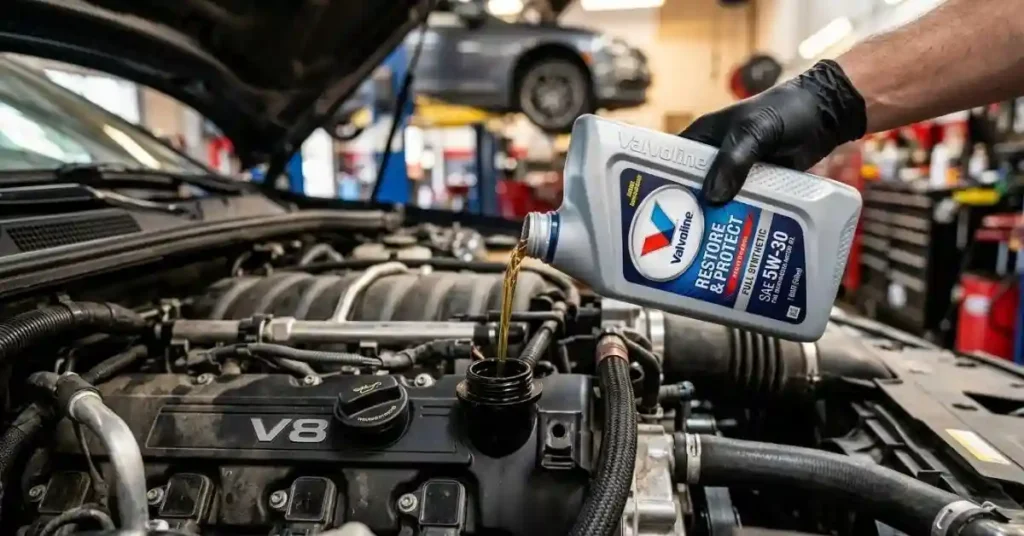
Does Restore and Protect Help Fuel Economy?
Valvoline says cleaner engine components can reduce friction and support fuel economy. The company markets Restore & Protect as an oil that can help maximize efficiency as deposits are controlled.
Still, I would keep expectations realistic.
You should not buy this oil expecting a dramatic jump in miles per gallon. Fuel economy depends on many things, including tire pressure, driving style, vehicle condition, traffic, temperature, load, and engine health.
A clean engine is helpful. It is not a magic fuel-saving switch.
| Factor | Possible effect on fuel economy |
| Correct oil grade | Helps the engine operate as designed |
| Deposit control | May support efficient operation |
| Tire pressure | Can have a noticeable everyday effect |
| Driving habits | Often have a large effect |
This is one place where I prefer practical expectations over impressive-sounding claims.
How Does It Compare With Regular Full Synthetic Oil?
The biggest difference is not that regular full synthetic oil is “bad.” Modern quality synthetic oils already provide strong lubrication and protection.
Restore & Protect is simply built around a more specific deposit-control goal.
Valvoline’s current comparison describes Restore & Protect as a premium synthetic with Active Clean technology, while standard full synthetic oils focus more broadly on general synthetic performance.
| Feature | Restore & Protect | Typical full synthetic |
| Full synthetic | Yes | Usually |
| Deposit control | Active cleaning focus | Varies by formula |
| Future deposit defense | Liqui-Shield | Varies |
| Main appeal | Cleaning plus protection | General protection |
I would not say every driver needs the extra deposit-cleaning focus. But for someone specifically concerned about piston deposits, the difference is meaningful.
What About Turbo and Direct-Injection Engines?
This is another interesting part of the formula.
Valvoline says Restore & Protect is compatible with most gasoline engines, including turbocharged and gasoline direct-injection powertrains. The company also says it provides LSPI protection.
Turbo engines can put oil under demanding heat and operating conditions. Direct-injection engines can also have deposit-related concerns.
Still, “compatible with most” is not the same as “approved for every engine.”
Always Check the Manufacturer Requirement
Before using it in a turbocharged or GDI engine, I would check the owner’s manual for the exact oil grade and specification.
This is especially important for newer vehicles where a manufacturer approval may matter beyond the basic API category.
Common Restore and Protect Mistakes I Would Avoid
After looking closely at how the product is designed to work, a few mistakes stand out.
| Mistake | Better approach |
| Expecting instant engine cleaning | Think in terms of repeated oil changes |
| Choosing it only because it says 5W-30 | Check the owner’s manual first |
| Treating it like an engine flush | Remember it is motor oil |
| Extending oil changes to “let it work” | Follow the vehicle maker’s schedule |
| Expecting it to repair worn parts | Use oil for lubrication and deposit control |
The biggest mistake is probably assuming that an oil can fix every problem caused by engine age.
It cannot.
If an engine has low compression, a serious oil leak, worn bearings, damaged rings, or another mechanical fault, the right answer may be inspection or repair.
Is Restore and Protect Safe for Older Engines?
Valvoline says the oil is suitable for high-mileage vehicles and that its cleaning action works during normal oil service.
I would still approach a neglected engine with some common sense.
If a vehicle has an unknown maintenance history, check the oil level, look for leaks, inspect the old oil, and follow the proper service interval. A new oil does not remove the need for basic engine care.
| Older-engine situation | What I would do |
| High mileage but maintained | Consider it if specifications match |
| Some deposits suspected | Consistent oil changes make sense |
| Serious oil consumption | Investigate the cause |
| Major mechanical symptoms | Get the engine inspected |
This is a good example of why I would not call Restore & Protect an “engine repair” product.
It is still oil.
What I Like About Valvoline Restore and Protect
The strongest part of this product, in my view, is that its purpose is easy to understand once you get past the marketing language.
It is designed to do two related jobs: help remove existing piston deposits and help prevent more from forming.
The product also meets current API SQ and ILSAC GF-7A requirements according to Valvoline’s current product information.
Another positive is that it does not require a separate engine-cleaning treatment. You use it as motor oil during regular service.
The 5W-30 version is also useful for vehicles that specifically call for that viscosity.
What I Would Keep in Mind Before Buying
The biggest limitation is that the headline deposit-removal claim is easy to misunderstand.
“Up to 100%” is a testing claim under specified conditions. It is not a promise that every engine will become factory-clean after four oil changes.
The second limitation is compatibility. Even a high-quality oil is the wrong choice if your vehicle requires a different viscosity or specification.
Finally, the oil’s cleaning focus does not mean you can neglect normal maintenance.
| Question | My practical answer |
| Is it a real full synthetic oil? | Yes |
| Is deposit cleaning its main difference? | Yes |
| Does it work instantly? | No |
| Can it repair engine damage? | No |
| Should you check your manual first? | Absolutely |
Final Thoughts on My Valvoline Restore and Protect Oil Review
After researching the formula and its claims, I think the most useful way to understand Valvoline Restore and Protect Oil is as a full synthetic motor oil with an unusually strong focus on piston deposit control. The Active Clean and Liqui-Shield technologies give it a clear purpose beyond basic lubrication.
The key lesson for me is to keep expectations realistic. The four-oil-change cleaning claim is based on testing, not a guarantee for every vehicle. If your engine requires 5W-30 and the listed specifications fit your vehicle, Restore & Protect is an interesting option for someone who wants both normal synthetic protection and ongoing deposit control.
My practical advice is simple: check the owner’s manual, use the correct viscosity, follow the normal oil-change schedule, and give the formula time to do its job. That is a much better approach than expecting one oil change to undo years of engine deposits.
To Get More About Home, Engine Oil Product You Can Visit Our Site. If You Found our Posts Helpful Leave a Comment Below