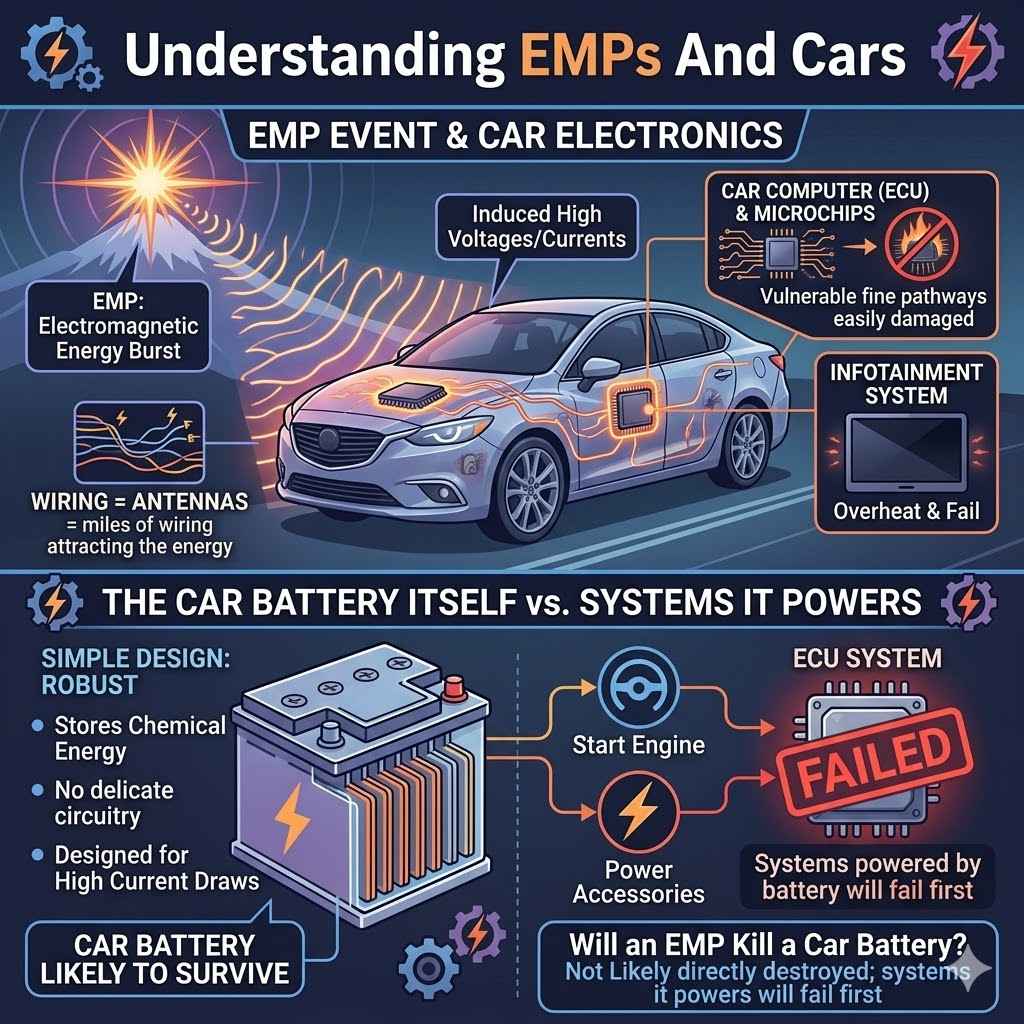
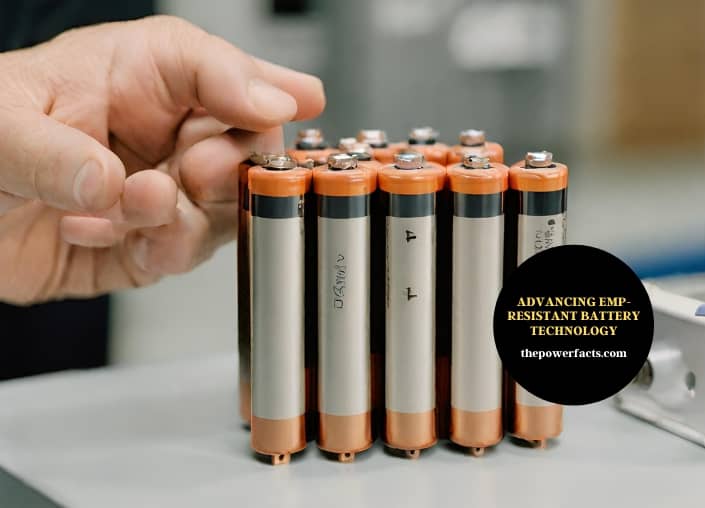
An EMP is unlikely to directly destroy a car battery, but it can potentially disrupt or damage the vehicle electronics connected to it.
For drivers in the United States, an electromagnetic pulse is more relevant to vehicle electronics than to the chemical energy stored inside a conventional 12-volt battery. A battery stores energy chemically, while an EMP is a short burst of electromagnetic energy that can induce unwanted voltages and currents in electrical conductors. That difference matters when asking whether an EMP would actually kill the battery.
The strongest U.S. government and EMP Commission evidence does not establish that an EMP simply destroys every automotive battery. Instead, documented vehicle testing has focused on electronic systems, wiring, controls, and vehicle operation. The EMP Commission tested 37 vehicles from model years 1986 through 2002 and found a range of effects, including nuisance electronic behavior and, in some running vehicles, engine stoppage at higher simulated field strengths. Those tests do not prove that the batteries themselves were destroyed, and they should not be treated as a direct prediction for every modern vehicle.
The practical takeaway is straightforward: if a serious EMP event occurred, the battery would not necessarily be the first or most vulnerable part of the vehicle. The more significant concern would be the electronic systems and wiring that allow a modern car to start, run, control fuel and ignition, communicate between modules, and operate safety and convenience features.
Usually, the answer is no based on the available evidence. A conventional automotive battery is an electrochemical energy-storage device. Its stored energy comes from chemical reactions between its internal materials rather than from an electronic circuit that needs a continuous external signal to remain charged.
An EMP can interact strongly with conductors and electronic components. That does not mean the pulse automatically transfers enough destructive energy into the battery chemistry to make the battery suddenly unusable. The important distinction is between the battery itself and the electrical system attached to the battery.
The battery terminals are connected to cables, electrical loads, control modules, sensors, actuators, and other components. A sufficiently strong electromagnetic field can induce voltages and currents in conductive paths. Those induced electrical stresses can reach sensitive components even though the battery is not the original target.
The U.S. Department of Energy describes high-altitude EMP as having E1, E2, and E3 components with different characteristics. E1 is the fast component associated with disruption and electrical stress in electronics and control systems. E2 is longer and has characteristics comparable in some respects to lightning-related transients. E3 is much slower and primarily concerns long conductors and large interconnected electrical systems. These mechanisms are not equivalent to directly charging or chemically destroying a car battery.
For that reason, saying an EMP will kill every car battery is too broad. The better statement is that a sufficiently intense EMP can create conditions that may damage parts of a vehicle’s electrical system, while direct destruction of the battery itself is not established as a universal outcome.
Source: carxplorer.com
Battery chemistry
A conventional lead-acid automotive battery stores energy through electrochemical reactions, so it is fundamentally different from a sensitive electronic control module.
Battery cables
The cables connected to the battery can provide conductive paths through which induced electrical stresses may reach other vehicle components.
Electronic modules
Engine control units, body controllers, sensors, communication networks, and other electronics may be more relevant to EMP vulnerability than the battery’s internal chemistry.
Actual damage depends on exposure
The outcome depends on the strength, waveform, coupling path, vehicle design, component susceptibility, and other conditions rather than on the word EMP alone.
Why the Battery and Car Electronics Are Different
A battery can supply electricity to an electronic component, but that does not make the battery itself equivalent to the component. Electronics contain semiconductor devices and circuit structures designed to operate within defined voltage and current limits. An intense transient can exceed those limits. The battery’s electrochemical system works by a different physical mechanism.
This distinction also explains why a car could potentially experience an electronic failure while the battery remains capable of delivering normal voltage and starting current. A damaged control module, fuse, sensor circuit, or communication network can prevent the engine from operating even when the battery remains charged.
Possible outcome
The battery remains functional while one or more electronic systems fail.
Another possible outcome
The vehicle experiences a temporary malfunction and later operates normally after the disturbance ends.
Not established
It is not scientifically justified to claim that every vehicle battery will be permanently destroyed by an EMP.
How Can an EMP Affect a Car if the Battery Survives?
The main concern is the vehicle’s network of conductors and electronic controls. An electromagnetic field can induce electrical signals in conductive structures, and cables can behave as unintended antennas under electromagnetic exposure. The resulting electrical stress can reach connected circuitry.
Modern vehicles depend on electronics for far more than entertainment. Engine management, fuel control, ignition control, transmission operation, braking functions, airbag systems, instrument clusters, communications between control modules, and other functions can involve electronic components. The exact architecture varies substantially by vehicle.
The EMP Commission’s vehicle assessment provides a useful historical example. Its laboratory testing exposed 37 vehicles from 1986 through 2002 to progressively higher simulated EMP field strengths. The test vehicles included both running and nonrunning cars. The commission reported that no effects were subsequently observed in the vehicles that were not turned on during exposure, while some running vehicles experienced anomalies. Three vehicles stopped at field strengths around 30 kilovolts per meter or above, and one vehicle had dashboard electronics that required repair.
Those findings show why it is misleading to reduce the question to battery failure. The documented concern was vehicle behavior and electronic vulnerability. The test also found nuisance effects such as dashboard light abnormalities, while eight of the 37 tested vehicles did not show anomalous responses during the testing conditions.
The historical study has an important limitation: it does not represent every vehicle currently sold in the United States. Automotive electronics, wiring layouts, shielding practices, control networks, and vehicle architectures have changed considerably since the tested model years. The results are therefore evidence that vehicles can respond differently to strong EMP exposure, not a precise failure rate for a particular modern car.
Source: storage.googleapis.com
Engine control
Electronic engine management can be affected if a pulse creates sufficient electrical stress in associated wiring or components.
Sensors and actuators
A vehicle depends on numerous sensors and electronically controlled devices, and their response depends on their design and exposure.
Communication networks
Modern vehicles use communication networks to allow control modules to exchange information, creating additional electronic pathways.
Dashboard systems
Instrument clusters and other displays can malfunction without the battery itself being destroyed.
Running Versus Parked Vehicles
Whether a vehicle is running can matter because operating systems are actively powered and communicating. The EMP Commission specifically tested vehicles in both running and nonrunning states. Its historical results found more notable effects among vehicles that were running during exposure.
That does not mean a parked vehicle is guaranteed to be immune. A parked vehicle still contains electronic components and conductive wiring. It simply means that the available test evidence does not support treating running and nonrunning vehicles as identical conditions.
Running vehicle
Active electronic systems can be operating during exposure, and historical testing observed engine stalls and other anomalies in some running vehicles.
Nonrunning vehicle
Historical EMP Commission testing reported no subsequent effects in the nonrunning vehicles tested, under the conditions of that study.
What U.S. Testing Actually Tells Us About EMP and Cars
The strongest directly relevant evidence comes from controlled vehicle testing rather than from claims that an EMP automatically destroys all cars. The EMP Commission evaluated 37 automobiles in an EMP simulation laboratory, using vehicles from 1986 through 2002 and increasing the simulated field intensity until the vehicle showed an anomaly or the test equipment reached its limit.
The commission reported that the most serious observed effect was engine stoppage in three running cars at approximately 30 kilovolts per meter or above. One automobile suffered dashboard electronic damage that required repair. Twenty-five vehicles displayed nuisance effects such as blinking dashboard lights, while eight vehicles showed no anomalous response.
The report estimated that relatively few automobile effects would occur below 25 kilovolts per meter in the tested population and that stronger fields could produce more serious or nuisance responses. These figures describe the commission’s specific test program and modeling assumptions. They should not be presented as a universal failure rate for today’s vehicles.
The study is especially useful because it challenges two opposite oversimplifications. One is the claim that an EMP will instantly destroy every vehicle. The other is the claim that cars are completely unaffected because they are made partly from metal. The testing showed that vehicle response can vary and that strong fields can produce real electronic and operational effects.
The Department of Energy also treats EMP vulnerability as a system-level engineering problem. Its current EMP work focuses on assessing how electromagnetic waveforms interact with electrical systems and on developing resilience and mitigation approaches. That approach supports a more careful conclusion: vulnerability depends on the particular system and exposure rather than on a simple yes-or-no label applied to every vehicle.
Source: thepreppingcorner.com
37 cars were tested
The EMP Commission’s automobile testing involved 37 vehicles from model years 1986 through 2002.
Three running cars stopped
Three vehicles experienced engine stoppage at approximately 30 kilovolts per meter or higher in the reported test conditions.
One car required electronic repair
Dashboard electronics in one tested vehicle were damaged and required repair.
Eight cars showed no anomalous response
Eight of the 37 tested vehicles did not exhibit anomalous behavior under the reported test conditions.
Why Older Test Results Cannot Predict Every Modern Car
The vehicle test is valuable evidence, but its age matters. A 2002-era vehicle is not electrically identical to a current model. Modern cars may contain different processors, sensors, communications networks, battery-management systems, driver-assistance electronics, and power electronics.
That means there is no sound basis for assigning a specific EMP survival percentage to a particular modern vehicle without vehicle-specific testing. Claims such as every new car will fail, every old car will survive, or every electric vehicle is automatically immune go beyond what the available evidence establishes.
Documented
Historical testing demonstrates that strong simulated EMP exposure can cause different responses among vehicles.
Not established
The historical study does not establish a precise failure probability for a specific modern vehicle.
Practical implication
Vehicle-specific construction and electronic architecture matter when assessing vulnerability.
What Would an EMP-Damaged Car Look Like?
An EMP-related vehicle problem could look like several ordinary electrical failures, so symptoms alone cannot prove that an EMP caused the problem. A vehicle might fail to start, stall, display warning lights, lose certain electronic functions, or experience unusual behavior in one or more control systems.
If a car fails after a suspected electromagnetic event, begin with conventional automotive diagnosis. Check the battery condition, terminal connections, main fuses, relevant relays, and visible wiring before assuming that an electronic control module has been destroyed. A weak battery or loose terminal can produce symptoms that look dramatic but have nothing to do with an EMP.
If the battery has normal voltage but the vehicle still will not start, the next question is whether the starter operates, whether the engine cranks, whether diagnostic equipment can communicate with the vehicle, and which systems have power. These observations help separate a battery problem from a control-system problem.
A professional technician may need manufacturer-specific diagnostic equipment to determine whether control modules communicate correctly. If multiple modules suddenly fail at once or diagnostic communication is unavailable across systems, professional electrical diagnosis becomes especially important.
Do not repeatedly replace expensive electronic modules based only on the assumption that an EMP caused the failure. Modern vehicle networks can produce multiple symptoms from a single power, grounding, communication, or module problem.
Source: thedailyautomotive.com
Battery appears dead
Measure battery voltage and inspect the terminals before concluding that an electromagnetic event destroyed the battery.
Engine will not start
Determine whether the starter turns the engine, because a no-crank condition and a crank-but-no-start condition point toward different systems.
Warning lights appear
Warning lights may indicate electronic faults, low voltage, communication problems, or ordinary component failures.
Several systems fail together
Multiple simultaneous electronic faults justify professional diagnosis because a shared power, ground, network, or control-module problem may exist.
A Simple Diagnostic Order
If a vehicle is safe to inspect, use the least invasive checks first. Start with the battery and physical connections. Next inspect major fuses and obvious wiring. Then determine whether the starter operates. If the vehicle cranks but does not start, the problem may involve engine control, fuel, ignition, sensors, or communications rather than the battery itself.
If the vehicle has been exposed to a suspected high-energy electromagnetic event, avoid unnecessary electrical experiments or improvised protection methods. A damaged high-voltage system in an electrified vehicle requires additional caution and should be handled according to the manufacturer’s safety procedures by a qualified technician.
Step 1
Check the battery state and terminal connections.
Step 2
Inspect accessible fuses, relays, and visible wiring for obvious problems.
Step 3
Determine whether the engine cranks when the vehicle is started.
Step 4
Use appropriate diagnostic equipment if the vehicle has power but electronic systems do not operate normally.
Step 5
Seek qualified automotive electrical service when multiple modules or high-voltage systems are involved.
Can You Protect a Car Battery or Vehicle From an EMP?
There is no simple consumer action that can guarantee that a particular vehicle will survive every possible EMP environment. Protection is an engineering problem involving electromagnetic coupling, shielding, grounding, component susceptibility, wiring, and the characteristics of the event.
The fact that the battery itself may not be the main vulnerability also changes how protection should be considered. Simply focusing on the battery does not address the control modules and wiring that can be affected by induced electrical stresses.
Improvised advice such as disconnecting a battery, wrapping a vehicle in ordinary material, or adding an arbitrary grounding connection should not be treated as a proven universal EMP protection method. These actions can create ordinary vehicle safety or electrical problems and do not establish a tested level of protection.
For routine preparedness in the United States, the more useful approach is to maintain the vehicle normally and keep basic transportation resilience in mind. A healthy battery, sound electrical connections, reliable tires, appropriate maintenance, and access to conventional diagnostic support are useful regardless of whether an EMP ever occurs.
For organizations that genuinely need EMP resilience, the appropriate approach is formal assessment and testing rather than consumer-level guesswork. The U.S. Department of Energy and Department of Homeland Security conduct ongoing work on EMP effects, assessment methods, and resilience for critical infrastructure. Vehicle-specific protection claims should similarly be supported by controlled testing rather than by general statements about metal bodies or battery chemistry.
Source: storage.googleapis.com
Maintain the battery
A properly maintained battery reduces ordinary electrical problems, even though maintenance cannot guarantee EMP immunity.
Keep connections sound
Clean, secure electrical connections help normal vehicle operation and make post-event diagnosis easier.
Do not assume shielding
A metal vehicle body does not automatically prove that every electronic component inside is protected from every electromagnetic environment.
Avoid untested modifications
Improvised grounding, shielding, or battery-disconnection methods should not be treated as guaranteed protection.
Use qualified testing for critical applications
Organizations with genuine EMP resilience requirements should rely on engineering assessment and controlled testing rather than informal vehicle hacks.
What About Electric and Hybrid Vehicles?
Electric and hybrid vehicles should not be assigned a simple EMP survival label without vehicle-specific evidence. Their electrical architecture differs from that of conventional gasoline vehicles and may include high-voltage batteries, inverters, power electronics, control modules, and additional electronic systems.
A high-voltage traction battery is not the same thing as the vehicle’s low-voltage electronics. The presence of a large battery does not automatically mean that an EMP will destroy it, nor does it prove that the vehicle’s electronics are immune. Because high-voltage systems can remain hazardous even when a vehicle appears inactive, owners should follow manufacturer safety procedures and use qualified technicians for high-voltage diagnosis.
Do not generalize from battery size
A larger traction battery does not automatically determine EMP vulnerability.
Power electronics matter
Inverters, converters, controllers, and other electronics can be important parts of an electrified vehicle’s electrical architecture.
Safety comes first
High-voltage vehicle systems require appropriate training and manufacturer-specific procedures during inspection or repair.
Frequently Asked Questions
Q
Will an EMP drain a car battery?
An EMP should not be described as automatically draining a car battery in the way that leaving headlights on can discharge it. The principal concern is electromagnetic interaction with conductors and electronic systems. A battery could remain charged while other vehicle electronics are disrupted or damaged.
Q
Can a car still run after an EMP?
Yes, a vehicle can potentially continue operating, but the outcome depends on the vehicle and the electromagnetic exposure. Historical EMP Commission testing found that some vehicles experienced no anomalous response, while others experienced nuisance behavior or engine stoppage under stronger simulated fields.
Q
Does a metal car body protect the electronics from an EMP?
A metal vehicle body can influence electromagnetic coupling, but it does not prove complete protection. Openings, wiring, antennas, cables, grounding arrangements, component placement, and shielding design all affect how electromagnetic energy interacts with vehicle electronics.
Q
Would disconnecting the car battery protect it from an EMP?
Disconnecting the battery should not be treated as a guaranteed EMP protection method. It may change some conductive paths, but it does not establish that all electromagnetic coupling to the vehicle’s electronics has been eliminated. It can also create ordinary electrical or vehicle-system complications.
Q
Are older cars safer from an EMP than newer cars?
There is not enough evidence to make that a universal rule. Older vehicles generally used less complex electronics than many newer vehicles, but the EMP Commission’s historical testing showed variation even among the vehicles it tested. Modern vehicle designs also differ substantially, so age alone does not establish EMP survival.
✦ Wrapping Up
Conclusion
An EMP is not best understood as a giant electrical shock that automatically destroys every car battery. A conventional battery stores energy chemically, while the more immediate EMP concern for a vehicle is the electromagnetic stress that can couple into wiring and electronic systems.
The available U.S. evidence shows that vehicles can respond differently to strong EMP exposure. Historical EMP Commission testing found temporary anomalies, engine stoppage, and electronic damage in some vehicles, while others showed no anomalous response. Those results demonstrate real vehicle vulnerability but do not establish that every battery or every modern car will fail.
If you are evaluating a vehicle after a suspected electromagnetic event, treat it like a potentially complex electrical fault. Check the battery and connections first, avoid unsupported protective modifications, and use qualified automotive electrical service when multiple electronic systems are affected or when a high-voltage vehicle is involved.
💡 Key Takeaway
Do not assume an EMP has killed the battery; first determine whether the battery still works and then diagnose the vehicle’s electrical and electronic systems.