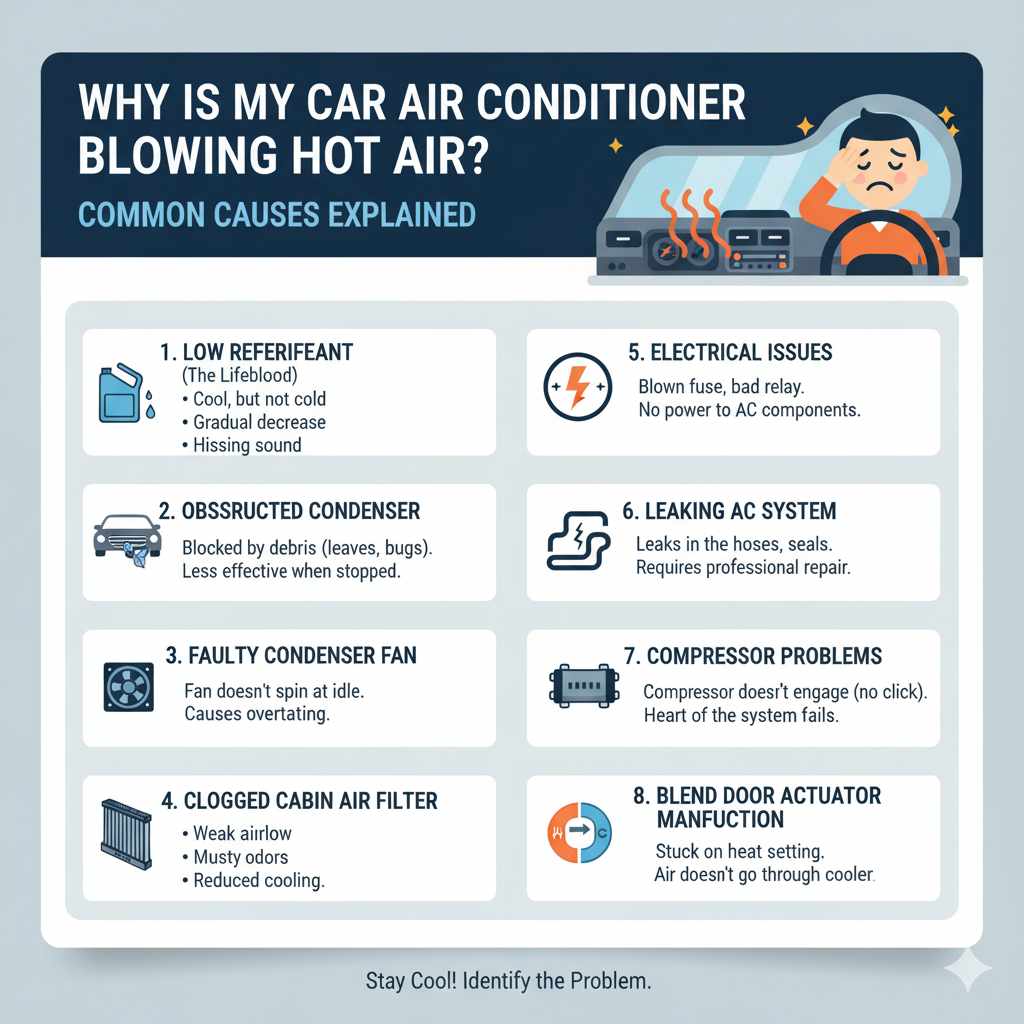
Your car AC may blow hot air because of low refrigerant, a failing compressor, a blocked condenser, a faulty cooling fan, or a problem with the temperature controls.
In the United States, a working car AC is a welcome relief during a hot summer commute, a long interstate drive, or a trip through stop-and-go traffic. If your vents suddenly send warm air into the cabin, you may wonder whether you need a simple fix or an expensive repair. The good news is that a few safe checks can help you narrow down the cause before you visit a repair shop.
Start by noticing when the problem occurs. Does the AC blow warm air all the time, cool the cabin only while driving, or turn warm after several minutes? These clues can help separate a possible airflow problem from a refrigerant leak, compressor fault, or control issue. You can check basic settings and visible signs at home, but refrigerant work and electrical diagnosis often require the right tools and training.
Your car AC blows cold air when several parts work together. The compressor moves refrigerant through the system, the condenser releases heat, and the evaporator absorbs heat from cabin air. The blower then pushes that cooled air through the vents.
When one part fails, the system may deliver warm air instead. The fault might involve refrigerant levels, heat exchange, electrical power, airflow, or the controls that direct air through the cabin. The same symptom can have several causes, so warm air alone does not prove that the compressor or any other part has failed.
The most useful first step is to note the conditions. Check whether the air is warm from the start, becomes warm after cooling briefly, or cools only when the car is moving. These patterns help guide the next checks without requiring you to take the system apart.
Source: thedailyautomotive.com
Warm air from the start
Possible causes include low refrigerant, a compressor that is not operating, a control fault, or a blend door that sends air past the heater core.
Cold air changes to warm air
Possible causes include an intermittent electrical fault, compressor cycling problems, icing, or a refrigerant charge issue.
Cold while moving but warm at idle
Check for a condenser fan problem, restricted airflow, or poor heat removal when the car is stationary.
Strong airflow but poor cooling
The blower may be working correctly while the refrigerant circuit or temperature controls are failing.
How the Car AC System Removes Heat
The AC system does not create cold in the same way a block of ice does. Instead, it moves heat from the cabin to the outside air by changing the pressure and state of refrigerant as it travels through the system.
The compressor raises refrigerant pressure, the condenser releases heat, and the expansion device lowers refrigerant pressure before the refrigerant enters the evaporator. Air passing over the evaporator loses heat, and the blower sends that air into the cabin. A failure in this process can leave the vents blowing air that feels no cooler than the outside air.
Refrigerant
The working fluid that carries heat through the AC circuit. The system needs the correct refrigerant type and charge.
Condenser
The heat exchanger, usually near the front of the vehicle, that releases heat to outside air.
Evaporator
The heat exchanger inside the HVAC housing that absorbs heat from cabin air.
Blend door
A flap inside the heating and ventilation housing that controls how much air passes through the heater core or the cooling path.
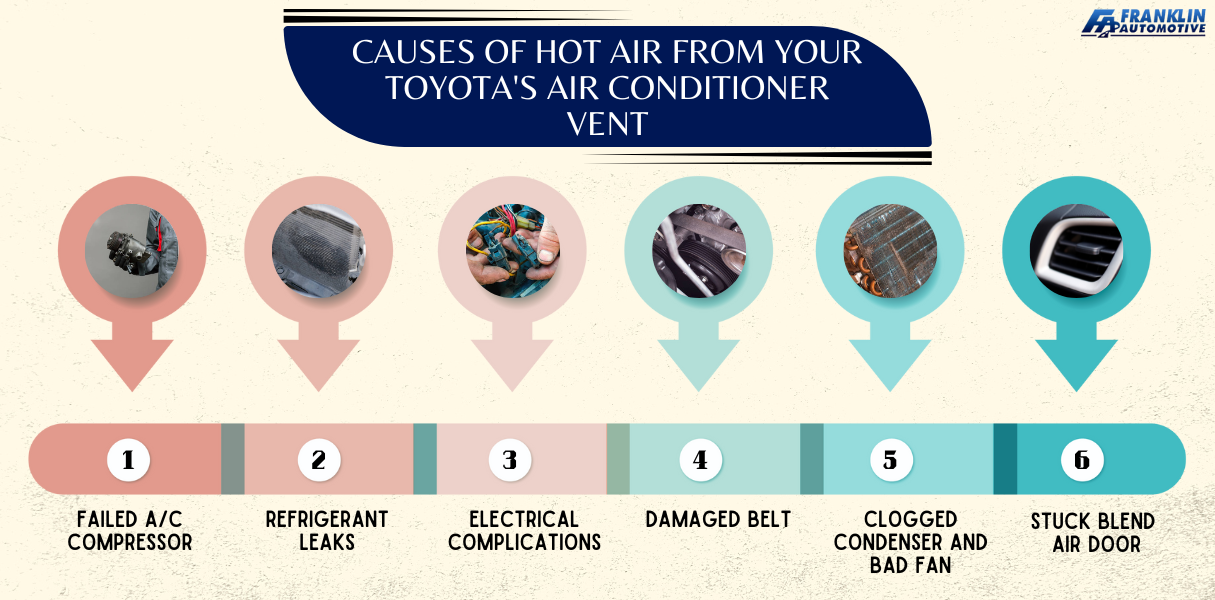
Common Causes of Hot Air From Car AC
Several faults can cause the same warm-air symptom. The most effective repair begins with identifying the cause instead of replacing parts based on guesswork.
Some problems need a technician and specialized equipment. Others begin with a simple check of the controls or a visual inspection of accessible parts. Use the following causes as a guide, not as a diagnosis of your specific car.
Source: carxplorer.com
Low refrigerant
A leak or an incorrect charge can reduce cooling performance. A low charge does not identify the leak location, and topping up without diagnosis may only provide temporary relief.
Compressor failure
A worn compressor, damaged internal parts, or a fault in its drive or control can prevent proper refrigerant circulation.
Condenser damage or blockage
Bent fins, debris, or damage from road debris can reduce heat transfer and make cooling less effective.
Condenser fan failure
A failed fan, motor, relay, fuse, or control can reduce airflow through the condenser, especially when the vehicle is stopped.
Electrical or sensor faults
A faulty pressure sensor, temperature sensor, fuse, wiring connection, or control module can prevent normal AC operation.
Blend door or actuator failure
The heating and ventilation system may direct warm air into the cabin even when the cooling system is working.
Restricted airflow or evaporator icing
A dirty cabin air filter, blocked intake, or an evaporator that freezes can reduce cooling or airflow.
Low Refrigerant or a Refrigerant Leak
Low refrigerant is a frequent cause of poor AC performance. The system is designed to operate with a specified charge, and too little refrigerant can reduce its ability to move heat. The charge can fall because refrigerant has escaped through a leaking seal, hose, condenser, evaporator, or another connection.
Refrigerant does not get used up like fuel during normal operation. If the system repeatedly needs more, there is a reason to investigate. A technician can use suitable leak detection methods and pressure measurements to locate the fault and confirm the required charge.
Do not rely on a hissing sound, oily residue, or a lack of visible liquid to rule a leak in or out. Some leaks are hard to see, and refrigerant may escape without leaving an obvious mark. The correct diagnosis depends on the vehicle and the test results.
What you may notice
Cooling gradually gets weaker, the AC struggles in hot weather, or the system stops cooling consistently.
What to do
Arrange a refrigerant leak check and correct charging procedure. Ask the shop to explain the cause if a recharge is recommended.
A Bad AC Compressor
The compressor moves refrigerant through the AC circuit. If it fails mechanically or cannot engage when required, the system may stop cooling. Some vehicles use a traditional clutch, while others use variable-displacement compressors or electrically driven units, so the signs differ by design.
Listen for new grinding, rattling, or squealing sounds when the AC is requested. These noises can point to a compressor, pulley, belt, or another engine accessory, but sound alone cannot identify the failed part. A compressor may also fail without making a dramatic noise.
Avoid trying to force the compressor to run or jumping electrical connections. A technician can check control commands, pressure readings, electrical supply, and compressor operation before deciding whether replacement is necessary.
Possible clue
The AC no longer cools and the compressor or its control system does not operate as expected.
Important limitation
A compressor that does not engage is not automatically defective. Low refrigerant, pressure protection, electrical faults, or control conditions can prevent operation.
Condenser or Cooling Fan Problems
The condenser needs to release heat to the outside air. Dirt, damaged fins, or restricted airflow can reduce this process. A cooling fan fault can have a similar effect, particularly at a traffic light or while parked in hot weather.
If the AC feels cooler at highway speed than it does at idle, poor condenser airflow is one possibility. Moving air can improve heat removal when the car is moving, while a stationary car depends more heavily on its fan system. This symptom is a useful clue, but it does not rule out refrigerant or control faults.
With the engine off and cool, you may look through the front grille for obvious debris or visible damage without reaching into the fan area. Do not remove covers or touch the fan to test it. Electric cooling fans can start unexpectedly, including after the engine has been switched off.
Possible clue
The AC cools better on the road than when idling, or cooling weakens in slow traffic.
What to do
Have the fan operation, fan controls, condenser condition, and refrigerant pressures checked if the pattern persists.
Step-by-Step Car AC Troubleshooting
Follow a simple order when checking an AC system that blows hot air. Start with controls and visible conditions, then use the symptoms to decide whether professional testing is needed. This approach can prevent an unnecessary parts replacement.
Park in a safe place and keep hands, tools, and loose clothing away from moving engine parts. If you need to inspect the engine bay, follow the owner’s manual and allow hot components to cool first.
Source: flexautofl.com
Step 1: Confirm the settings
Set the temperature to its coldest setting, select AC, and choose recirculation if suitable. Confirm that the system is not set to heat or a high temperature.
Step 2: Check the airflow
Notice whether air comes from the vents at a normal rate. Weak airflow suggests a different path of diagnosis from strong airflow that remains warm.
Step 3: Compare idle and moving conditions
If it is safe, note whether cooling changes when the vehicle is stationary versus moving. Do not handle controls in a way that distracts you while driving.
Step 4: Check accessible filters and intakes
Use the owner’s manual to locate the cabin air filter and check whether it is dirty or blocked. Inspect accessible outside air openings for leaves or debris.
Step 5: Look for warning signs
Notice unusual noises, burning smells, visible damage, engine temperature warnings, or a sudden change in performance.
Step 6: Arrange targeted testing
If the basic checks do not help, give a mechanic the exact symptoms and conditions. Ask for diagnosis before approving replacement parts.
Check the AC Controls and Temperature Settings
Begin inside the cabin because a wrong setting is easy to fix and does not require tools. Confirm that the AC indicator is on, the temperature is set to cold, and the airflow is directed to the desired vents. If your car has separate driver and passenger temperature controls, check both sides.
Some vehicles have automatic climate control that adjusts the compressor, fan, and air doors based on sensor readings. A setting that looks correct may not rule out a control or sensor fault, but it helps eliminate simple mistakes.
If one side blows cold air and the other blows warm air, a blend door actuator or an issue with a dual-zone control system may be responsible. Low refrigerant can also produce uneven temperatures in some conditions, so the symptom alone is not conclusive.
Signs of success
The vents begin to deliver cooler air after you correct the settings and allow the system a short time to respond.
If it fails
Continue to the airflow and symptom checks rather than repeatedly switching settings in the hope that a mechanical fault will clear.
Check Airflow and the Cabin Air Filter
A cabin air filter traps dust, leaves, and other debris before air enters the cabin. If the filter is heavily clogged, airflow may become weak, and the AC can seem ineffective even if parts of the refrigeration system still work.
Compare airflow at different fan speeds. If the fan sounds normal but very little air comes from the vents, a clogged filter, blocked intake, evaporator restriction, or blower problem may be involved. If airflow is strong but the air remains warm, refrigerant, compressor, condenser, or temperature-control faults deserve more attention.
Replace the filter only with the correct type and orientation for your vehicle. Some models have no easily accessible cabin filter, and some require extra steps to reach it. Follow the owner’s manual rather than forcing a cover or panel.
Weak airflow
Check the cabin filter and accessible air intake first, then seek help if airflow remains poor.
Normal airflow but warm air
A filter is less likely to be the main cause, so further AC system diagnosis may be needed.
Inspect for Obvious Damage Without Opening the System
With the vehicle switched off, look for obvious damage around accessible front-end components. A damaged condenser or a large buildup of leaves may be visible through the grille. Do not remove parts or reach between the radiator and condenser to clear debris while the engine or fan system may be active.
A visual check cannot confirm the refrigerant charge or prove that a component works. A clean-looking condenser may still have a leak, and a fan that appears intact may have a failed motor or electrical supply. Use the inspection to gather clues rather than to make a final diagnosis.
Do not loosen refrigerant fittings or disconnect hoses. Refrigerant under pressure can cause cold burns and eye injuries, and the correct recovery equipment is needed before opening the circuit.
Look for
Obvious impact damage, heavy debris, loose exterior covers, or signs of physical damage that can be seen safely.
Avoid
Opening AC lines, touching fans, probing live wiring, or spraying chemicals into electrical parts.
Use the Symptoms to Narrow Down the Cause
The pattern of the failure can help you and your mechanic focus on the right tests. Record when the AC stops cooling, whether the airflow changes, and whether the engine temperature remains normal. These details are often more useful than simply reporting that the AC blows hot air.
The table below links common symptoms to possible causes and the next sensible step. Each entry is a starting point, not proof that a specific part has failed.
Source: hitchesguide.com
AC warm at idle but cooler at speed
Possible condenser airflow or fan issue. Have fan operation and heat rejection checked.
AC warm at all speeds
Possible low refrigerant, compressor or control fault, or a blend door problem. Begin with settings and arrange system testing.
AC cools briefly, then warms up
Possible intermittent electrical control, pressure-related cycling, or evaporator icing. Note how long cooling lasts and seek diagnosis.
One side is cold and the other is warm
Possible blend door, actuator, dual-zone control, or refrigerant distribution issue. Have both sides and the refrigerant circuit checked.
Airflow is weak at every fan speed
Possible clogged filter, blower fault, blocked intake, or evaporator restriction. Start with the filter and accessible intake.
AC failure comes with a grinding noise
Possible compressor, pulley, belt, or other accessory fault. Stop using the AC if the noise is severe and arrange an inspection.
Why Does the AC Blow Hot Air Only When Idling?
When the car is stationary, less outside air naturally passes through the condenser. The cooling fan must provide the airflow needed to remove heat. If the fan or its control system fails, AC performance may drop at idle and improve when the car moves.
This pattern can also result from other faults, including an incorrect refrigerant charge or a compressor that struggles under certain conditions. Do not assume a fan replacement is the answer until the system has been tested.
If the engine temperature also rises in traffic, take the issue seriously. A cooling system fault may affect engine temperature as well as cabin comfort. Stop safely if the temperature warning appears or the engine begins to overheat.
Best next check
Ask a technician to inspect fan operation, condenser airflow, refrigerant pressures, and related controls.
Why Does the AC Blow Cold Then Hot?
Cooling that comes and goes can point to an intermittent electrical connection, a sensor or control fault, pressure-related compressor shutdown, or ice forming on the evaporator. The exact cause depends on the vehicle design and the conditions when the change occurs.
If airflow becomes weak at the same time that the air warms up, icing or an airflow restriction deserves attention. If airflow stays strong but the temperature changes suddenly, the compressor controls, refrigerant circuit, or blend door may be involved.
Avoid repeatedly cycling the AC as a substitute for diagnosis. Record how long it stays cold, whether the fan speed changes, and whether the problem appears in traffic or during longer drives. This information helps guide testing.
Useful detail to record
How long cooling lasts, whether the vehicle is idling or moving, and whether airflow weakens when warm air begins.
When to See a Mechanic
Arrange professional service when basic checks do not restore cooling, when the AC repeatedly fails, or when you notice noises, leaks, or electrical symptoms. A qualified technician can measure system pressures, test electrical controls, check compressor operation, and use approved methods to find refrigerant leaks.
Modern vehicles may use different refrigerants and control systems. Some newer models have electrically driven compressors, while others use belt-driven units. A repair procedure that applies to one model may not be correct for another, so the vehicle’s service information matters.
Before approving a major repair, ask what test identified the fault. A sound diagnosis should connect the symptom to a measured or observed problem, rather than simply recommending a compressor because the vents are warm.
Source: www.youtube.com > FixIT
Ask whether a leak test is needed
If refrigerant is low, ask how the technician will locate the leak and verify the repair.
Ask how the compressor was checked
The shop should consider power supply, control signals, system pressures, and compressor operation as appropriate for the vehicle.
Request an itemized estimate
Ask for separate labor, parts, refrigerant service, and any additional repairs so you can understand the proposed work.
Confirm the refrigerant type
Use the specification on the vehicle label and in the service information. Different refrigerants and oils are not automatically interchangeable.
What a Proper AC Diagnostic May Include
A technician may start by confirming the complaint and measuring vent temperature under defined conditions. The technician may then inspect the condenser and fans, check compressor operation, and read system pressures using equipment suited to the vehicle.
Depending on the results, the next steps may include electronic fault-code checks, electrical circuit tests, refrigerant leak detection, or an inspection of the HVAC blend doors. Pressure readings must be interpreted with the refrigerant type, outside temperature, engine speed, and manufacturer specifications in mind.
If the system needs to be opened, refrigerant should be recovered using suitable equipment. The technician should repair the underlying fault, evacuate the system when required, and charge it according to the vehicle’s specified procedure and amount. Simply adding refrigerant until a gauge looks right is not a reliable universal method.
Diagnosis before replacement
Testing can help avoid replacing a compressor, condenser, or other expensive part when the actual fault is electrical or related to system charge.
Verification after repair
The shop should confirm cooling performance and check the relevant system operation after the repair.
When Not to Keep Driving
Warm air alone is usually a comfort problem, but some accompanying symptoms signal a more serious fault. If the engine temperature warning comes on, steam appears, or the engine overheats, pull over safely and follow the owner’s manual. Continuing to drive an overheating engine can cause serious damage.
Stop using the AC if you hear a severe grinding or belt noise, smell burning, or see smoke. If the vehicle has an electrical burning smell or the engine runs abnormally, stop in a safe location and arrange help rather than trying repeated restarts.
Never open a hot cooling system or touch moving belts and fans. If you are unsure whether the vehicle is safe to operate, ask for roadside assistance.
Stop and assess
Engine overheating, smoke, a burning smell, or severe mechanical noise requires prompt attention.
Do not attempt a roadside refrigerant repair
Leave pressurized AC components and refrigerant handling to someone with the right equipment and training.
Can You Fix a Car AC That Blows Hot Air at Home?
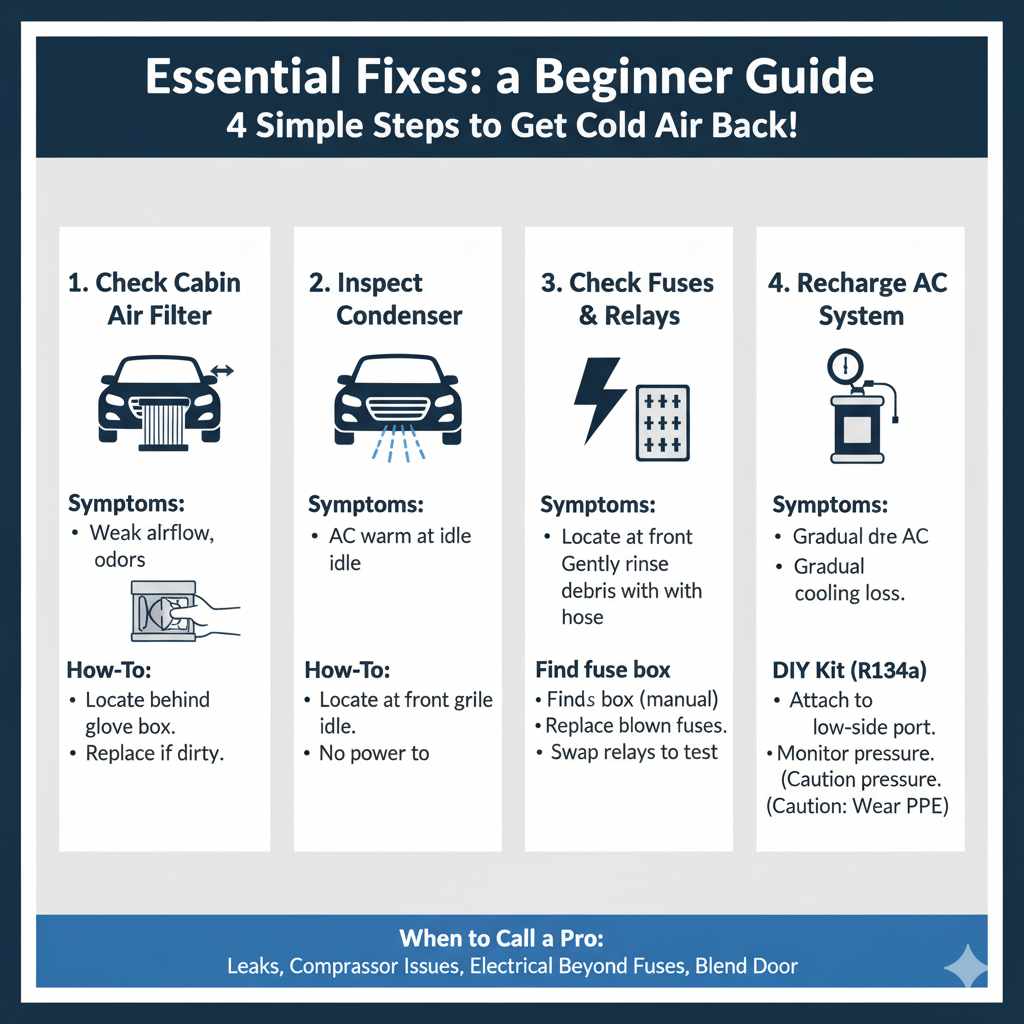
You can handle a few low-risk checks at home, but you should not assume that every AC problem is a do-it-yourself repair. Checking settings, replacing an accessible cabin air filter, and removing loose debris from an accessible air intake may help when those items are actually causing the problem.
Repairs involving refrigerant, compressor circuits, high-current electrical parts, or internal HVAC components can require special tools and vehicle-specific procedures. A wrong refrigerant, incorrect charge, or unsuitable oil can damage the system or create a safety hazard.
Use the owner’s manual to confirm which checks and routine maintenance tasks are permitted for your vehicle. If a repair requires opening the refrigerant circuit, use a qualified service provider with appropriate recovery and charging equipment.
Source: carsolutionpro.com
Reasonable home checks
Verify climate settings, check the cabin filter if accessible, inspect visible air intake obstructions, and note the conditions that affect cooling.
Repairs best left to trained technicians
Refrigerant recovery, leak repair, system evacuation, compressor replacement, and advanced electrical diagnosis.
Avoid unverified stop-leak products
Some additives can complicate later service or damage equipment. Check vehicle requirements and obtain a proper diagnosis before using any additive.
Should You Use an AC Recharge Kit?
A recharge kit may seem like a quick solution, but adding refrigerant is not the same as repairing the AC. If the system has a leak, the refrigerant can escape again. If the charge is already correct or the real fault is electrical, adding more refrigerant will not fix the cause.
Some products also contain additives, and the compatibility of refrigerant, oil, and additives depends on the vehicle and equipment. Pressure-gauge readings can be misleading when outside temperature, compressor design, fan operation, and system conditions vary.
The safer choice is to confirm the refrigerant specification and diagnose the system first. If the system is low, repair the leak as needed and recharge it using the manufacturer’s specified method and amount.
Use a kit only if
The product is specifically compatible with the vehicle and refrigerant system, the procedure is permitted, and you understand the risks and limitations. When in doubt, seek professional service.
Do not use
A product with an unknown refrigerant, incompatible oil, or an unverified stop-leak additive.
How to Help Prevent AC Cooling Problems
Routine care can help keep your AC system working, although it cannot prevent every leak or mechanical failure. Follow the maintenance schedule in the owner’s manual and address changes in cooling performance before they become persistent.
Keep the area around accessible air intakes clear of leaves and loose debris. Replace the cabin air filter at the interval specified for your vehicle and driving conditions. If the AC begins to cool less effectively, arrange diagnosis rather than waiting until it stops working completely.
A short record of symptoms can also make future service easier. Note the outside conditions, whether the car was moving, how long the system stayed cold, and whether the airflow changed. This information can help a technician reproduce an intermittent fault.
Source: detroitchinatown.org
Follow the service schedule
Use the maintenance intervals and inspection guidance supplied for your vehicle rather than relying on one schedule for every car.
Keep air intakes clear
Remove accessible loose debris without reaching into fan areas or damaging delicate condenser fins.
Respond to early warning signs
Weak cooling, recurring warm air, unusual noises, or repeated refrigerant loss deserve diagnosis.
Record intermittent symptoms
Note when the issue starts and stops, the fan setting, driving conditions, and any warning lights.
Does Running the AC Regularly Prevent Problems?
Using the AC periodically when conditions and the owner’s manual permit may help keep you familiar with how the system normally performs. However, regular use does not guarantee that seals, hoses, the compressor, or electrical parts will remain fault-free.
Some vehicles automatically manage compressor operation during defrost or climate-control use. Others limit operation under certain temperatures or operating conditions. Follow the instructions for your specific model instead of forcing the AC to run when the vehicle’s controls prevent it.
The best preventive measure is to act when performance changes. A system that starts blowing warm air deserves a proper check, especially if the problem returns after a temporary improvement.
Main lesson
Routine use is not a substitute for correct maintenance, leak repair, and diagnosis when cooling performance changes.
Common Mistakes When Troubleshooting Car AC
The biggest mistake is replacing a part before confirming the fault. A warm cabin does not automatically mean the compressor is broken, and a low refrigerant reading does not explain why the charge became low.
Another common mistake is treating a temporary improvement as proof of a lasting repair. If cooling returns after a recharge or after the car rests, an underlying leak, control fault, or icing problem may still be present.
Avoid using a single pressure reading, a visual inspection, or a sound as the only basis for a repair decision. The system needs to be assessed under suitable conditions with the correct specifications and diagnostic equipment.
Source: thedailyautomotive.com
Mistake: Adding refrigerant repeatedly
Why it fails: It does not repair a leak and can lead to an incorrect charge. Better approach: Find the cause of refrigerant loss and charge the system correctly.
Mistake: Assuming the compressor is bad
Why it fails: Electrical faults, pressure protection, and control issues can prevent compressor operation. Better approach: Test the full system before replacing parts.
Mistake: Ignoring weak airflow
Why it fails: A clogged filter or restricted air path can reduce comfort even when the refrigeration system is operating. Better approach: Check accessible filters and intakes first.
Mistake: Reaching into the engine bay while it is running
Why it fails: Belts, fans, and hot parts can cause serious injury. Better approach: Keep clear of moving parts and follow safe inspection procedures.
Mistake: Ignoring engine temperature warnings
Why it fails: An overheating engine can suffer serious damage. Better approach: Stop safely and follow the vehicle’s emergency guidance.
What Information Should You Give the Repair Shop?
A clear symptom report helps a technician narrow down the possible causes. Instead of saying only that the AC is broken, explain whether the air is warm from the start, becomes warm after a few minutes, or improves when the car moves.
Mention any recent repairs, unusual sounds, warning lights, or refrigerant service. If the issue began after a collision, engine repair, battery replacement, or work near the front of the vehicle, share that information because it may affect the diagnostic path.
Ask the technician to explain the test results and why the proposed repair addresses them. This keeps the conversation focused on evidence and helps you compare estimates when more than one repair option is reasonable.
Describe the pattern
Warm all the time, warm only at idle, cold then warm, or different temperatures from separate vents.
Describe other symptoms
Weak airflow, unusual noises, burning smells, warning lights, or engine temperature changes.
Share recent work
Mention AC service, cooling-system repairs, front-end work, or electrical repairs performed shortly before the problem began.
Questions to Ask Before Approving an AC Repair
A useful estimate explains the fault, the repair, and how the shop will confirm the result. You do not need to know every technical detail, but you should understand why a part or service is necessary.
If a shop recommends a compressor, ask whether it tested the electrical supply, control signals, and refrigerant pressures. If it recommends a recharge, ask whether the charge was confirmed to be low and whether the system was checked for leaks.
Source: thedailyautomotive.com
What test confirmed the problem?
Ask for the observed fault, measured result, or diagnostic finding that supports the recommendation.
Is there an underlying leak?
If refrigerant is low, ask whether leak detection or repair is required before charging the system.
What is included in the estimate?
Confirm whether labor, parts, refrigerant recovery, charging, leak testing, and follow-up checks are included where needed.
How will the repair be verified?
Ask how the shop will confirm that the system cools correctly and that the original symptom has been addressed.
Why the Cheapest Quote May Not Be the Best Repair
A low quote may cover only a refrigerant top-up or one replacement part. A higher quote may include leak detection, repair, proper charging, and performance checks. These services are not directly comparable unless you know what each estimate includes.
That does not mean the more expensive estimate is automatically better. Ask for a clear explanation of the diagnosis, the parts proposed, and the work required. A well-supported repair should address the actual fault rather than rely on repeated temporary fixes.
Compare the scope
Check the parts, labor, diagnostic steps, refrigerant service, and verification included in each estimate.
Check parts and warranty terms
Ask whether the replacement part is new, remanufactured, or used, and what coverage applies to the repair.
Frequently Asked Questions
Q
Why Is My Car AC Blowing Hot Air But the Fan Still Works?
The cabin blower can work even when the AC system cannot cool the air. Possible causes include low refrigerant, a compressor or control fault, a condenser airflow problem, or a blend door that directs warm air into the cabin. If airflow is strong but remains warm, check the climate settings and arrange AC diagnosis if the problem continues.
Q
Can Low Refrigerant Make Car AC Blow Hot Air?
Yes. A refrigerant charge that is too low can reduce cooling and may cause the system to stop operating normally. The system is sealed, so repeated refrigerant loss suggests a leak that needs investigation. A technician can identify the refrigerant type, check the system, repair leaks as needed, and restore the correct charge.
Q
Why Does My Car AC Blow Cold Air While Driving but Hot Air at a Stop?
A condenser fan or airflow problem is one possible cause. When the car moves, outside air passes through the condenser and helps remove heat. At a stop, the fan must provide much of that airflow. Other faults can create a similar pattern, so the fan, refrigerant circuit, and related controls should be checked before replacing parts.
Q
Can a Blown Fuse Cause the Car AC to Blow Hot Air?
Yes. A fuse or another electrical fault can stop the compressor, cooling fan, or control system from operating correctly. Check the owner’s manual for the correct fuse information and use only the specified fuse rating. If a replacement fuse blows again, do not keep replacing it; have the circuit inspected for a fault.
Q
Why Does My Car AC Blow Hot Air on One Side and Cold Air on the Other?
This pattern can occur when a blend door actuator or dual-zone climate control system does not direct air correctly. Low refrigerant can also contribute to uneven vent temperatures in some vehicles. A technician can compare the temperature settings, inspect the door operation, and test the AC system to determine the cause.
Q
Will Adding Refrigerant Fix My Car AC?
It may restore cooling temporarily if the system is undercharged, but it will not fix the leak that allowed refrigerant to escape. Adding refrigerant to a system that is already correctly charged can cause other problems. Confirm the cause of poor cooling and follow the vehicle’s specified charging procedure rather than guessing.
Q
Is It Safe to Drive With the AC Blowing Hot Air?
If the only issue is warm cabin air and the engine runs normally, the vehicle may remain drivable, although hot weather can make the trip uncomfortable. Do not continue driving if the engine overheats, smoke appears, a burning smell develops, or severe mechanical noises occur. Stop safely and arrange assistance when these warning signs appear.
Q
How Can I Tell Whether My Car AC Compressor Is Bad?
Poor cooling, unusual noises, or a compressor that does not operate when requested can suggest a compressor problem. However, low refrigerant, pressure protection, electrical faults, and control issues can prevent normal operation too. A proper diagnosis checks the relevant pressures, electrical commands, and compressor operation before replacement.
✦ Wrapping Up
Conclusion
When your car AC blows hot air, the cause may be as simple as an incorrect setting or a clogged cabin filter, or it may involve a refrigerant leak, compressor fault, condenser problem, or failed control. The symptom alone cannot tell you which part needs repair. Pay attention to when the air becomes warm and whether airflow changes at the same time.
Start with safe checks of the climate settings, cabin air filter, and visible air intake obstructions. Note whether the system cools at idle, while moving, or only for a short time. If these checks do not solve the problem, ask a qualified technician to test the system and explain the evidence behind the recommended repair.
💡 Key Takeaway
Set the AC to its coldest setting, check the cabin filter if accessible, and record when cooling fails. If the air remains warm, arrange a proper diagnosis instead of adding refrigerant or replacing parts without evidence.