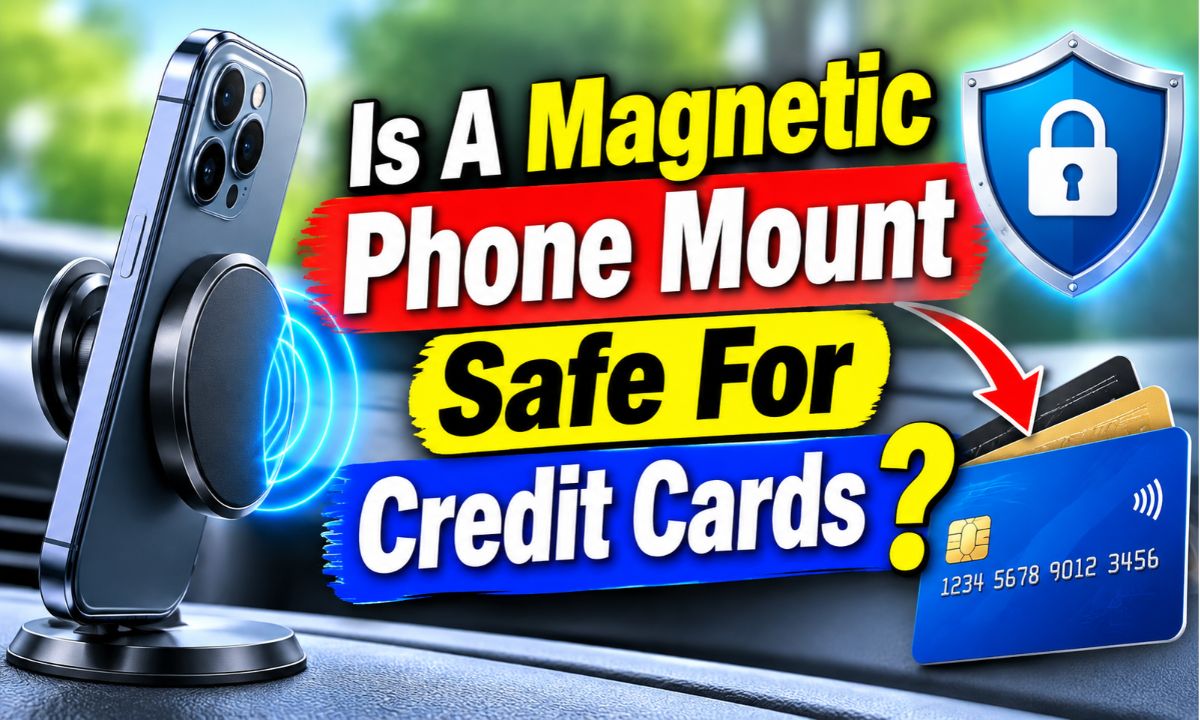
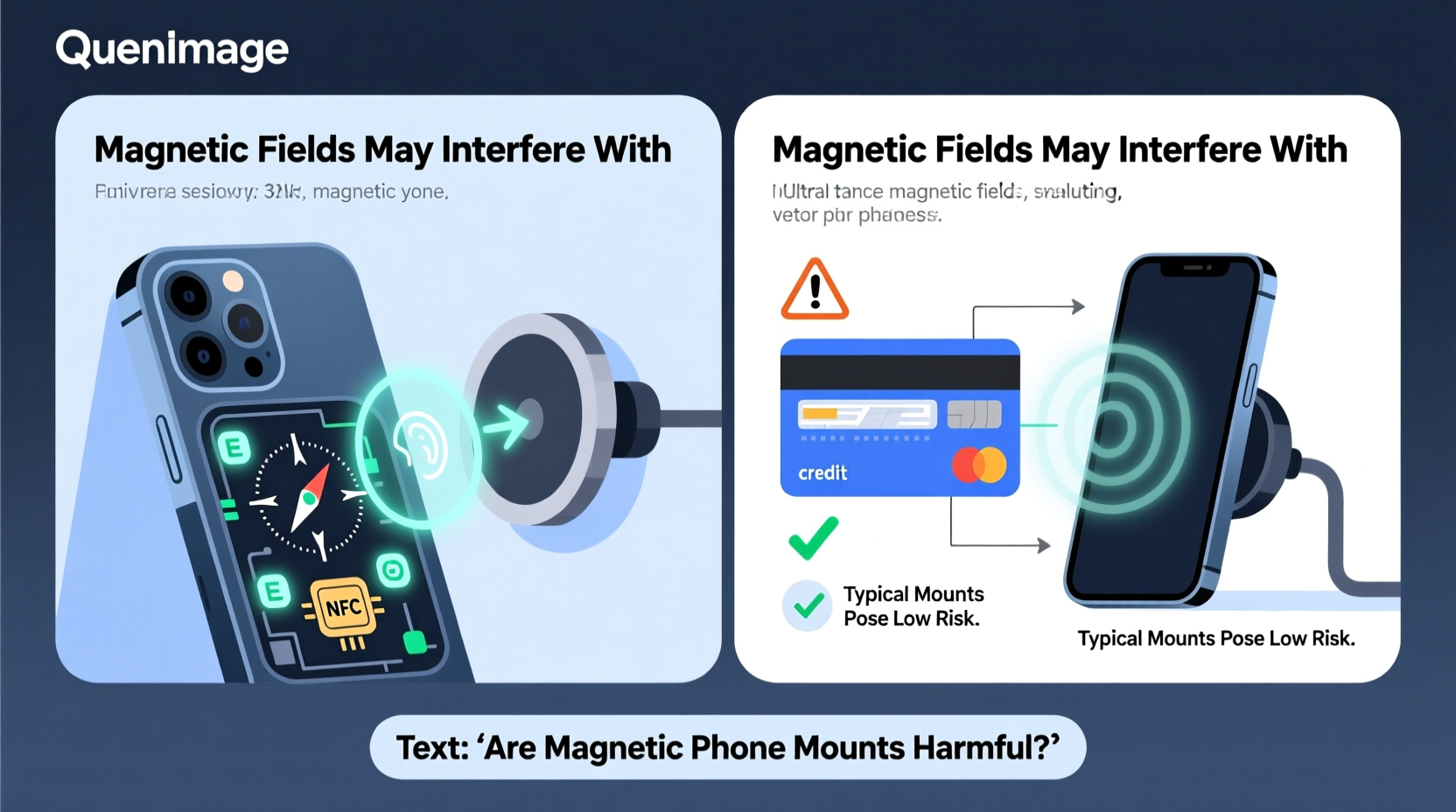
Yes, most magnetic phone mounts are safe around credit cards during normal use, but direct contact with strong magnets can damage magnetic stripes.
If you drive in the United States, a magnetic phone mount can make it easier to keep your phone in view for navigation, hands-free calls, and traffic updates. You may also carry credit cards in a wallet, phone case, or center console. This raises a fair question: can the magnet in your phone holder damage your cards?
The short answer is that most modern credit cards can handle normal everyday conditions around common phone mounts. However, the magnetic stripe on the back of a card can be affected by a strong magnetic field. The risk depends on the magnet’s strength, the distance between the magnet and card, and how long they stay together. Cards stored directly against a strong magnet deserve more care than cards kept in a separate wallet.
There is also a difference between magnetic stripes, payment chips, and contactless payment systems. These parts do not all work in the same way. Understanding that difference can help you use a magnetic phone holder without putting your payment cards at unnecessary risk.
Yes, most magnetic phone mounts are safe for credit cards when the cards are kept away from direct contact with the magnet. A typical mount is designed to hold a smartphone or a metal plate attached to its case. It is not designed to erase card data.
Still, safe everyday use does not mean that every magnet is harmless. A powerful magnet can affect the magnetic stripe on a payment card if it gets close enough. This is why keeping your wallet away from the mounting point is a sensible habit.
For example, imagine that you attach your phone to a magnetic holder on your dashboard. Your credit card sits inside a wallet in your pants pocket. In this situation, the card is not exposed to the magnet in the same way as a card pressed directly against the mount.
The risk becomes more concerning when you place a card between the phone and the mount, store it in a magnetic phone wallet, or leave it against the magnet overnight. The longer and closer the exposure, the more reason you have to keep the card somewhere else.
Source: id.pinterest.com
Normal use
A credit card stored in a separate wallet is generally at low risk from a regular phone mount.
Direct contact
A card pressed against a strong magnet may experience damage to its magnetic stripe.
Long-term storage
Leaving a card attached to a magnetic phone accessory for extended periods is an unnecessary risk.
Unusual magnets
Large or unusually powerful magnets may create a stronger field than an ordinary consumer phone holder.
Why the Type of Magnet Matters
Magnetic phone mounts use different magnet designs. Some use small permanent magnets, while others use several magnets arranged in a ring or group. Their field strength can vary based on the material, size, design, and distance from the object.
A compact magnet in a standard car holder is not automatically as powerful as an industrial neodymium magnet. The word magnetic alone does not tell you how much risk a particular accessory creates.
You should also consider the metal plate supplied with some mounts. The plate itself is not usually a magnet. It is a piece of metal that the mount’s magnet attracts. However, the plate does not guarantee that nearby cards are shielded from the magnetic field.
Small phone mount magnets
Usually intended for holding lightweight phones and accessories.
Multiple magnet systems
May create a different field pattern depending on their arrangement.
Strong neodymium magnets
Can create powerful magnetic fields and deserve extra care around magnetic storage media.
How Can a Magnet Damage a Credit Card?
A magnet can damage a credit card by changing the magnetic information stored in its stripe. This stripe is usually the dark band found on the back of the card. It contains small magnetic areas that represent payment and account-related information used by compatible card readers.
When you swipe a card, the reader detects the magnetic pattern on the stripe. If a strong external magnetic field changes that pattern, the reader may no longer recognize the card correctly.
Think of a magnetic stripe as a small storage area that relies on a specific magnetic pattern. A strong enough external magnet can disturb that pattern. The card may still look perfectly normal, even if its swipe function stops working.
The European Union Intellectual Property Office explains that magnetic stripes store data by changing the magnetism of tiny particles in the stripe. This is why exposure to a sufficiently strong magnetic field can create a problem.
Not every brief encounter with a magnet will erase a card. Modern bank card stripes are designed to resist normal everyday exposure better than some older magnetic cards. However, that does not make them immune to powerful magnets.
Source: alibaba.com
Magnetic data
The stripe stores information through a pattern of magnetized particles.
External magnetic field
A sufficiently strong field can change the stored magnetic pattern.
Possible result
A card reader may fail to read the stripe even when the card looks undamaged.
Does the Magnet Need to Touch the Card?
No. A magnet does not have to touch a credit card to create a magnetic field around it. That field extends beyond the magnet itself, although its strength usually falls as the distance increases.
Direct contact is generally more concerning because the card is exposed to a stronger field. A small gap can reduce exposure, but there is no single safe distance that applies to every mount and every card.
The strength and shape of the magnet matter too. Two magnets of the same size may not create identical fields. This makes it difficult to give a universal distance in inches for every magnetic phone holder.
Close distance
Creates greater exposure than keeping the card farther away.
Long exposure
Can increase the chance of damage, depending on the magnet and card.
Card position
The magnetic stripe’s position relative to the magnet can affect exposure.
Which Parts of a Credit Card Can Magnets Affect?
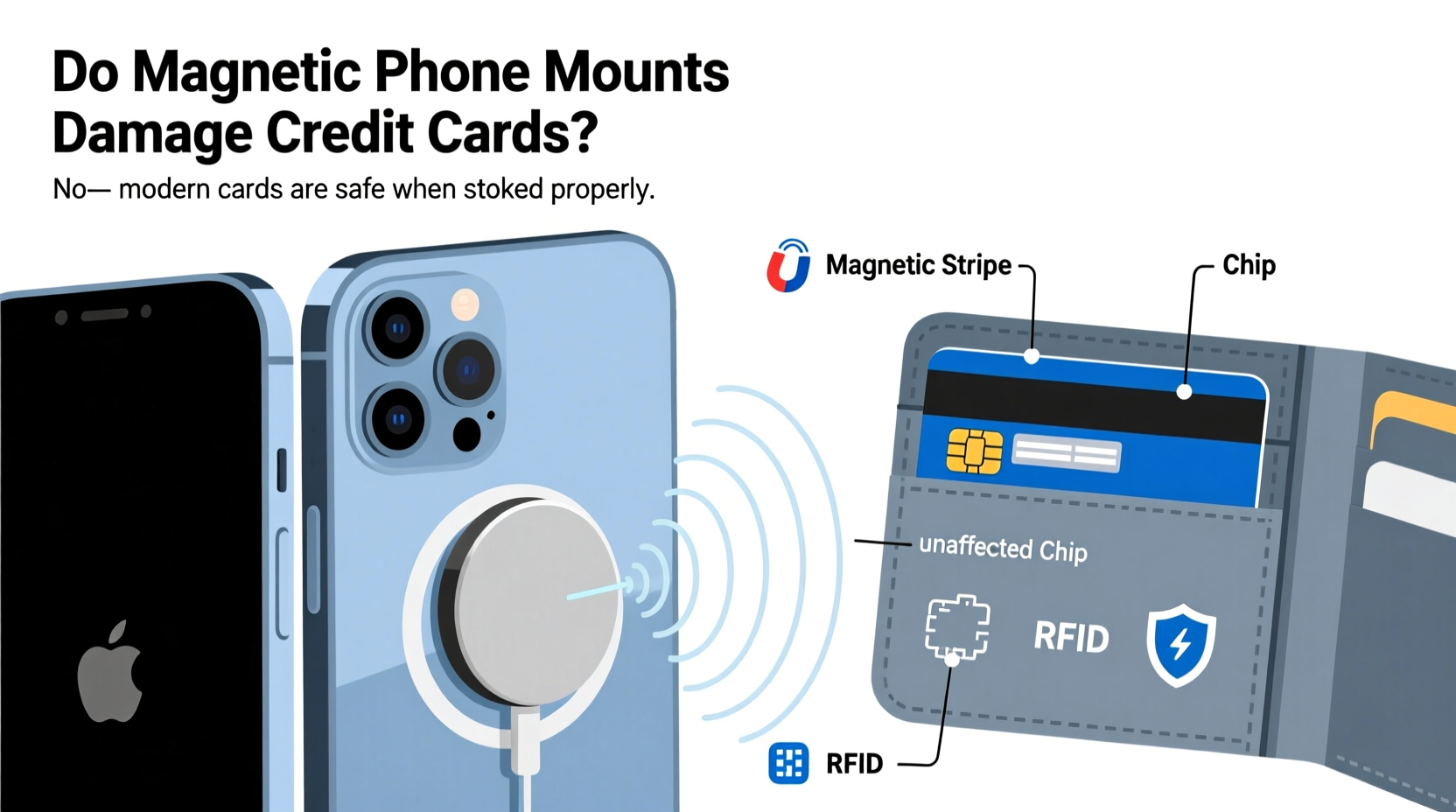
A modern credit card may contain more than one payment technology. It can have a magnetic stripe, an EMV chip, and a contactless payment antenna. These components perform different jobs, so the effect of a magnet is not the same for each one.
The magnetic stripe is the part with the clearest known sensitivity to magnetic fields. It stores information through magnetized particles. A strong magnet can change that information.
An EMV chip uses electronic circuitry rather than magnetic storage. It communicates with a payment terminal through its metal contacts. A normal permanent magnet does not erase its stored payment data in the same way that it can affect a magnetic stripe.
Contactless cards use a small antenna and chip to communicate with a payment terminal. They rely on radio-frequency communication rather than a magnetic stripe. However, this does not mean you should ignore all manufacturer warnings about magnets and electronic accessories.
Apple specifically warns users not to place credit cards, security badges, passports, or key fobs between an iPhone and a MagSafe Charger because magnetic strips or RFID chips in those items may be damaged. This warning applies to that charging setup and should not be turned into a claim that every ordinary phone mount will damage every contactless card.
Source: amazon.com
Magnetic stripe
Stores data magnetically and can be damaged by a sufficiently strong external magnetic field.
EMV chip
Uses electronic circuits and is not dependent on magnetic data storage.
Contactless antenna
Uses radio-frequency communication with a compatible payment terminal.
RFID components
May be covered by specific accessory safety warnings, so follow the device manufacturer’s instructions.
Are Chip Credit Cards More Resistant to Magnets?
Chip cards have an advantage because their main payment method does not depend on the magnetic stripe. If the stripe stops working, you may still be able to insert the card into a compatible terminal and use its chip.
This does not mean that the entire card is indestructible. Physical damage, a broken chip, or problems with the card’s electronic components can still prevent payment.
If your card has both a chip and a stripe, damage to the stripe does not automatically mean that the whole card is useless. It may continue to work through chip or contactless payment, depending on the card and the payment terminal.
Chip payment
Does not rely on the magnetic information stored in the stripe.
Swipe payment
Can fail if the magnetic stripe has been damaged.
Contactless payment
May continue to work if the contactless components remain functional.
Can a Magnetic Car Phone Mount Damage Cards in Your Wallet?
A magnetic car phone mount is unlikely to damage cards stored in a separate wallet away from the mount. The important factor is how close the wallet gets to the magnet, not simply whether the magnet is inside your vehicle.
Many drivers place their wallets in a center console, glove compartment, door pocket, or pants pocket. These locations may keep the cards away from the magnetic holder. However, the actual distance varies with the mount’s location and the vehicle’s layout.
The situation changes if you keep your credit card in a phone case that attaches directly to the magnetic holder. The card may sit close to the magnet for every drive. That is not a storage method I would recommend when a separate wallet is available.
Also, do not assume that a dashboard surface or a plastic phone case blocks magnetic fields. Ordinary plastic does not provide reliable magnetic shielding. A card can still be exposed even when a thin layer of plastic separates it from the magnet.
Source: shopee.com.my
Wallet in your pocket
Usually a better option than storing cards directly on the magnetic mount.
Wallet in the glove compartment
Can provide useful separation if the compartment is not next to the mounting magnet.
Card behind the phone
May be exposed to the magnet and should be avoided for long-term storage.
Card in a console
Check the distance between the card and the mount rather than assuming the console offers protection.
What If Your Phone Mount Uses a Metal Plate?
Many magnetic phone holders include a thin metal plate that attaches to the back of a phone or phone case. The magnet attracts this plate and keeps the phone in place.
The metal plate is not the same as a magnetic shield. It is mainly there to help the phone attach to the holder. It does not automatically protect a nearby credit card from magnetic exposure.
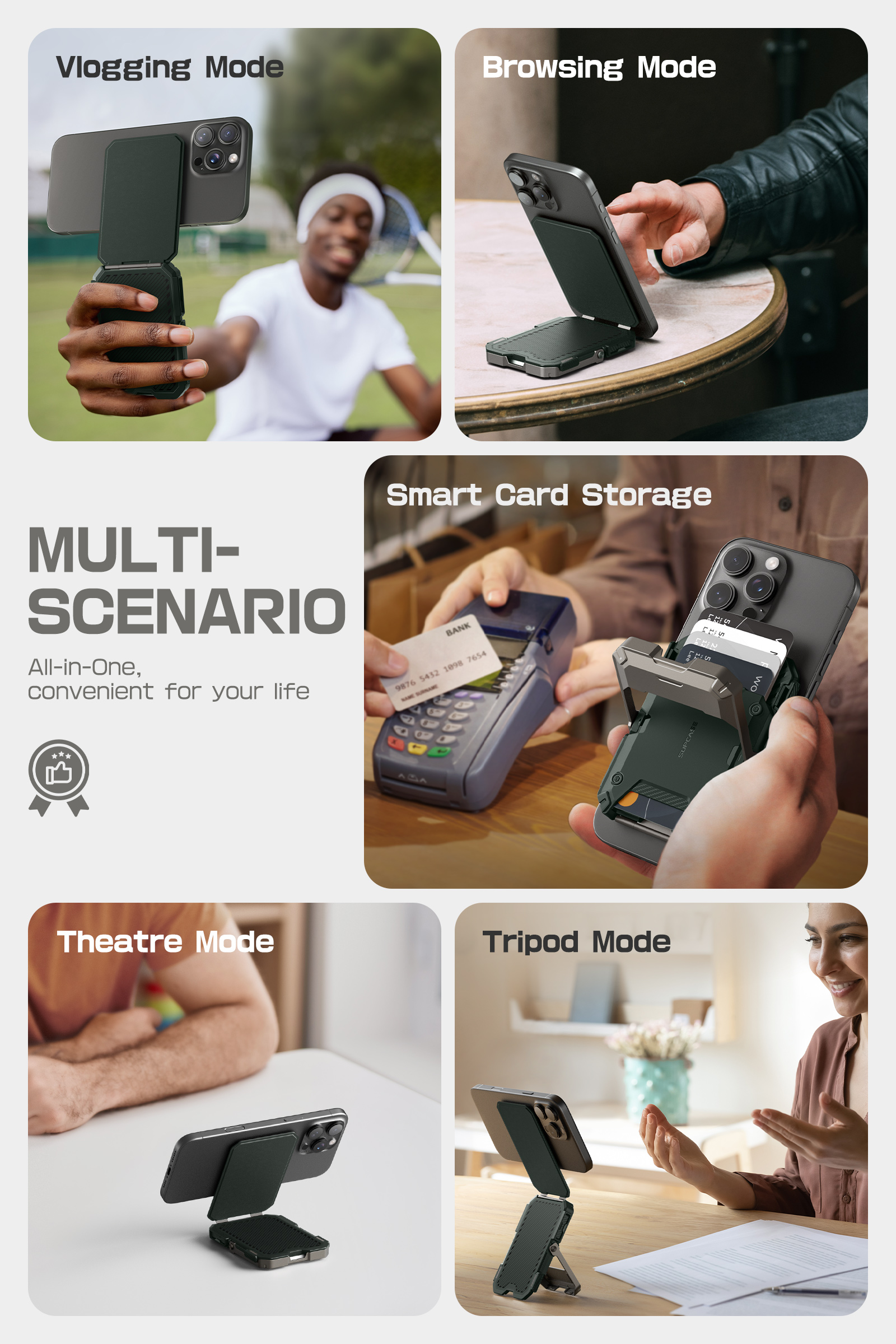
If your case includes a card compartment, check whether the cards sit between the phone and the mounting point. If they do, use a different storage method or remove the cards before attaching the phone.
Metal mounting plate
Helps the phone attach to the holder but does not guarantee card protection.
Plastic case
Provides physical separation but does not reliably block a magnetic field.
Separate wallet
Keeps payment cards away from the mount and avoids unnecessary exposure.
Are MagSafe Phone Mounts Safe for Credit Cards?
MagSafe phone accessories are designed around a magnetic attachment system. They can hold a compatible phone, wallet, charger, or other accessory in place. Their magnets are useful, but you should still pay attention to where you store payment cards.
A MagSafe-compatible phone mount is not automatically dangerous to credit cards. However, a MagSafe wallet or charger creates a more direct interaction when cards are attached to the back of the phone.
Apple’s guidance is especially relevant when using a MagSafe Charger. Apple advises users not to place credit cards, security badges, passports, or key fobs between the phone and charger because the magnetic strips or RFID chips in those items may be damaged.
A magnetic phone holder and a MagSafe charging accessory are not necessarily identical. Their magnet arrangements, intended uses, and operating conditions can differ. Follow the instructions for the exact accessory you own instead of assuming that every product has the same safety limits.
If you use a magnetic phone wallet, check its card capacity and the manufacturer’s compatibility instructions. Remove the wallet when the accessory’s instructions require it, especially when charging.
Source: walmart.com
MagSafe phone mount
Can be used normally while keeping payment cards stored separately.
MagSafe wallet
Holds cards close to the phone’s magnetic attachment system, so follow the wallet maker’s guidance.
MagSafe charger
Should not be used with credit cards or other sensitive items trapped between the charger and phone.
Third-party accessories
May use different magnetic designs, so check the specific product manual.
Can You Charge Your Phone With a Card Wallet Attached?
Do not assume that a magnetic wallet can stay attached while you use a wireless charger. The wallet may contain cards that the charger manufacturer says should be kept away from the charging area.
For an Apple MagSafe Charger, remove the wallet and any payment cards before charging. Check the instructions for other charging systems as well.
This is also a useful way to prevent heat, charging alignment, and accessory compatibility problems. Removing the wallet takes only a moment and avoids placing cards between two magnetic accessories.
Before charging
Remove the magnetic card wallet unless the exact accessory instructions explicitly permit the setup.
During charging
Keep payment cards, security badges, and other sensitive items away from the charging interface.
Which Cards Are More Sensitive to Magnetic Phone Mounts?
Not all magnetic cards have the same resistance to magnetic fields. A modern bank card may have a more resistant stripe than an older hotel key card or temporary access card.
One important distinction is magnetic coercivity. This term describes how resistant a magnetic material is to losing or changing its stored magnetic pattern when exposed to an outside magnetic field.
High-coercivity stripes are generally more resistant than low-coercivity stripes. Many modern payment cards use high-coercivity magnetic stripes, while some hotel keys and older access cards use more easily changed magnetic media.
This is why a magnet that does not cause an obvious problem with your credit card could still affect another card. You should not assume that every plastic card in your wallet has the same level of protection.
Source: www.aliexpress.com
Modern credit cards
Often use more resistant magnetic stripes and may also include chip and contactless payment features.
Older bank cards
May rely more heavily on magnetic stripe transactions, depending on the card.
Hotel key cards
Can use low-coercivity magnetic stripes and may be more easily affected by magnets.
Gift and membership cards
May use magnetic stripes, barcodes, chips, or other technologies, depending on the issuer.
Work access cards
May use magnetic stripes or RFID technology, so check the card issuer’s instructions.
Why Hotel Key Cards Need Extra Care
Hotel key cards are worth extra attention because some use low-coercivity magnetic stripes. These stripes are easier to change than the high-coercivity stripes commonly used on modern bank cards.
If you keep a hotel key card in a magnetic phone wallet, you may find that it stops opening your room door. The card may still look clean and undamaged because magnetic data loss is not always visible.
If your hotel uses a contactless key card, the technology may be different. Follow the hotel’s instructions and keep the key away from strong magnets when the card’s type is unknown.
At check-in
Keep the room key in a separate pocket or sleeve.
During travel
Avoid storing hotel keys against magnetic phone accessories.
If the key fails
Ask the front desk to check or replace the card rather than assuming the phone mount is the only possible cause.
How to Protect Credit Cards Around a Magnetic Phone Mount
The simplest way to protect your credit cards is to keep them out of direct contact with the phone mount. You do not need to stop using a magnetic holder or replace every accessory you own.
Start by checking where the magnet sits. Look at the back of the phone, the mounting plate, and any card storage compartment. This helps you understand whether a card could sit directly in the magnetic field.
Next, keep your payment cards in a separate wallet. A normal wallet does not need to be expensive or specially designed to block magnets. The main goal is to avoid placing the cards directly against the magnet.
If your phone case has a built-in card holder, consider removing the cards before attaching the phone to the mount. This is especially useful if the card holder sits directly over the mounting area.
Source: shopee.com.my
Use a separate wallet
Store credit cards away from the magnetic phone holder.
Avoid direct contact
Do not press magnetic stripes against the mount or a powerful magnetic attachment.
Check accessory instructions
Follow warnings supplied by the phone holder, charger, and card wallet manufacturers.
Keep hotel keys separate
Temporary magnetic key cards may need more protection than regular payment cards.
Do not rely on plastic
A thin plastic phone case does not reliably stop magnetic fields.
Avoid loose strong magnets
Keep powerful replacement magnets and magnetic tools away from your wallet.
Simple Steps for Drivers
You can make your car setup safer with a few small changes. First, install the phone holder where it does not interfere with your view or vehicle controls. Then choose a regular storage spot for your wallet.
Keep your wallet in a pocket, bag, or compartment that is not directly beside the magnetic mount. Avoid placing cards on the dashboard or behind the mounted phone.
Before a long trip, check that your cards are not sitting inside a magnetic phone attachment. If you use a card-holding phone case, remove the cards when using a magnetic holder unless the manufacturer confirms that the arrangement is suitable.
Dashboard
Keep payment cards away from the phone mounting point.
Center console
Use a separate compartment when it provides enough distance from the mount.
Glove compartment
Can be a convenient wallet storage location when it is not next to a strong magnet.
Phone case
Remove cards before attaching the phone if they sit close to the magnetic system.
Do Magnetic Shielding Wallets Help?
Some wallets use metal layers or shielding materials to reduce exposure to certain magnetic or radio-frequency fields. However, these products do not all provide the same type of protection.
RFID-blocking and NFC-blocking wallets are designed to reduce wireless communication with compatible readers. That does not automatically mean they protect magnetic stripes from strong magnets.
A metal case may redirect or reduce a magnetic field under certain conditions, but its performance depends on the material, shape, thickness, and magnet arrangement. Do not treat an ordinary aluminum wallet as guaranteed magnetic protection.
For everyday use, distance remains a simple and practical precaution. A separate wallet stored away from the mount is often easier than trying to find a special shielding product.
RFID protection
Helps limit certain wireless card-reading signals but does not automatically protect magnetic stripes.
Metal construction
May change a magnetic field, but results depend on the exact design and material.
Physical separation
Reduces exposure without relying on an unverified shielding claim.
What Are the Signs That a Credit Card May Have Magnetic Damage?
A damaged magnetic stripe may cause a payment terminal to reject a swipe. The card might still work when inserted into a chip reader or tapped at a contactless terminal.
However, a failed transaction does not prove that a magnet damaged your card. A dirty reader, worn stripe, damaged card, payment network issue, or bank security check can cause similar problems.
The best approach is to test the card through another supported payment method. This can help you narrow down the problem without assuming that your phone mount caused it.
Swipe does not work
The terminal cannot read the magnetic stripe, although the card may still work through another payment method.
Chip still works
The card’s chip may remain functional even if the magnetic stripe is damaged.
Contactless payment works
The contactless system may still function if its components are undamaged.
Repeated reading errors
May point to card wear or a damaged stripe, but other causes should be checked.
What to Do If Your Card Stops Working
If your credit card stops working after being stored near a magnetic phone mount, do not panic. First, inspect the card for cracks, deep scratches, bending, or visible damage.
Try inserting the card into a compatible chip reader. If that works, the problem may be limited to the magnetic stripe. You can also try contactless payment if your card supports it.
If the card fails at several terminals, contact the card issuer using the phone number on the back of the card or its official app. Ask whether the card needs to be replaced.
If the bank confirms that the stripe is damaged, request a replacement card. Avoid repeatedly trying to swipe a card that no longer reads properly.
Step 1: Inspect the card
Look for physical damage, dirt, scratches, or signs of bending.
Step 2: Try the chip
Use a compatible chip reader to check whether the card still works.
Step 3: Test contactless payment
If available, see whether tapping the card works.
Step 4: Contact your bank
Ask the issuer to check the card and arrange a replacement if needed.
Step 5: Change storage habits
Keep the replacement card away from direct contact with strong magnets.
Can a Magnet Steal Your Credit Card Information?
A regular magnetic phone mount does not read or steal your credit card information. Its job is to hold a phone in place, not communicate with payment cards.
A magnetic field that damages a stripe and a device that reads payment information are two different things. Magnetic damage changes stored information, while payment readers use compatible technology to access card data.
If you are concerned about contactless payment security, focus on card protection, bank alerts, and safe payment habits. Do not confuse ordinary phone mount magnets with wireless payment readers.
Magnetic damage
Can change information stored on a magnetic stripe.
Payment reading
Requires compatible reading technology.
Account security
Use bank alerts and report suspicious transactions to your card issuer.
Magnetic Phone Mounts vs. Other Magnetic Accessories
Not every magnetic accessory creates the same level of exposure. A magnetic phone mount, a magnetic wallet, a bag clasp, and a powerful workshop magnet may have very different designs and magnetic field strengths.
The most useful comparison is how close the card sits to the magnet and how long it remains there. A card briefly passing near a mount is different from a card stored against a strong magnetic closure every day.
The following table gives a practical comparison. It describes general exposure patterns rather than guaranteeing that every product in a category is safe or unsafe.
Magnetic phone mount
Usually presents a low practical risk when payment cards are stored separately.
Magnetic phone wallet
May keep cards close to the magnetic attachment system for long periods.
Magnetic bag clasp
Can create repeated close exposure when cards are stored beside the clasp.
Industrial magnet
May create a much stronger field and should be kept away from magnetic storage media.
Which Magnetic Accessory Should You Be Most Careful With?
Pay the most attention to accessories that hold cards directly against their magnets. A magnetic wallet, a magnetic phone case with card storage, or a bag with a magnetic clasp may keep a card in the same position for hours.
A dashboard phone mount is usually easier to manage because your wallet can stay in a different location. This separation is a useful advantage for drivers who want a magnetic holder without changing how they pay.
Powerful loose magnets deserve the most caution. Do not use a phone mount as a storage place for extra magnets, and do not place payment cards against strong magnets simply because the cards still look normal.
Best everyday habit
Keep your wallet separate from your phone and its magnetic accessories.
Extra caution
Avoid long-term storage of magnetic stripe cards beside strong magnetic closures.
Avoid experimentation
Do not test the strength of a phone mount by repeatedly exposing valuable payment cards.
Common Myths About Magnetic Phone Mounts and Credit Cards
There is a lot of confusion about magnets and payment cards. Some people believe that any magnet will instantly destroy a credit card, while others assume that modern cards cannot be affected at all.
Neither view is accurate. The real answer depends on the type of card, magnetic field strength, distance, and exposure time. Understanding a few common myths makes it easier to use your accessories safely.
Myth: Every magnet destroys credit cards
Fact: A card needs exposure to a sufficiently strong magnetic field for its stripe to be damaged. Ordinary brief exposure does not automatically erase card data.
Myth: Modern credit cards cannot be damaged by magnets
Fact: Modern payment cards may have more resistant stripes and chips, but magnetic stripes are still vulnerable to sufficiently strong magnetic fields.
Myth: A plastic phone case blocks magnetic fields
Fact: Ordinary plastic does not provide reliable magnetic shielding.
Myth: A damaged stripe means the whole card is useless
Fact: The chip or contactless function may still work if those parts remain functional.
Myth: RFID-blocking wallets always protect magnetic stripes
Fact: Blocking wireless communication and protecting magnetic data are different functions.
Myth: A magnetic phone mount can steal card details
Fact: A normal phone mount magnet does not function as a payment card reader.
Is a Magnetic Phone Mount Safer Than a Regular Phone Holder?
A magnetic phone mount can be convenient, but it is not automatically safer than a clamp-style phone holder. Both designs have different benefits and possible drawbacks.
A clamp holder uses physical grips to hold the phone. It does not need a magnetic attachment system, which removes the concern about placing a nearby magnetic stripe directly against the mount’s magnet.
A magnetic mount offers quick attachment and removal. If you keep your wallet separate, it can be a practical choice for everyday driving.
Choose a mount based on phone compatibility, stability, visibility, and ease of use. If you often carry hotel keys or magnetic access cards near your phone, a nonmagnetic holder may offer a simpler setup.
Magnetic holder
Convenient attachment, but requires sensible card storage.
Clamp holder
Uses physical grips and avoids the mount magnet issue.
Dashboard placement
Should not block the driver’s view or interfere with vehicle controls.
What Does the Available Evidence Actually Establish?
The available technical guidance supports a clear distinction between magnetic stripe exposure and normal use of a magnetic phone accessory. It does not establish that every phone mount has the same magnetic field strength or that every card will respond in the same way.
Apple’s support guidance warns against placing sensitive cards and other items between an iPhone and MagSafe Charger. A Brookstone magnetic phone holder manual also tells users to keep its magnetic mount away from credit cards and other magnetic media. These are product-specific precautions, not universal measurements for all phone holders.
The European Union Intellectual Property Office explains how magnetic stripes store data. K&J Magnetics also discusses card exposure through magnet experiments and notes that results depend on the magnet, card, and test setup.
These sources support a practical precaution: keep cards away from direct exposure to strong magnets. They do not establish a universal safe distance for all magnetic phone mounts.
No hands-on testing of the seven pictured accessories or their magnetic field strengths is claimed in this guide. Product images do not establish the strength of a magnet or prove that a wallet protects payment cards.
DOCUMENTED
Magnetic stripes store data through magnetized particles, and strong external fields can affect magnetic storage.
DOCUMENTED
Apple warns against placing sensitive cards and items between an iPhone and MagSafe Charger.
REPORTED TESTING
K&J Magnetics describes experiments involving magnets and magnetic stripe cards, while noting that results depend on the test conditions.
NOT ESTABLISHED
A single universal safe distance for every magnetic phone mount and every payment card.
NOT TESTED BY US
The exact magnetic field strength and card-damage performance of the products shown in the supplied image list.
Reader Questions and Coverage Gaps
The main reader need is to know whether a magnetic phone mount can damage a payment card. Closely related questions include whether chip cards are affected, whether a car wallet is safe, and what to do if a card stops working.
The reviewed technical and product guidance addresses magnetic stripe sensitivity, MagSafe precautions, and card storage. A useful improvement is to explain the difference between magnetic stripe data, EMV chips, and contactless payment components in one practical guide.
The following gap map separates the main question from useful follow-up needs. The follow-up needs are editorial inferences from the reader’s task, not verified search-volume or demand claims.
Question: Can a magnetic mount damage a credit card?
Stage: Before use. Basis: Main query. Coverage: Answered by the technical explanations. Benefit: Helps readers understand the overall risk. Priority: High.
Question: Are chip cards affected in the same way?
Stage: Before use. Basis: Inferred next need. Coverage: Answered with distinctions between stripe and chip technology. Benefit: Prevents confusion about different payment methods. Priority: High.
Question: Where should I store my wallet in a car?
Stage: During use. Basis: Inferred next need. Coverage: Answered with practical storage examples. Benefit: Gives drivers an easy precaution. Priority: High.
Question: What if my card stops working?
Stage: After possible exposure. Basis: Inferred next need. Coverage: Answered with a troubleshooting sequence. Benefit: Helps readers identify possible stripe problems. Priority: High.
Question: Do RFID-blocking wallets protect magnetic stripes?
Stage: Product selection. Basis: Inferred next need. Coverage: Answered by distinguishing radio-frequency protection from magnetic shielding. Benefit: Prevents misleading product assumptions. Priority: Medium.
Frequently Asked Questions
Q
Can I keep my credit card next to a magnetic phone mount?
It is better to avoid storing a credit card directly beside a magnetic phone mount. A regular mount may not cause damage during brief exposure, but a sufficiently strong magnet can affect the card’s magnetic stripe.
Keep your card in a separate wallet or compartment away from the mounting point. This is a simple way to reduce unnecessary exposure.
Q
Can a magnetic phone holder erase a credit card?
Yes, a sufficiently strong magnet can change or erase information stored on a credit card’s magnetic stripe. However, this does not mean that every magnetic phone holder will erase a card.
The magnet’s strength, the distance, and exposure time all matter. Modern cards may still work through their EMV chip or contactless function if the magnetic stripe is damaged.
Q
Are MagSafe magnets strong enough to damage credit cards?
You should follow Apple’s warnings when using MagSafe accessories. Apple specifically advises against placing credit cards and other sensitive items between an iPhone and a MagSafe Charger because magnetic strips or RFID chips may be damaged.
A MagSafe phone mount and a MagSafe charger may have different designs. Check the instructions for your exact accessory and keep payment cards away from direct contact with the magnetic system.
Q
Do magnets damage the chip in a credit card?
An ordinary permanent magnet does not damage an EMV chip in the same way that a strong magnetic field can damage a magnetic stripe. The chip uses electronic circuitry rather than magnetically stored data.
However, payment cards may also have contactless components. Follow the card and accessory manufacturers’ safety instructions instead of assuming every part of a card has identical protection.
Q
Can a magnetic phone mount damage a debit card?
Yes, a debit card with a magnetic stripe can be affected by a sufficiently strong magnet. Debit cards often use the same basic magnetic stripe technology as credit cards.
If your debit card has a chip or contactless feature, those payment methods may continue to work even if the stripe becomes unreadable. Keep the card away from direct contact with strong magnets.
Q
Can a magnetic phone mount damage hotel key cards?
It can, depending on the hotel key card’s technology and the strength of the magnet. Some hotel keys use low-coercivity magnetic stripes, which are more easily affected than many modern bank card stripes.
Keep hotel keys in a separate pocket or sleeve. If your key stops working, ask the hotel front desk to check or replace it.
Q
Does an RFID-blocking wallet protect credit cards from magnets?
Not necessarily. RFID-blocking wallets are designed to reduce certain wireless signals used by contactless cards and access devices. That is different from protecting magnetic stripe data.
Some wallets may use materials that also change magnetic fields, but you should not assume they offer reliable magnetic protection unless the manufacturer provides suitable test information.
Q
How far should credit cards stay from a magnetic phone mount?
There is no universal safe distance for every magnetic phone holder. The magnetic field depends on the mount’s magnet design, strength, and arrangement, while card resistance can vary too.
The practical approach is to avoid direct contact and keep cards in a separate wallet away from the mount. Follow any distance instructions supplied by the accessory manufacturer.
Q
Can a magnetic phone mount damage gift cards?
It depends on the type of gift card. Some gift cards use magnetic stripes, while others use barcodes, QR codes, or electronic systems.
If your gift card has a magnetic stripe, keep it away from strong magnets. A barcode-only card does not rely on magnetic data, although it can still be damaged by bending, scratches, or heat.
Q
Should I replace my credit card after it touches a phone mount magnet?
Not automatically. Brief contact does not prove that the card has been damaged. Try the chip or contactless payment method if available and check whether the magnetic stripe still works.
If the stripe repeatedly fails or your bank confirms a card problem, contact the issuer and request a replacement. You do not need to replace a card simply because it was briefly near a normal phone mount.
✦ Wrapping Up
Conclusion
A magnetic phone mount is generally safe for credit cards when you use it normally and keep your wallet away from the magnet. The main concern is the magnetic stripe on the back of a card. A sufficiently strong magnetic field can change the data stored there, which may stop a card reader from recognizing it.
Modern credit cards often have EMV chips and contactless payment features that work differently from magnetic stripes. This means that stripe damage does not always make the entire card unusable. Still, it is better to prevent unnecessary exposure than to deal with a failed card later.
If you use a magnetic phone holder in your car, store your wallet in a separate pocket or compartment. Do not keep payment cards between your phone and a magnetic mount, and follow the manufacturer’s instructions for MagSafe chargers and other magnetic accessories.
You do not need to give up the convenience of a magnetic phone holder. A little separation between your phone mount and your wallet is usually the simplest way to enjoy both convenience and sensible card protection.
💡 Key Takeaway
Keep your credit cards in a separate wallet, avoid placing them directly against magnetic phone mounts, and follow the manufacturer’s warnings for MagSafe accessories. If a card stops working, test its chip and contactless functions before asking your bank for a replacement.