
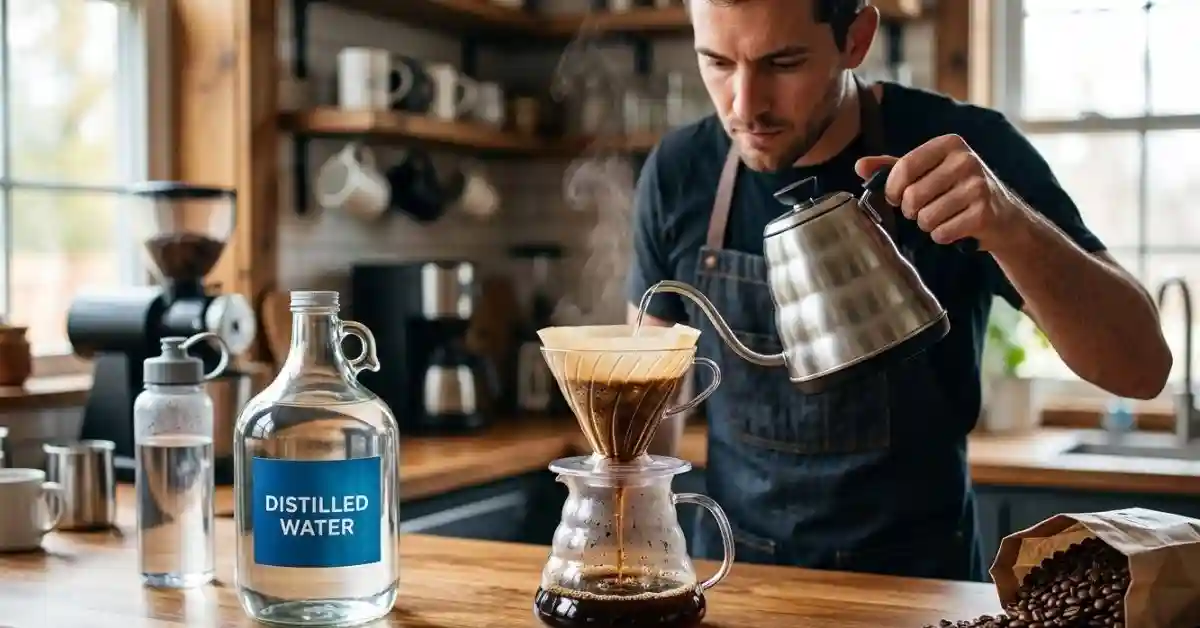
Yes, you can use distilled water to make coffee. Your coffee maker will heat it, run it through the grounds, and brew your cup just fine. The bigger question is whether you should use distilled water every day.
I looked into this because water is easy to overlook when coffee tastes flat, sharp, or just “off.” We often blame the beans or the machine first. But water makes up most of the drink. I learned that distilled water can change both the taste of coffee and the way some coffee makers work.
Can You Use Distilled Water to Make Coffee?
You can use distilled water in a coffee maker. It is clean and free from most minerals that are found in normal drinking water.
The catch is that those minerals can help coffee taste better. Coffee needs some minerals in the water to pull flavor from the grounds. With almost no minerals, distilled water may make a cup taste weak, dull, or flat.
| Water type | Coffee result | Daily use |
| Distilled water | Often flat or dull | Not my first pick |
| Filtered water | Clean and balanced | Great choice |
| Mineral water | Full and rich | Good if not too hard |
This does not mean distilled water is bad for coffee. It simply means it is not the best match for most coffee recipes.
I would treat distilled water as a useful option when your tap water has a strong taste or very high mineral content. For daily brewing, I would usually choose good filtered water instead.
Why distilled water tastes different in coffee
Distillation removes minerals from water. That includes minerals such as calcium and magnesium.
These minerals play a role in coffee extraction. Without them, the water may not pull the same mix of flavor from the coffee grounds.
That can leave you with a cup that tastes thin or lacks depth. The coffee may still smell good, but the flavor can feel empty.
Why Water Matters So Much in Coffee
It is easy to think coffee is just beans plus water. In practice, the water has a big effect on the final cup.
When hot water meets coffee grounds, it pulls many compounds from the beans. The water’s mineral content can affect how well this happens.
| Water factor | What it can change |
| Mineral level | Coffee extraction |
| Water taste | Final cup flavor |
| Hardness | Balance and mouthfeel |
This is one reason the same coffee can taste different in two homes.
Your beans may be the same. Your coffee maker may be the same. Yet your cup can still taste very different because the water changed.
I think this is one of the most useful things to understand if you are trying to improve home coffee. Before buying a new machine, it can make sense to check the water you already use.
Does distilled water extract coffee well?
Distilled water can extract coffee, but it has very few minerals to help with that process.
This does not mean it extracts nothing. You will still get coffee. The issue is more about balance and flavor.
| What you notice | Possible reason |
| Flat taste | Very low mineral content |
| Weak body | Poor extraction balance |
| Sharp taste | Uneven extraction |
If you brew with distilled water and like the result, there is no need to panic. Taste is personal. But if your coffee seems dull, the water may be part of the problem.
Is Distilled Water Better for Your Coffee Maker?
This is where things get a bit more interesting.
At first, distilled water sounds perfect for a coffee machine. It has very little mineral content, so it leaves far less mineral scale behind.
That can be helpful in areas with hard water. Hard water can cause scale to build up inside a coffee maker over time.
| Water choice | Scale risk | Coffee flavor |
| Distilled | Very low | Often flat |
| Filtered | Low to medium | Usually balanced |
| Hard tap water | High | Can vary |
But less scale does not automatically mean better coffee.
Some coffee machines may also use water sensors. Certain machines can have trouble sensing very low-mineral water. This is not true for every machine, so the owner’s manual matters.
If your coffee maker says not to use distilled water, follow the maker’s instructions.
Can distilled water damage a coffee maker?
Distilled water does not normally “damage” a coffee maker simply because it has no minerals. But some machines may not be designed to work with water that has extremely low mineral content.
The bigger issue is often machine performance, not damage.
If you use distilled water in a coffee maker with a water sensor, check the manual first. It may give a specific recommendation about filtered, bottled, or mineral-containing water.
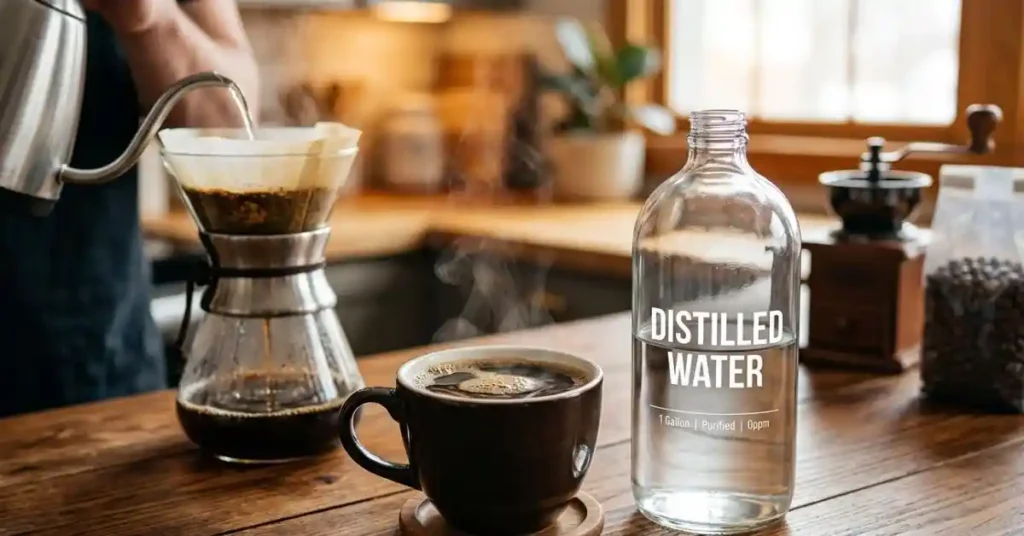
Distilled Water vs Filtered Water for Coffee
For most home coffee drinkers, filtered water is the safer middle ground.
It can reduce bad smells, chlorine, and some unwanted tastes. At the same time, it usually keeps enough minerals for good coffee extraction.
| Comparison | Distilled water | Filtered water |
| Mineral content | Very low | Some remains |
| Taste in coffee | Can seem flat | Often more balanced |
| Scale control | Excellent | Good |
| Best use | Special cases | Daily brewing |
This is why I would not jump straight from tap water to distilled water.
If your tap water tastes bad, try filtered water first. A simple water filter can solve the taste issue without removing nearly every mineral.
What if my tap water is very hard?
Very hard water can create a different problem.
It may contain a lot of calcium and magnesium. These minerals can help extraction, but too much can make coffee taste harsh or create scale inside the machine.
In that case, filtered water may be a better choice than either untreated tap water or fully distilled water.
You can also mix distilled water with mineral-containing water. This gives you more control over the mineral level.
Can You Mix Distilled Water With Regular Water?
Yes. Mixing distilled water with regular or mineral-containing water can be a useful way to reduce mineral content without removing it all.
This can help if your tap water is very hard but you do not want to brew with fully distilled water.
| Goal | Simple approach |
| Reduce hard-water minerals | Mix distilled with filtered water |
| Keep more flavor | Use mostly filtered water |
| Avoid scale | Use softer water |
The exact mix depends on your starting water. Tap water can vary a lot from one area to another.
I would not assume one mix works for every home. If you know your water hardness, you can make a more informed choice.
Does Distilled Water Make Coffee Taste Better?
Usually, no. But there are exceptions.
If your tap water has a strong chlorine taste, bad odor, or very high mineral content, switching away from tap water can make a big improvement.
The important point is that distilled water is not the only way to fix poor water.
A good filter may remove the unwanted taste while leaving enough minerals for better extraction.
| Coffee problem | Water change to try |
| Chlorine taste | Filtered water |
| Heavy scale | Soft or filtered water |
| Flat coffee | Try mineral-containing water |
| Harsh coffee | Try softer filtered water |
If distilled water makes your coffee taste worse, that does not mean your coffee beans are bad. The water may simply be too low in minerals for the brew you are making.
When Does Distilled Water Make Sense?
There are times when distilled water can be useful.
For example, if your local tap water is very hard, distilled water can reduce the mineral load. It can also be handy if you want to build your own water recipe for coffee.
Some coffee fans use distilled water as a base and then add minerals made for brewing. This gives them much more control over the final water.
That is more advanced than most people need, though.
| Situation | Is distilled water useful? |
| Very hard tap water | Yes, with care |
| Bad tap water taste | Sometimes |
| Everyday simple brewing | Usually not ideal |
| Custom coffee water | Very useful |
For a normal home setup, I would keep things simple. Good filtered water is often enough.
Common Mistakes I Would Avoid With Distilled Water
The biggest mistake is thinking that “pure” water must make better coffee.
It sounds logical. Less stuff in the water should mean a cleaner cup, right?
Coffee does not quite work that way.
Water needs some minerals for good extraction. Removing almost all of them can change the balance of the brew.
Mistake: Using distilled water to fix every coffee problem
If your coffee tastes bad, water may be the cause. But it may also be your grind size, coffee dose, brew time, or bean freshness.
| Mistake | Better approach |
| Blame water alone | Check the whole brew |
| Use only distilled water | Try filtered water |
| Ignore machine instructions | Read the manual |
I learned that changing one thing at a time is much more useful. If you change your beans, grind, water, and coffee ratio all at once, you will not know what fixed the problem.
Mistake: Ignoring the taste of your own tap water
This is simple but often missed.
Taste your tap water by itself. If you do not like the water, there is a good chance you will notice that taste in your coffee too.
A filter may be all you need.
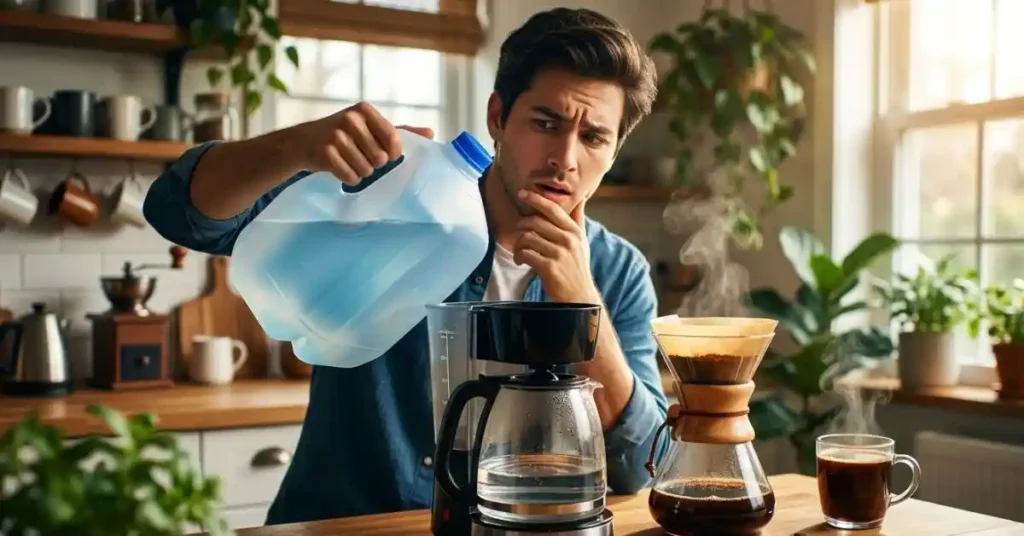
What Water Should You Use for the Best Coffee?
For most people, I would start with fresh, clean, filtered water.
You do not need fancy bottled water. You do not need a complex mineral recipe. And you do not need distilled water just because it sounds pure.
A good starting point is water that tastes clean and has a moderate mineral level.
| Coffee setup | Water I would choose |
| Basic drip machine | Filtered water |
| Pour-over | Filtered water |
| Espresso machine | Filtered, suitable water |
| Very hard-water home | Filtered or softened water |
If your coffee still tastes wrong, then look at your grind and brew method.
What About Bottled Water?
Bottled water can work well, but not all bottled water is the same.
Some brands contain very little mineral content. Others contain quite a lot. The label can give you clues about the mineral content.
Very high-mineral water is not always a great choice for coffee makers. It can add more scale and may affect taste.
If you use bottled water often, choose one that tastes clean and has moderate mineral content.
Can You Use Distilled Water in an Espresso Machine?
You can, but I would be more careful with an espresso machine.
Espresso machines are sensitive to water quality. Mineral buildup can cause trouble, but extremely low-mineral water may also be a poor fit for some machines.
Check the machine’s water requirements before using distilled water.
For espresso, water is also part of the recipe. A small change in water can affect extraction, crema, body, and taste.
If you are serious about espresso, using water made for coffee brewing can make more sense than using plain distilled water.
My Simple Water Test for Better Coffee
If your coffee tastes wrong, you can do a very simple test.
Brew the same coffee twice. Keep the grind, dose, and brew time the same. Change only the water.
Try your normal tap water first. Then try filtered water.
| Test | Keep the same | Change |
| Cup 1 | Beans, grind, dose | Tap water |
| Cup 2 | Beans, grind, dose | Filtered water |
Taste both while they are warm.
This kind of test is far more useful than guessing. You may find that water makes a bigger difference than you expected.
If you want to test distilled water too, make a third cup. Just remember that a different taste does not mean the distilled cup is automatically better.
Final Thoughts on Using Distilled Water for Coffee
So, can you use distilled water to make coffee? Yes. But I would not make it my first choice for everyday brewing. Distilled water has almost no minerals, and that can leave coffee tasting flat or weak.
For most people, clean filtered water is the better starting point. It can reduce bad tastes and limit scale while keeping some minerals for coffee extraction.
My biggest lesson is simple: do not focus only on the beans or coffee maker. Water is a major part of the cup. If your coffee tastes off, test the water before you spend money on new gear.
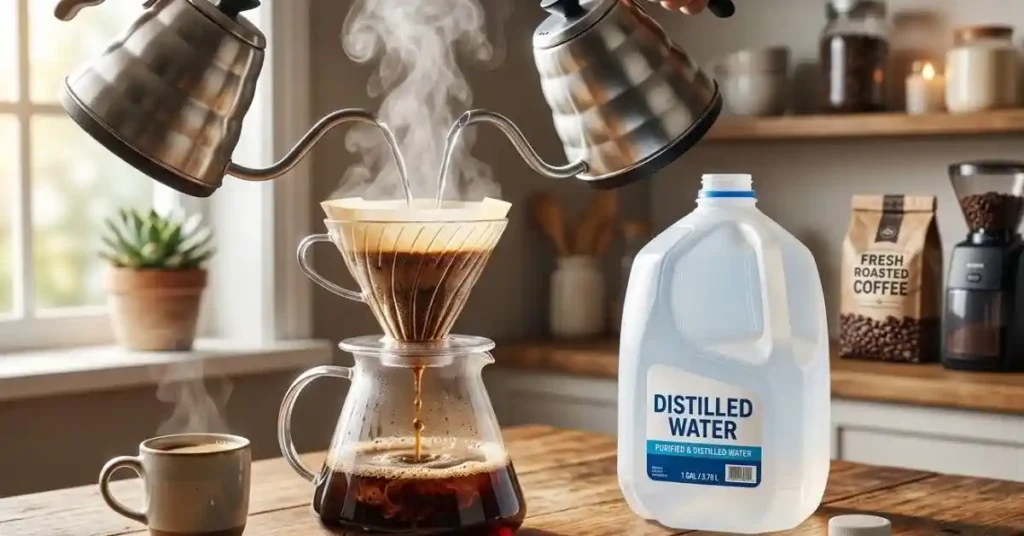
FAQ
1. Can you use distilled water to make coffee?
Yes, you can use distilled water to make coffee. But it has few minerals, so your coffee may taste flat or weak. Filtered water is often a better pick.
2. Is distilled water good for coffee makers?
Distilled water can cut down scale in a coffee maker. Still, some machines need minerals in the water. Check your coffee maker guide before you use it.
3. Does distilled water make coffee taste better?
Not in most cases. Distilled water may make coffee taste dull due to its low mineral level. Clean, fresh filtered water often gives a more full taste.
4. Is filtered water better than distilled water for coffee?
For most coffee fans, yes. Filtered water can cut bad tastes while keeping some key minerals. This can help give your coffee a more rich and full taste.
5. Can distilled water help with hard water and coffee?
Yes, distilled water has very few minerals, so it can help cut scale from hard water. But you may need to add some minerals for a good brew.
To Get More About Home, Home and Kitchen Product You Can Visit Our Site. If You Found our Posts Helpful Leave a Comment Below