
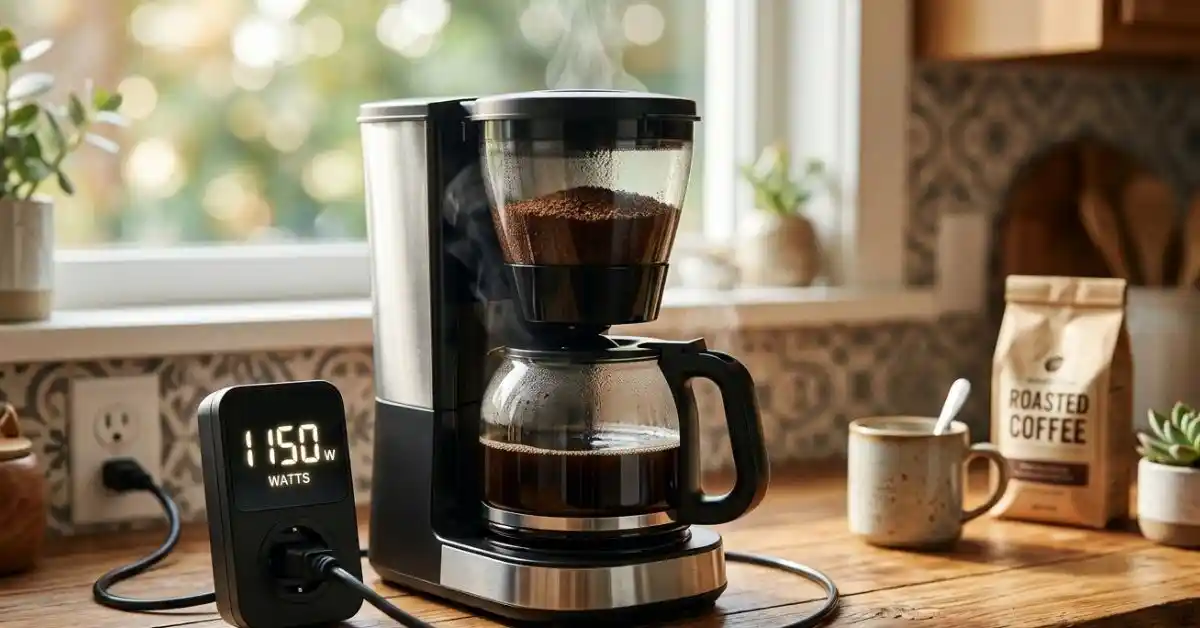
If you have ever looked at your electric bill and wondered, how many watts does a coffee maker use?, you are not alone. I used to think a coffee maker was such a small appliance that its power use did not matter. Then I started looking at the numbers more closely. The answer can vary a lot by the type and size of the coffee maker.
Most home coffee makers use about 600 to 1,500 watts while heating water. A small drip coffee maker may use less, while an espresso machine or high-power brewer can use much more. The good news is that a coffee maker usually runs for a short time, so its total energy use is often lower than the watt number first suggests.
How Many Watts Does a Coffee Maker Use?
The simple answer is that most standard coffee makers use around 600 to 1,200 watts, while larger models may use up to about 1,500 watts. Single-serve machines, drip brewers, and espresso machines can all have different power needs.
When I first checked coffee maker wattage, I made the same mistake many people make. I saw a 1,000-watt rating and assumed the machine used 1,000 watts every time I made coffee. That is not quite how it works.
Watts show the rate at which the machine uses power. Your energy bill is based on kilowatt-hours (kWh), which also takes time into account.
| Coffee maker type | Typical watt range |
| Small drip coffee maker | 600–900 watts |
| Standard drip coffee maker | 900–1,200 watts |
| Single-serve coffee maker | 1,000–1,500 watts |
| Espresso machine | 1,000–1,800+ watts |
These are common ranges, not fixed rules. The best way to know your exact coffee maker wattage is to check its label, manual, or product specifications.
Why Coffee Makers Need So Much Power
The main reason is simple: heating water takes energy.
A coffee maker has to heat cold water to a hot brewing temperature. The heating element does most of the work. This is why the machine may draw close to its rated wattage during the heating stage.
Once the water is hot, some machines use less power. A drip coffee maker with a warming plate may keep drawing power after brewing has finished.
| Coffee maker part | Main job | Power use |
| Heating element | Heats water | High |
| Pump | Moves water | Moderate |
| Warming plate | Keeps coffee warm | Lower |
| Display or timer | Controls the machine | Very low |
This helped me understand why the first few minutes of brewing can be the biggest part of the energy use.
How Much Electricity Does a Coffee Maker Use Per Hour?
A 1,000-watt coffee maker uses 1 kilowatt of power when running at full rated power. If it ran for one full hour at that rate, it would use 1 kWh of electricity.
But most people do not run a coffee maker for an hour.
For example, if a 1,000-watt machine runs for 10 minutes, its energy use is about 0.167 kWh.
Here is a simple way to see it:
| Rated power | Running time | Approx. energy used |
| 600 watts | 10 minutes | 0.10 kWh |
| 1,000 watts | 10 minutes | 0.17 kWh |
| 1,200 watts | 10 minutes | 0.20 kWh |
This is one of the most useful things I learned when comparing coffee maker power use. High wattage does not always mean high daily energy use. Run time matters just as much.
The Easy Watt-to-kWh Formula
You do not need to be good at math to work this out.
Use this basic formula:
Watts ÷ 1,000 × hours used = kWh
So, a 1,000-watt coffee maker used for 10 minutes would be:
1,000 ÷ 1,000 × 0.167 = 0.167 kWh
That gives you a rough idea of the energy used during one brewing session.
Does a 1,000-Watt Coffee Maker Use a Lot of Electricity?
Not usually, especially if you only brew one or two pots a day.
A 1,000-watt coffee maker sounds powerful when you see the number on the box. Yet it may only run for a short time. The bigger issue can be what happens after the coffee is brewed.
If the warming plate stays on for hours, it keeps using electricity. The power draw may be much lower than the heating element, but the long run time can add up.
| Usage habit | Likely effect |
| Brew once and turn it off | Lower energy use |
| Leave warming plate on for hours | Higher energy use |
| Use auto shut-off | Helps limit wasted power |
I learned this the hard way with appliances that I left on simply because I was going to use them again later. That habit is easy to overlook.
How Many Watts Does a Drip Coffee Maker Use?
A typical drip coffee maker often uses 900 to 1,200 watts while brewing. Small models may use less, while large machines with extra features can use more.
Drip coffee makers are fairly simple. Water moves through a heating system, gets hot, and passes through the coffee grounds.
The wattage depends on several things:
- Size of the machine
- Heating speed
- Number of cups
- Heating element design
- Extra features
- Brand and model
A larger coffee maker does not always use dramatically more power. However, it may need more time or energy to heat a larger amount of water.
What About the Warming Plate?
The warming plate is easy to forget.
After brewing, many drip coffee makers keep the carafe warm. The plate needs electricity to stay hot. If you leave it on for several hours each morning, that extra use can matter more than you might expect.
A simple habit is to turn the machine off once you have poured your coffee.
How Many Watts Does a Single-Serve Coffee Maker Use?
Many single-serve coffee makers use roughly 1,000 to 1,500 watts during active heating. Some models can use more or less.
That higher watt number does not mean every cup costs a lot to make. Single-serve machines often heat a small amount of water and run for only a few minutes.
This is where wattage can be misleading.
A 1,500-watt machine running for three minutes may use less total energy than a lower-watt machine that stays on for a much longer time.
| Machine | Example use | Energy idea |
| 1,000 W drip maker | 10 minutes | About 0.17 kWh |
| 1,500 W single-serve | 3 minutes | About 0.08 kWh |
| 900 W brewer | 20 minutes | About 0.30 kWh |
These are examples, not exact measurements for every machine.
How Many Watts Does an Espresso Machine Use?
Espresso machines can use 1,000 to 1,800 watts or more, depending on the model and heating system. Some larger machines can have even higher power ratings.
Espresso machines need heat for brewing. Some also need heat and pressure for steam. Machines with larger boilers or more advanced systems may use more power.
I would not judge an espresso machine by watts alone. If you are comparing machines, also look at how long they take to heat, whether they have a standby mode, and how long they stay hot.
| Espresso machine feature | Why it matters |
| Large boiler | Can need more energy to heat |
| Steam system | Adds heat demand |
| Fast heat-up | Can reduce active heating time |
| Standby mode | May lower idle power use |
How Much Does It Cost to Run a Coffee Maker?
The cost depends on your electricity rate, the coffee maker’s wattage, and how long you use it.
You can estimate the cost with this formula:
Energy used in kWh × your electricity price = running cost
For example, if a coffee maker uses 0.17 kWh for one brewing session, you would multiply 0.17 by your local electricity rate.
Here is a simple example using a made-up rate:
| Energy used | Example rate | Cost |
| 0.10 kWh | $0.15/kWh | $0.015 |
| 0.17 kWh | $0.15/kWh | $0.026 |
| 0.30 kWh | $0.15/kWh | $0.045 |
Your real cost will depend on your power rate. If you live in a place with a higher electricity price, the same coffee maker will cost more to run.
The important point is that one cup of brewed coffee usually does not require a huge amount of electricity. Daily habits matter more when the machine runs for long periods.
What Uses More Electricity: Coffee Maker or Kettle?
This is not as simple as looking at wattage.
An electric kettle can have a high watt rating, often around 1,500 watts or more. A coffee maker may have a lower rating. Yet the kettle may run for only a few minutes.
The coffee maker may take longer because it heats water more slowly and performs the full brewing process.
| Appliance | Common power range | Main energy factor |
| Coffee maker | 600–1,500 W | Brew time |
| Electric kettle | 1,000–3,000 W | Heat time |
| Espresso machine | 1,000–1,800+ W | Heat and steam |
So, a higher watt rating does not automatically mean higher energy use.
Common Coffee Maker Wattage Mistakes I Used to Make
Understanding watts is easy once you avoid a few common mistakes. I used to focus almost entirely on the number printed on the appliance.
That is not enough.
Mistake 1: Treating Watts as Energy Cost
Watts measure power. They do not tell you the full cost of running the machine.
Time matters too.
Mistake 2: Ignoring the Warming Plate
A coffee maker that brews for 10 minutes and stays warm for three hours has a very different energy pattern from one that shuts off right away.
Mistake 3: Assuming Bigger Means Much More Expensive
A large coffee maker may have a higher watt rating, but that does not mean the cost will be huge. The actual run time still matters.
Mistake 4: Forgetting Standby Power
Some modern machines have clocks, displays, timers, or smart features. These may use a small amount of power while plugged in.
| Mistake | Better approach |
| Only check watts | Check watts and run time |
| Leave coffee hot all morning | Turn it off when done |
| Guess the power use | Check the model label |
| Ignore standby use | Unplug if needed |
How Can I Reduce Coffee Maker Electricity Use?
You do not need to stop drinking coffee to save power. A few small changes can help.
First, avoid making more coffee than you need. Heating extra water takes extra energy.
Second, use the auto shut-off feature if your machine has one. This is one of the easiest habits to build.
Third, do not keep the warming plate on for hours. If you need coffee later, a good insulated carafe can keep it warm without constant heating.
You can also:
- Measure the water you actually need.
- Turn the machine off after brewing.
- Avoid repeated small brewing cycles when one larger batch works.
- Unplug the machine if you do not use it often.
- Keep the machine clean so it can work as designed.
None of these steps will transform your electric bill overnight. But they can reduce waste without making coffee less convenient.
Can a Coffee Maker Run on a Portable Power Station?
Yes, but you need to check the power station’s continuous output rating.
A 1,000-watt coffee maker may need close to 1,000 watts while heating. A small power station may not be able to supply that much power.
You also need to consider battery capacity. A power station rated in watt-hours (Wh) tells you how much energy it can store, while watts tell you how much power it can provide at a given time.
| Power station detail | What it tells you |
| Output watts | What it can run at once |
| Battery watt-hours | How much energy it stores |
| Surge rating | Short-term extra power |
This distinction is important for camping, backup power, RV use, and outages.
What Wattage Should I Look for in a Coffee Maker?
There is no single best wattage for everyone.
If you want a simple drip machine, a model around 600 to 1,200 watts is common. If you want fast heating or more advanced brewing, you may see higher watt ratings.
I would not choose a coffee maker based on wattage alone. Look at how much coffee you make, how fast you want it, whether it has auto shut-off, and whether it keeps coffee warm.
For someone who only wants a morning cup, a lower-power machine may be more than enough.
Final Thoughts
So, how many watts does a coffee maker use? Most home coffee makers use about 600 to 1,500 watts while actively heating and brewing. Espresso machines and larger models can use more.
The bigger lesson is that watts are only part of the story. A high-watt coffee maker used for a few minutes may use less energy than a lower-watt machine that stays hot for hours. Once I started looking at both wattage and run time, coffee maker energy use made much more sense.
If you want to know the exact power use of your machine, check its label or manual and note the watt rating. Then look at how long you use it each day. That gives you a much better picture than the watt number alone.
FAQs
1. How many watts does a coffee maker use?
Most coffee makers use 600 to 1,500 watts while brewing. Small drip models may use less, while large or fast machines may use more power.
2. Does a 1,000-watt coffee maker use a lot of electricity?
A 1,000-watt coffee maker is not usually costly to run. It uses power for a short time, so daily energy use can stay fairly low.
3. How many watts does a drip coffee maker use?
Most drip coffee makers use about 900 to 1,200 watts while brewing. Check the label or manual to find the exact wattage of your model.
4. How much electricity does a coffee maker use per hour?
A 1,000-watt coffee maker can use about 1 kWh in one hour at full power. Most coffee makers run far less than one hour per day.
5. How can I reduce coffee maker power use?
Turn the coffee maker off after brewing and avoid long warming times. Using auto shut-off can also help cut wasted power over time.
To Get More About Home, Home and Kitchen Product You Can Visit Our Site. If You Found our Posts Helpful Leave a Comment Below