
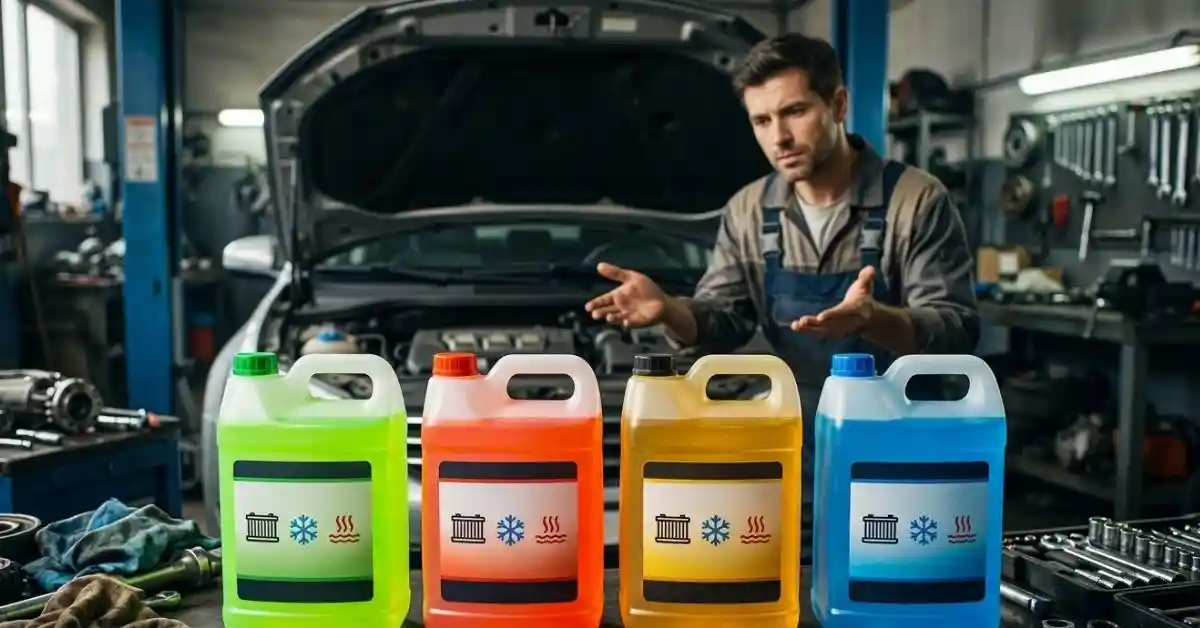
When I first started learning about engine coolant, I thought the main difference was color. Green meant one thing, orange meant another, and that seemed simple enough. It turns out coolant is a lot more specific than that.
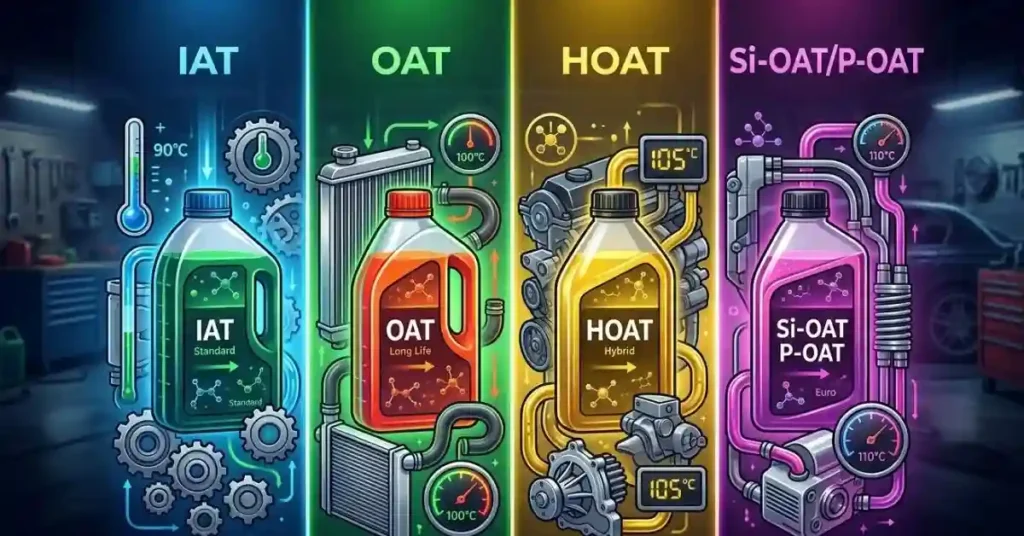
So, what are the 4 types of coolant? The four types often discussed are IAT, OAT, HOAT, and P-OAT. These names describe the way the coolant protects the metal parts inside an engine from corrosion. The important part is that these types are not always interchangeable.
I have found that the easiest way to understand coolant is to ignore the color at first. Instead, look at the coolant technology, the vehicle maker’s specification, and the owner’s manual. That simple habit can prevent a very expensive mistake.
What Are the 4 Types of Coolant?
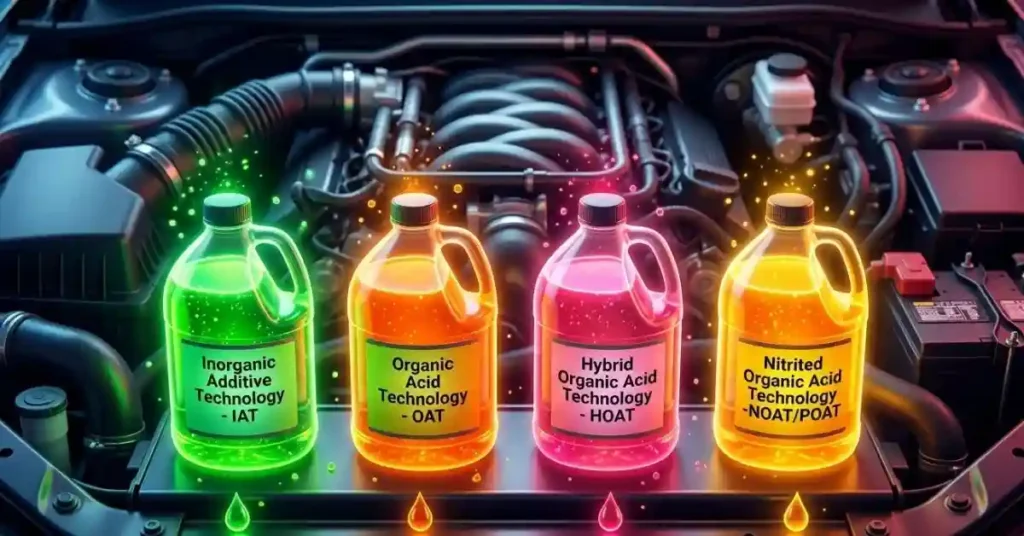
The four common coolant categories are IAT, OAT, HOAT, and P-OAT. They use different additive packages to protect the cooling system.
One thing worth noting is that there is no single worldwide list that every manufacturer uses. Some sources group P-OAT and Si-OAT under the wider HOAT family. So, when someone asks about the “four types,” they are usually using a more detailed breakdown of modern coolant chemistry.
| Coolant type | Full name | Common use |
| IAT | Inorganic Additive Technology | Older vehicles |
| OAT | Organic Acid Technology | Many modern vehicles |
| HOAT | Hybrid Organic Acid Technology | Many mixed-metal systems |
| P-OAT | Phosphate Organic Acid Technology | Many Asian vehicles |
The key point is simple: do not choose coolant just by its color. Color is a dye, not a reliable technical standard.
Why Are There Different Coolant Types?
Modern engines use many different metals and alloys. Aluminum is common, while older systems may have more iron, copper, brass, or other materials.
The coolant must protect these parts from corrosion while also handling high heat. That is why manufacturers developed different inhibitor packages.
| Cooling system need | Why it matters |
| Corrosion control | Protects metal parts |
| Heat control | Helps prevent overheating |
| Long service life | Reduces frequent coolant changes |
This is also why two coolants that look almost identical may not be suitable for the same vehicle.
1. IAT Coolant: The Traditional Choice
IAT stands for Inorganic Additive Technology. It is the traditional coolant chemistry that many people remember as the old-style green coolant.
IAT uses inorganic corrosion inhibitors such as silicates and phosphates. These additives provide strong, fast protection, but they can wear out sooner than the inhibitors used in many newer formulas.
Where Is IAT Coolant Used?
IAT is most closely linked with older vehicles. If you have an older car with an older cooling system, IAT may still be exactly what the manufacturer calls for.
The mistake I often see people make is assuming that newer must always mean better. That is not true with coolant. The correct fluid for an older engine may be an older technology.
| IAT advantage | IAT drawback |
| Strong initial protection | Shorter service life |
| Good for many older systems | Additives deplete faster |
| Often easy to find | Not ideal for every modern engine |
IAT coolant may need more frequent replacement than many long-life coolants. Your vehicle’s service schedule should always take priority over a general mileage or time estimate.
2. OAT Coolant: The Long-Life Option
OAT means Organic Acid Technology. It uses organic acid corrosion inhibitors rather than relying mainly on the traditional inorganic inhibitor package.
OAT became popular because it can offer a much longer service life than traditional IAT coolant. Many modern vehicles use OAT-based formulas.
Why Do Modern Cars Use OAT?
Modern engines often have a lot of aluminum. They also run complex cooling systems with tight passages and different metals.
OAT coolant is designed to protect these systems while keeping the inhibitor package stable for a longer period.
One thing I learned is that “long life” does not mean “never change it.” The coolant can still become contaminated, lose protection, or be affected by leaks and other cooling-system problems.
| OAT feature | What it means |
| Organic inhibitors | Different corrosion protection |
| Long-life design | Longer service intervals |
| Modern applications | Common in newer vehicles |
OAT is also associated with products such as Dex-Cool-type coolant, but you should still check the exact vehicle specification before using one.
3. HOAT Coolant: A Hybrid Approach
HOAT stands for Hybrid Organic Acid Technology. As the name suggests, it combines organic inhibitors with selected inorganic inhibitors.
I find HOAT easier to understand if you think of it as a middle ground. It keeps the long-life idea of OAT while adding other inhibitors that can give specific metals extra protection.
NAPA also describes HOAT as a combination of OAT and IAT-style protection.
Why Is HOAT Not Just One Coolant?
This is where coolant shopping gets confusing.
There are several HOAT formulas. Some use silicates. Others use phosphates. Some are designed for particular vehicle makers or regions.
So, seeing “HOAT” on a bottle is helpful, but it may not be enough to confirm that the product is right for your car.
| HOAT version | Main feature |
| Si-OAT | Uses silicate with organic inhibitors |
| P-HOAT | Uses phosphate with organic inhibitors |
| N-HOAT | Uses nitrite in some heavy-duty formulas |
These variations exist because different engines and cooling systems have different needs.
4. P-OAT Coolant: Popular in Asian Vehicles
P-OAT means Phosphate Organic Acid Technology. It is an organic-acid coolant that uses phosphate as part of its inhibitor system.
P-OAT is commonly associated with many Asian vehicle applications. Toyota, Honda, Nissan, Hyundai, Kia, and Mazda vehicles may use phosphate-containing coolant formulas, although the exact specification still varies by model and year.
Why Does P-OAT Use Phosphate?
Phosphate can provide useful corrosion protection, especially for certain metal combinations.
The important catch is water quality. Phosphate-containing coolants can react poorly with hard water and may contribute to deposits. That is one reason coolant makers stress using the correct water when a concentrate needs dilution.
| P-OAT point | Practical lesson |
| Phosphate based | Good protection for certain systems |
| Common in Asian vehicles | Check the maker’s specification |
| Water quality matters | Use the recommended water |
If your owner’s manual calls for a phosphate-based coolant, I would not replace it with a random “universal” product just because the bottle says it works in many cars.
Coolant Types Compared Side by Side
After looking at all four, the differences become much easier to see.
| Type | Main inhibitor idea | Typical application |
| IAT | Inorganic inhibitors | Older vehicles |
| OAT | Organic acid inhibitors | Many modern vehicles |
| HOAT | Organic + inorganic inhibitors | Various modern systems |
| P-OAT | Organic acids + phosphate | Many Asian applications |
This table is useful for learning the chemistry. It should not be used as a substitute for your vehicle’s coolant specification.
Does Coolant Color Tell You the Type?
This is probably the biggest coolant mistake I have come across.
Color does not reliably tell you what type of coolant you have. Green, orange, blue, pink, yellow, and purple can all be used for different coolant technologies. Manufacturers add dyes mainly to help identify fluids and leaks.
Why I Never Choose Coolant by Color
Imagine you open your hood and see pink coolant. It is tempting to buy another pink bottle.
That is not enough.
Another brand may use pink dye for a different formulation. Even two products with the same color may have different inhibitor packages.
| Common assumption | Better approach |
| “My coolant is green, so I need green.” | Check the specification |
| “Blue coolant works in every car.” | Check the owner’s manual |
| “The color matches, so it is safe.” | Confirm the chemistry and approval |
Color is a clue at best. It is not a specification.
Can You Mix the 4 Types of Coolant?
This is where I would be very careful.
Different coolant technologies may not work well together. Mixing the wrong formulas can reduce corrosion protection or create other cooling-system problems. NAPA specifically warns that the chemical composition matters more than color when deciding whether coolants can be mixed.
What Should You Do If You Have the Wrong Coolant?
If you are not sure what is already in the system, I would not start adding random coolant.
| Situation | Better action |
| Same approved coolant | Top up as directed |
| Unsure what is inside | Identify it first |
| Wrong coolant added | Ask a qualified technician |
| Major contamination | Consider a proper flush |
A small top-up is not the same as completely refilling an empty cooling system. If the coolant type is unknown, finding out first is usually the safer choice.
Common Coolant Mistakes I Would Avoid
Coolant problems often start with small assumptions. I have learned that the simple-looking jobs can cause the most trouble when people rush.
Mistake 1: Choosing by Color
This is the classic one.
The better approach is to check the owner’s manual, service information, or the coolant maker’s vehicle application guide.
Mistake 2: Assuming “Universal” Means Perfect
Some modern products are marketed as universal and are designed to work across many coolant technologies. For example, some products claim compatibility with IAT, OAT, HOAT, and POAT.
That can be useful, but I still prefer checking the vehicle requirement first.
| Mistake | Better habit |
| Match the color | Match the specification |
| Pick the cheapest bottle | Check the required chemistry |
| Trust the word “universal” | Read the product claims |
Mistake 3: Using Tap Water Without Checking
Concentrated coolant often needs to be mixed with water. The water quality matters because minerals can contribute to deposits and cooling-system problems.
If the coolant maker or vehicle maker specifies distilled or deionized water, follow that instruction.
Mistake 4: Ignoring the Coolant Level
A correct coolant type cannot protect an engine if the system is low.
A low level can point to a leak, a bad hose, a radiator issue, a water pump problem, or another fault.
How Do You Know Which Coolant Your Car Needs?
This is the part I would focus on most.
Start with the owner’s manual. Look for the coolant specification, not just a color name.
Then check the coolant bottle. Look for the vehicle specification, approval, or compatibility statement.
| Check first | Why |
| Owner’s manual | Gives the vehicle requirement |
| Coolant specification | Confirms the correct formula |
| Product label | Shows intended applications |
If the manual says a specific standard or manufacturer approval is required, that information matters more than whether the coolant is labeled IAT, OAT, or HOAT.
What If You Are Topping Off Coolant?
Topping off sounds easy, but it is worth slowing down for a minute.
First, let the engine cool. Never remove a pressurized radiator cap from a hot engine.
Then check the coolant level and identify the correct coolant before adding anything.
A Simple Top-Up Checklist
| Step | What I would do |
| 1 | Let the engine cool |
| 2 | Check the reservoir level |
| 3 | Confirm the coolant specification |
| 4 | Add the correct fluid |
| 5 | Look for leaks if the level keeps dropping |
If you keep needing to add coolant, that is not normal maintenance. It is a reason to look for the source of the loss.
What About Green, Orange, Blue, and Pink Coolant?
The color question deserves one last look because it causes so much confusion.
Green is often linked with traditional IAT coolant. Orange is commonly associated with OAT products. Blue and pink are used by various manufacturers for several different formulas. That means color can vary by brand and vehicle.
| Color | Can it identify the type? |
| Green | No |
| Orange | No |
| Blue | No |
| Pink | No |
The safest rule is simple: never use color as your only reason for choosing coolant.
My Biggest Lesson About the 4 Types of Coolant
The biggest thing I learned is that coolant is not just colored liquid that keeps an engine cool. Its additives protect the radiator, engine passages, water pump, and other metal parts from corrosion.
IAT, OAT, HOAT, and P-OAT describe different approaches to that protection. But the “best” type is not the same for every car.
Your vehicle’s required specification should win every time. If the manual calls for a particular coolant, that is the one I would use rather than guessing from color or a generic label.
Final Thoughts
So, what are the 4 types of coolant? A common four-part breakdown is IAT, OAT, HOAT, and P-OAT. Each uses a different corrosion-inhibitor system, and each can suit different engines and cooling systems.
The practical lesson is even more important than memorizing the names: check the vehicle specification, not just the color. That one habit can help you avoid poor coolant choices, unnecessary flushing, and cooling-system trouble.
FAQs
1. What are the 4 types of coolant?
The four common coolant types are IAT, OAT, HOAT, and P-OAT. Each uses a different mix of additives to protect engine parts from rust and wear.
2. What is the difference between IAT and OAT coolant?
IAT coolant is common in older cars, while OAT coolant is used in many newer cars. OAT also tends to last longer than IAT coolant.
3. Is HOAT coolant better than OAT coolant?
Not always. HOAT coolant suits some engines, while OAT suits others. The best choice is the coolant type listed in your car’s manual.
4. Can I mix different types of coolant?
It is best not to mix coolant types unless the product says they are safe to mix. Check the car manual and coolant label before adding a new type.
5. Does coolant color tell you its type?
No. Coolant color does not reliably show its type. Green, blue, pink, and orange coolants can have different formulas, so check the coolant spec.
To Get More About Home, Home and Kitchen Product You Can Visit Our Site. If You Found our Posts Helpful Leave a Comment Below