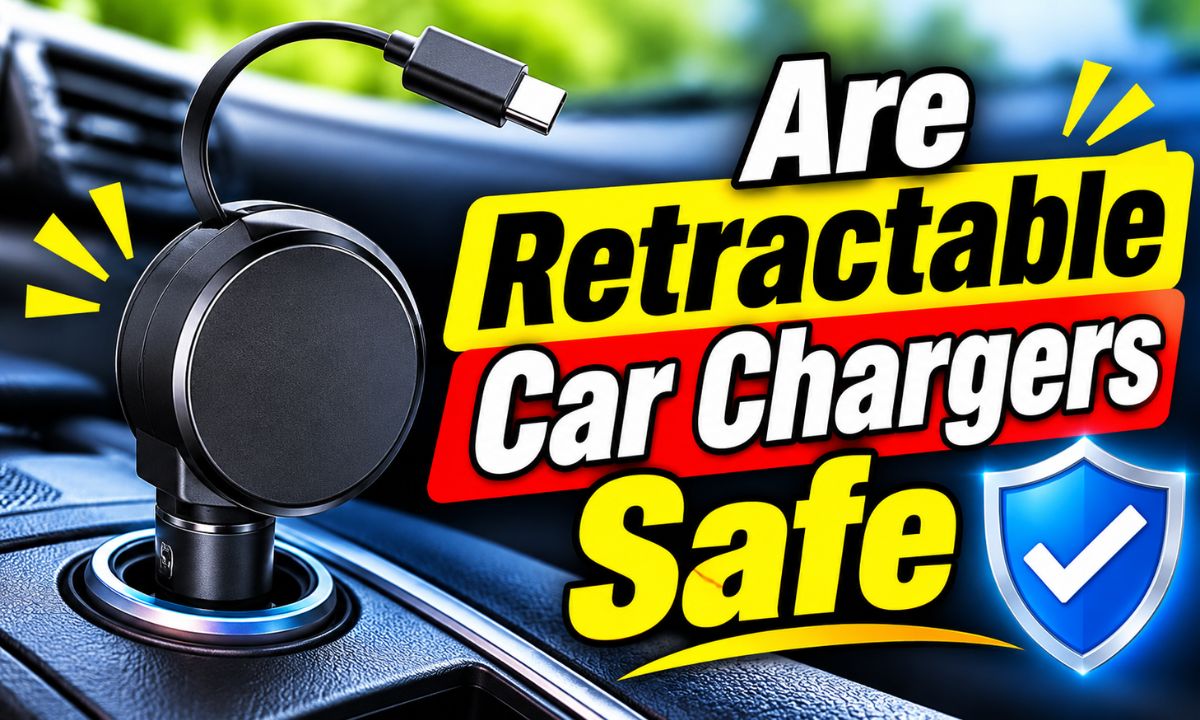
Yes, retractable car chargers are generally safe when they are well-made, undamaged, compatible with your devices, and used correctly.
If you drive in the United States, you may use your car’s 12-volt power outlet to charge a phone during a daily commute, road trip, or long drive. A retractable car charger can make this easier because its cable pulls out when needed and winds back into its case when you finish.
Still, a charger that looks neat and simple is an electrical device. A poor-quality model, worn cable, loose connector, or faulty power circuit can cause problems. Heat, slow charging, damaged phone ports, and electrical faults are all worth watching for.
The good news is that you do not need special tools to use one safely. You need a reliable charger, the right charging cable, a suitable power rating, and a few simple habits. You should also make sure the cable does not get in the way of your driving.
A retractable car charger is a phone charger designed for use in a vehicle. It usually plugs into a 12-volt accessory outlet or another compatible vehicle power connection. Instead of using a separate loose cable, it has a cable built into its body.
You pull the cable out when you want to charge your phone. After charging, you release or guide the cable back into its housing. A spring-loaded reel or similar winding system stores the extra cable inside.
Many models have USB-C or Lightning connectors. Some include more than one built-in cable, while others offer extra USB-A or USB-C ports for another device.
Built-in cable
The cable stays attached to the charger, which reduces loose wires in your vehicle.
Retracting mechanism
A small internal system winds the cable back into its housing after use.
Vehicle power connection
Most models use a compatible 12-volt or 24-volt vehicle accessory outlet.
Charging electronics
Internal circuits manage the power supplied to connected devices. Their quality matters for safe operation.
How Does the Retractable Mechanism Work?
The retractable cable sits on a small reel inside the charger. When you pull the cable, the reel turns and stores tension in a spring or another winding system. When you release the cable according to the manufacturer’s instructions, the mechanism pulls it back inside.
This design helps prevent cables from hanging around the dashboard or center console. However, the reel also adds moving parts that can wear out after repeated use.
If the cable sticks, retracts unevenly, or needs extra force, the mechanism may be damaged. Do not keep pulling it hard because this can put stress on the cable and its internal connections.
Smooth movement
A healthy mechanism should extend and retract without unusual resistance, grinding, or sudden jerks.
Proper cable tension
The cable should stay at its intended length without pulling against the phone or connector.
What Makes a Retractable Car Charger Safe?
A retractable car charger is safe because of its electrical design and build quality, not simply because its cable can disappear into a case. The most important parts are the power circuit, cable, connectors, insulation, and protective features.
A reliable charger should be designed for the electrical input of your vehicle. It should also supply power within the limits supported by the connected phone and cable.
The USB Implementers Forum explains that USB cables have different capabilities and that certification programs cover specific cable requirements. A cable’s appearance alone does not prove that it supports a particular charging speed or power level.
Overcurrent protection
This feature helps limit excessive current that could damage the charger or connected device.
Overvoltage protection
It helps protect connected electronics from voltage that exceeds the intended operating range.
Overtemperature protection
A suitable design may reduce or stop power when internal temperatures become too high.
Short-circuit protection
This helps prevent an electrical fault from causing an uncontrolled flow of current.
Quality insulation
Proper insulation helps prevent exposed conductors and unwanted electrical contact.
Why Electrical Protection Matters
Your car’s electrical system supplies power to the charger. The charger then converts and regulates that power for a phone or another compatible device.
If the internal electronics are poorly designed, a fault can cause excess heat, unstable output, or damage. Protective circuits help reduce these risks, but they cannot make a defective product safe.
Do not assume that every inexpensive charger includes all useful protections. Check the manufacturer’s technical information and product documentation before buying.
Check the specifications
Look for clear input voltage, output voltage, current, and supported charging standards.
Check product support
A real manufacturer should provide a model number, contact details, and useful product instructions.
What Are the Main Risks of Retractable Car Chargers?
The biggest risks come from poor construction, damaged parts, and incorrect use. The retractable design does not automatically make a charger dangerous, but it introduces a cable reel that needs proper care.
A charger can also be unsafe even when its cable looks fine. Problems inside the power adapter may not be visible from the outside.
Understanding the common warning signs makes it easier to decide when to stop using a charger.
Overheating
Poor internal components, excessive load, damaged connections, or inadequate heat control can cause unusual heat.
Cable wear
Repeated pulling, sharp bends, twisting, and rough retraction can damage the wires inside the cable.
Electrical faults
Defective circuits or poor insulation can create short-circuit, burn, or fire risks.
Loose connections
A poorly fitted plug or damaged connector can interrupt charging and create unwanted heat.
Driving distractions
A cable that hangs near the driver can interfere with movement or draw attention away from the road.
1. Overheating During Charging
Some warmth during charging can occur. The charger and phone both use electronic circuits, and power conversion creates heat. However, a charger that becomes extremely hot, smells unusual, or changes color should not be treated as normal.
Heat may increase when you use a high-power charger, connect several devices, or leave the charger in a hot vehicle. Direct sunlight and poor airflow can make the problem worse.
If the charger becomes unusually hot, unplug it when safe to do so. Let it cool in a safe place and stop using it until the cause has been checked. Do not cover it or try to cool it with water.
Warning sign
The charger becomes too hot to handle comfortably, gives off a burning smell, or shows signs of melting.
What to do
Stop charging, disconnect the device when safe, and replace a faulty charger rather than attempting an internal repair.
2. Damage to the Internal Cable
A retractable cable moves more often than a cable that stays in one position. Each extension and retraction puts some mechanical stress on the cable and its connection points.
Pulling the cable at an angle can increase that stress. Letting it snap back quickly may also cause repeated impacts inside the housing.
A damaged cable may charge only when held at a certain angle. It may also disconnect randomly, become warm near a damaged section, or stop working.
Look for visible damage
Check for cuts, exposed wires, crushed sections, loose connectors, or damaged insulation.
Do not tape over serious damage
Electrical tape does not restore the cable’s original design or make damaged internal conductors safe.
3. Poor-Quality Electrical Components
A very cheap charger may look similar to a reputable model but use different internal components. Weak circuit protection, poor soldering, and low-quality materials can increase the chance of failure.
The US Consumer Product Safety Commission has published recalls involving USB charging products and automotive chargers. These records show that charging accessories can create overheating, fire, and electrical hazards when defective. They do not mean that every retractable charger has the same problem.
UL Solutions has also warned about USB chargers carrying counterfeit certification marks. A printed safety logo should not be accepted as proof unless the product and certification can be verified.
Avoid suspicious products
Be careful with chargers that have no clear manufacturer, model number, instructions, or credible product support.
Verify safety claims
Check whether a claimed certification applies to the exact product rather than trusting a logo on its packaging.
4. Cables That Interfere With Driving
A cable can be electrically safe and still create a road safety problem. If it stretches across the steering wheel, gear selector, pedals, or driver’s legs, it can interfere with normal vehicle operation.
A phone that falls while connected may pull the cable or distract the driver. Reaching down to retrieve it can take your attention away from traffic.
The National Highway Traffic Safety Administration warns against distracted driving. Set up your charger and phone before moving, and never adjust the cable while driving.
Keep the driver’s area clear
Route the cable along the center console or another safe path that does not cross controls.
Secure the phone
Use a suitable phone holder and keep the screen out of your hands while driving.
Are Retractable Car Chargers Safer Than Regular Car Chargers?
Neither design is automatically safer. A retractable charger offers better cable storage, while a regular charger often uses a separate cable that can be replaced more easily.
The actual safety difference depends on construction, electrical protection, cable quality, and how you use the product.
A high-quality retractable charger may be a sensible option for someone who wants a tidy vehicle. A well-made standard charger may be easier to maintain because a damaged cable can often be replaced without replacing the entire charger.
Retractable charger
Offers built-in cable storage and less loose wiring, but the cable and reel are additional parts that can wear.
Regular car charger
Uses a separate cable, which is easy to replace, but extra cable length may create clutter.
Both types
Need suitable electrical protection, compatible power ratings, good insulation, and careful use.
Which Type Should You Choose?
Choose a retractable model if cable storage is important and you can find a reliable product with clear specifications. It can be useful in a shared family vehicle or a car with limited storage space.
Choose a regular charger if you prefer a simple setup with a separate cable that you can replace when it wears out.
Do not choose a retractable model only because it looks modern. A simple, well-built charger is a better purchase than a complicated product with unclear safety information.
For daily commuters
A compact retractable charger can help keep the center console tidy.
For frequent travelers
A model with a durable cable and a suitable charging output can be useful on long road trips.
For simple maintenance
A standard charger with a replaceable cable may be easier to maintain over time.
How to Choose a Safe Retractable Car Charger
Start with the manufacturer, electrical specifications, and compatibility. These details tell you more about a charger than its color, shape, or advertised charging speed.
A good buying decision should account for your phone, your vehicle, and the way you plan to use the charger. You should also consider whether the cable can reach your phone without crossing the driver’s controls.
Use the following checks before buying a retractable car charger.
Buy from a reputable source
Choose a known brand or a seller that provides genuine product information and a clear return policy.
Read the power specifications
Check the supported input voltage, output voltage, current, and total power.
Check the cable connector
Make sure the built-in connector matches your phone or other device.
Look for protective features
Review the manufacturer’s information about overcurrent, overvoltage, short-circuit, and temperature protection.
Inspect the construction
Look for a solid housing, properly fitted connectors, and a smooth retracting mechanism.
Check the warranty
A clear warranty and accessible customer support make it easier to deal with a defective product.
Check the Input Voltage
Most passenger cars in the United States use a 12-volt electrical system. Many accessory chargers are designed for a range of vehicle input voltages, and some support both 12-volt cars and 24-volt vehicles.
Do not assume that every charger works with every vehicle. Read the input rating on the product and compare it with the vehicle’s accessory power specifications.
If you drive a truck, recreational vehicle, or another vehicle with a different electrical setup, check compatibility before plugging in the charger.
12-volt vehicle
Use a charger whose documented input range includes the vehicle’s accessory power supply.
24-volt vehicle
Choose a charger that specifically supports the relevant 24-volt input range.
Check USB-C and Fast Charging Support
USB-C describes a connector type. It does not automatically mean that a charger supports every fast-charging feature.
Some devices use USB Power Delivery, while others support additional charging systems. The charger, cable, and phone must support the same charging method for the expected performance.
For example, a charger rated for 30 watts cannot force a phone designed for a lower charging limit to accept 30 watts. The phone manages the power it receives within its supported limits.
USB-C Power Delivery
Look for documented USB-PD support if your phone uses this charging standard.
Cable power rating
Check that the cable supports the intended power level.
Phone compatibility
Check your phone manufacturer’s charging requirements before selecting a high-power model.
Do Safety Certification Marks Matter?
Yes. A recognized safety certification can provide useful evidence that a product has been evaluated against relevant requirements. However, the mark must be genuine and apply to the exact product.
UL Solutions has documented cases of counterfeit UL marks on USB chargers. This is why checking the manufacturer’s identity and the certification details is more useful than simply looking for a logo.
USB-IF certification is also worth understanding. It relates to USB compliance and cable capabilities, but it is not the same as a general electrical safety certification for the complete car charger.
Check the exact model
Look up the product and certification details through the relevant certification organization.
Do not confuse certifications
USB compliance, electrical safety testing, and manufacturer claims cover different things.
How to Use a Retractable Car Charger Safely
Safe use starts before you turn on the vehicle. Check the charger, inspect the cable, and choose a position that keeps the cord away from moving parts and controls.
Do not rush the setup. A few seconds spent placing the cable correctly can prevent a loose wire from becoming a distraction.
Follow these steps whenever you install or use a new retractable car charger.
Step 1: Read the instructions
Check the product’s supported vehicle voltage, charging output, and cable handling instructions.
Step 2: Inspect the charger
Look for cracks, damaged insulation, bent connectors, and other visible problems.
Step 3: Insert the charger correctly
Use the compatible accessory outlet and make sure the plug fits securely.
Step 4: Extend the cable gently
Pull it straight and avoid twisting, yanking, or extending it beyond its intended range.
Step 5: Connect your phone
Use the correct connector and check that the charging connection is stable.
Step 6: Route the cable safely
Keep it away from pedals, the steering wheel, the gear selector, and hot surfaces.
Step 7: Retract it carefully
Disconnect the phone and guide the cable back according to the manufacturer’s instructions.
What Does Safe Operation Look Like?
A properly working charger should maintain a stable connection and supply power without unusual sounds, smells, or excessive heat.
The cable should remain intact, and the retracting mechanism should work without sticking or making harsh noises.
If the phone repeatedly disconnects, the charger becomes unusually hot, or the cable shows damage, stop using the product and investigate the problem before charging again.
Stable charging
The phone displays its normal charging indicator without repeated interruptions.
Normal temperature
The charger does not show signs of overheating or produce a burning smell.
Clear driving area
The cable does not interfere with vehicle controls or the driver’s movement.
Warning Signs That Mean You Should Stop Using the Charger
Never ignore signs of electrical damage. A charger that worked yesterday may become unsafe after its cable, connector, or internal circuit starts to fail.
Disconnect the charger when it is safe to do so if you notice sparks, smoke, a burning smell, melted plastic, or unusual heat. If there is active smoke or fire, move away and follow appropriate emergency procedures rather than handling the device.
Do not open the charger to inspect its internal components. Most compact retractable chargers are not designed for consumer repair.
Burning smell
A sharp electrical or plastic smell can indicate overheating or damaged components.
Visible melting
Warped plastic or discolored areas suggest that the product may have become too hot.
Sparks or smoke
These are serious warning signs. Stop using the charger immediately.
Exposed wires
Damaged insulation can expose conductors and increase the chance of an electrical fault.
Repeated disconnections
Frequent charging interruptions can point to a damaged cable, connector, or power connection.
Crackling or buzzing
Unusual electrical noises should not be ignored, especially when paired with heat or a burning smell.
Should You Keep Using a Charger That Gets Warm?
Mild warmth does not always indicate a fault. Charging electronics naturally produce some heat, and a phone may also become warm while its battery is charging.
The key difference is whether the temperature seems unusual or continues to rise. A charger that becomes painfully hot, smells burnt, or shows visible damage should be removed from service.
Do not judge safety only by touching the outside. A device can have an internal fault before visible damage appears.
Mild warmth
May occur during normal charging, depending on the device, load, and surroundings.
Excessive heat
Requires stopping use and checking the product for a fault.
Can a Retractable Car Charger Damage Your Phone Battery?
A good, compatible retractable car charger should not damage your phone battery during normal use. Modern phones manage charging through internal power and battery management systems.
However, a faulty charger or incompatible charging setup can cause problems. Unstable power, poor-quality cables, and excessive heat can affect charging performance and may increase stress on electronic components.
Heat is especially important. Phones may become warm during charging, but repeated exposure to high temperatures is not good for lithium-ion batteries.
Use compatible charging standards
Match the charger and cable to the phone’s supported charging requirements.
Avoid excessive heat
Do not leave the phone charging in direct sunlight or inside a hot parked car.
Replace damaged cables
Do not continue charging through a cable with exposed wires or damaged connectors.
Avoid unknown accessories
Choose a charger with clear technical information and credible safety documentation.
Does Fast Charging Make a Retractable Charger Unsafe?
No. Fast charging is not automatically unsafe. It is designed to increase charging power when the phone, charger, and cable support a compatible charging system.
The charger and phone communicate to establish an appropriate power level. If the phone does not support a higher charging mode, it should use a compatible lower power level.
A high wattage printed on the charger does not prove that it is safe. Build quality, power regulation, cable capability, and compatibility still matter.
Choose a compatible wattage
Check your phone’s charging specifications rather than choosing the highest advertised number.
Use a suitable cable
The cable must support the intended power and charging protocol.
Can You Leave a Retractable Car Charger Plugged In?
Whether you can leave a retractable car charger plugged in depends on its design and your vehicle’s accessory power system. Some outlets stop supplying power when the vehicle is turned off, while others remain active.
An always-on outlet may continue supplying power to a connected accessory even when the engine is off. The charger may use a small amount of standby power, although the exact amount varies by product.
If your charger has no documented standby behavior, removing it when you leave the vehicle is a simple precaution. This also gives you a chance to inspect the plug and outlet.
Switched accessory outlet
Usually stops supplying power when the vehicle is switched off, depending on the vehicle design.
Always-on outlet
May continue supplying power when the vehicle is parked.
Long-term parking
Unplug accessories if the vehicle will remain unused for an extended period, unless the vehicle or charger instructions specify otherwise.
Can It Drain Your Car Battery?
Yes, a charger can contribute to battery drain if it remains connected to an outlet that stays powered. The amount depends on its standby consumption and how long the vehicle remains parked.
A healthy car battery may handle a small accessory load for a short period, but repeated long periods of use can become a problem, especially if the battery is old or already weak.
If you notice slow engine cranking or a discharged battery after parking, check all connected accessories. A qualified technician can help test the vehicle’s battery and electrical system.
Unplug when not needed
This removes the charger as a possible standby power load.
Check outlet behavior
Consult your vehicle manual to learn whether the accessory outlet remains powered after shutdown.
How to Maintain a Retractable Car Charger
Good maintenance can help extend the life of a retractable charger. The goal is to protect the cable, reel, connectors, and electrical housing from damage.
You do not need to take the charger apart or use special cleaning products. Regular visual checks and gentle handling are usually enough.
Always disconnect the charger from vehicle power before cleaning or inspecting its external parts.
Pull the cable straight
Avoid twisting or pulling it sideways because this can place extra stress on the cable.
Avoid sudden retraction
Guide the cable back gently instead of letting it snap into the housing.
Keep connectors clean
Remove loose dust with a dry, soft cloth. Do not pour liquids into the connector.
Store it away from heat
Avoid leaving the charger exposed to prolonged direct sunlight or extreme cabin temperatures.
Check the cable regularly
Look for cuts, loose sections, bent plugs, and signs of unusual wear.
Follow the manufacturer’s instructions
Use the specified extension and retraction method for your particular model.
How Often Should You Inspect It?
A quick inspection every few weeks is a useful habit for a charger that gets regular use. Check it sooner if the cable has been pulled hard or caught in a seat, door, or console.
There is no universal replacement schedule for all retractable chargers. Product quality, use frequency, storage conditions, and visible wear all affect service life.
Replace the charger if the cable becomes damaged, the plug stops fitting securely, or the retracting mechanism no longer works as intended.
Before long trips
Check that the cable and connector are in good condition.
After unusual events
Inspect the charger if it has been crushed, exposed to liquid, or pulled sharply.
Common Retractable Car Charger Problems and Solutions
Most charging problems can be traced to the cable, connector, accessory outlet, or compatibility. Start with a visual inspection and simple checks rather than opening the charger.
If the charger shows signs of overheating, smoke, sparking, or melted parts, do not perform further troubleshooting. Stop using it and replace it or contact the manufacturer.
The following table separates common symptoms from possible causes and sensible next steps.
Phone does not charge
Check device compatibility, the vehicle outlet, and the connector. Stop if the charger is damaged.
Charging keeps stopping
A loose plug, damaged cable, or unstable connection may be responsible.
Cable will not retract
The reel may be jammed or damaged. Do not force the cable.
Charger becomes very hot
Disconnect it safely and stop using it.
Phone charges slowly
Check the charging standard, power rating, cable capability, and phone settings.
Problem: The Charger Does Not Work
First, check whether the vehicle accessory outlet is active. Some outlets only work when the ignition is on or in an accessory position.
Next, check the connection between the charger and phone. If the cable or connector is visibly damaged, stop using it rather than testing it repeatedly.
If the charger has a separate USB port, you may check that port with a known-compatible cable, provided the charger itself shows no warning signs.
Check vehicle power
Consult the vehicle manual to confirm when the outlet should supply power.
Check the phone
Confirm that the phone’s charging port is clean and undamaged.
Problem: The Cable Gets Stuck
A cable that does not retract may have a damaged spring, tangled internal reel, or mechanical obstruction.
Do not pull the cable harder or insert sharp objects into the housing. These actions may cause more damage.
If the manufacturer’s instructions offer a safe reset method, follow those instructions. Otherwise, replace the unit or contact the manufacturer.
Do not force the reel
Extra pulling can damage the cable and its internal connections.
Check the warranty
A mechanical failure may qualify for manufacturer support or replacement.
Problem: The Phone Charges Slowly
Slow charging does not always mean the charger is defective. Your phone may limit charging speed because of temperature, battery level, settings, or the charging protocol.
The built-in cable may also have a lower power rating than the charger body. In that case, the phone may charge more slowly than expected.
Compare the documented output of the charger with your phone’s requirements. Do not assume that a high wattage advertised for one port applies to every cable or port.
Check output ratings
Review the maximum output for the specific built-in cable you are using.
Check device temperature
Let an overheated phone cool before trying again.
Are Retractable Car Chargers Safe in Hot Weather?
They can be safe in hot weather when used within the manufacturer’s stated temperature range. However, a parked vehicle can become much hotter than the outside air, especially when it sits in direct sunlight.
High temperatures can affect the charger housing, internal components, cable materials, and connected phone. A charger that is safe during a normal commute may not be suitable for prolonged storage in an extremely hot cabin.
Check the product’s operating and storage temperature limits. These are different: a product may support a wider temperature range while stored than while actively charging.
Park in the shade when possible
Reducing direct sunlight can help limit cabin heat.
Remove the charger during long parking periods
This can reduce exposure to extreme cabin temperatures and prevent unnecessary standby power use.
Check the phone temperature
Do not continue charging a phone that displays an overheating warning.
Follow temperature limits
Use and store the charger only within the manufacturer’s documented limits.
What About Cold Weather?
Very cold conditions can also affect electronic accessories and phone batteries. A phone may charge slowly or temporarily limit charging when its temperature is outside the recommended range.
Let the device return to a suitable temperature before charging if it has been exposed to extreme cold. Do not use direct heat sources to warm it quickly.
Check the charger’s storage and operating limits if you live in an area with very cold winters.
Avoid extreme temperature changes
Allow the charger and phone to adjust naturally before use.
Follow device warnings
If your phone reports a temperature problem, disconnect it and follow its instructions.
Are Retractable Car Chargers Safe for Long Road Trips?
A reliable retractable charger can be useful on a long road trip. It gives you access to charging power without leaving a long cable loose around the vehicle.
Before leaving, inspect the charger and make sure its cable reaches your phone without stretching tightly. A cable under constant tension may place stress on its connectors and pull the phone out of its holder.
If several people need to charge devices, check the total output of the charger. A multi-device model may divide its available power between connected devices.
Check the cable length
Make sure it can reach the intended phone location without crossing the driver’s area.
Check total output
Review the combined output when multiple devices are connected.
Carry a backup cable
A separate compatible cable can be useful if the retractable mechanism fails.
Secure the phone
Use a suitable holder and set up navigation before driving.
Can Passengers Use It While the Car Is Moving?
Passengers can generally use a compatible charging cable while the vehicle is moving. The important point is to keep the cable away from the driver’s controls and avoid distracting the driver.
A passenger should not stretch the cable across the driver or leave it hanging where it could become caught in a seat mechanism.
Drivers should avoid handling their phones while moving. If a phone needs attention, pull over somewhere safe and park first.
Passenger use
Route the cable along the passenger side or center console without obstructing vehicle controls.
Driver safety
Do not reach for, adjust, or operate a phone while driving.
Frequently Asked Questions
Q
Are retractable car chargers safe to use every day?
Yes, a properly made retractable car charger can be used every day when it is compatible with your vehicle and phone. Inspect the cable regularly and stop using it if you notice unusual heat, damage, sparks, or a burning smell.
Gentle handling also helps protect the internal reel and cable connections.
Q
Can a retractable car charger catch fire?
A defective or damaged charger can create a fire hazard. Poor internal components, electrical faults, damaged insulation, and overheating can all contribute to risk.
Choose a reputable product with clear safety information. Stop using it immediately if you notice smoke, sparks, melted plastic, or a burning smell.
Q
Do retractable car chargers damage iPhones or Android phones?
A compatible, properly functioning charger should not damage an iPhone or Android phone during normal use. The phone manages its charging needs when used with a suitable charging system.
Problems may occur with defective electronics, damaged cables, incompatible accessories, or excessive heat. Check the phone manufacturer’s charging requirements before buying.
Q
Is it safe to leave a retractable charger plugged in overnight?
It depends on the vehicle outlet and charger design. Some accessory outlets switch off when the vehicle is turned off, while others remain powered.
For a simple precaution, unplug the charger when it is not needed, especially if the outlet remains active or the vehicle will be parked for a long time.
Q
Why does my retractable car charger get hot?
Some warmth can occur during normal power conversion. However, excessive heat may indicate a faulty charger, damaged cable, poor connection, high electrical load, or inadequate cooling.
If the charger becomes unusually hot, unplug it when safe and stop using it. Replace it if you suspect an electrical fault.
Q
Can I use a retractable car charger with a 24-volt truck?
Only if the charger specifications explicitly support the truck’s 24-volt electrical input. Some models support both 12-volt and 24-volt systems, but others are designed for a narrower input range.
Check the product label and vehicle manual before connecting the charger.
Q
Are retractable USB-C car chargers safe for fast charging?
They can be safe when the charger, built-in cable, and phone support a compatible fast-charging standard. USB-C alone does not guarantee a particular charging speed or power level.
Check the manufacturer’s power specifications and use a product with suitable electrical protection.
Q
How long does a retractable car charger last?
There is no fixed lifespan for every retractable charger. Its service life depends on build quality, cable material, reel design, temperature exposure, and how often the cable is extended and retracted.
Replace it when the cable becomes damaged, the connection becomes unreliable, or the mechanism no longer works smoothly.
✦ Wrapping Up
Conclusion
Retractable car chargers are generally safe when they come from a reliable manufacturer, have suitable electrical protection, and match your vehicle and phone. Their built-in cables can also help keep your car organized by reducing loose wires.
However, no charger is completely free from risk. Poor construction, overheating, damaged cables, and incorrect use can cause problems. The retracting mechanism also needs gentle handling to avoid unnecessary wear.
Before buying, check the power specifications, cable compatibility, safety information, and manufacturer support. During use, keep the cable away from the driver‘s controls and inspect it regularly.
💡 Key Takeaway
Choose a well-documented retractable car charger that supports your vehicle and phone. Inspect it before use, extend and retract the cable gently, and stop using it immediately if you notice unusual heat, sparks, smoke, a burning smell, or visible damage.