
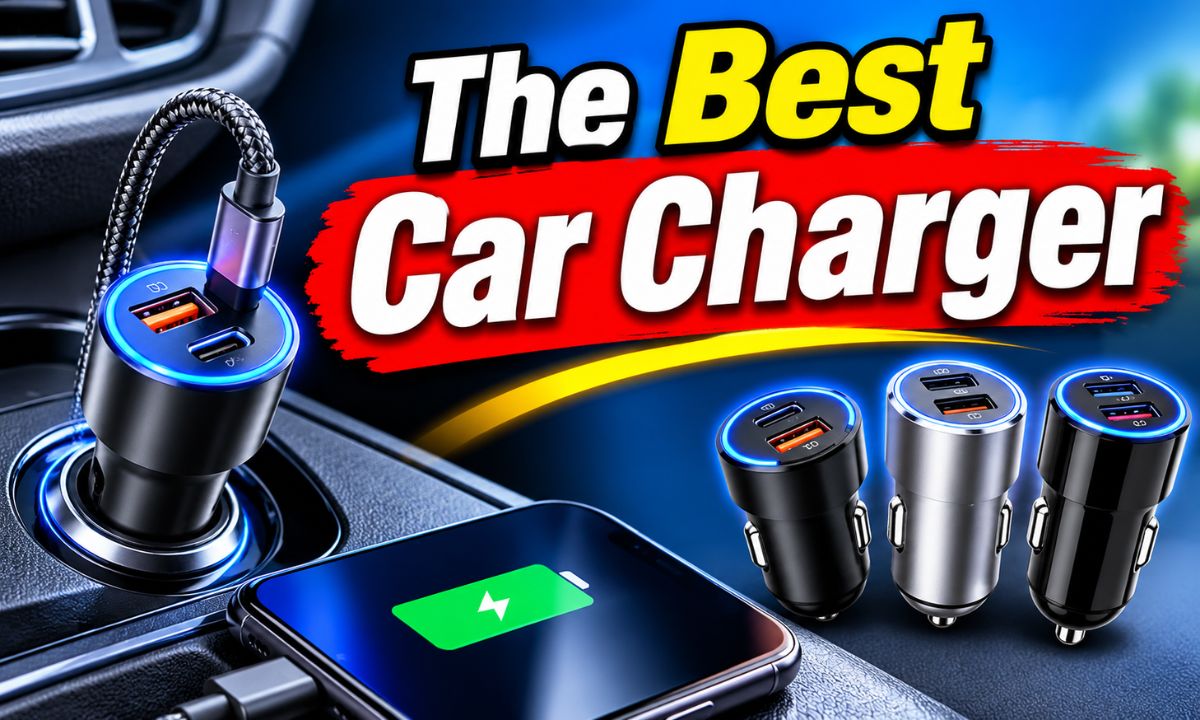
The Anker 167.5W 3-Port Car Charger is my top overall choice for powerful, flexible charging on the road.
Imagine heading to work on a busy Monday morning in the United States. Your phone battery is low, your passenger needs to charge a tablet, and your GPS is running. A regular car charger may not have enough ports or power for everyone. That is where a good car charger helps. It keeps your devices ready while you drive. Whether you commute through New York, travel across Texas, or take a family road trip, the right charger can make every trip easier. I looked at three options with different strengths to help you find the best car charger for your needs.
Table of Contents
Toggle🏆 Top 3 Products

Anker 167.5W 3-Port USB-C Car Charger
Its three ports and high total power make it a strong choice for charging phones, tablets, and compatible laptops.

LISEN 84W Retractable 4-in-1 Car Charger
Its built-in retractable cables and four charging options help keep a busy car interior neat.

67W 3-Port USB-C Car Charger
Its three charging ports and included USB-C cable offer a simple setup for everyday phone charging.
LISEN 84W Retractable 4-in-1 Car Charger
The LISEN 84W Retractable Car Charger is a good choice for drivers who want fewer loose cables in their vehicles. Its main feature is its built-in retractable cable design. It offers a USB-C cable, a Lightning cable, a USB-C port, and a USB-A port. This gives you four ways to connect devices. You can use it to charge compatible phones and other small devices during daily drives.
I like the idea of having charging cables ready without keeping several loose wires in the glove box. The retractable design can help keep your center console neat. The charger also has a rotating body that helps with positioning in the car socket. Its listed total output is 84W, with different power levels for its four outputs. Keep in mind that the total output does not mean every connected device receives 84W. Actual charging speed depends on the port, cable, device, and power-sharing setup.
✅ Pros
- ✔ Four charging options provide more flexibility for different devices.
- ✔ Built-in USB-C cable helps reduce the need to carry a separate cable.
- ✔ Built-in Lightning cable offers a direct option for compatible iPhones and Apple devices.
- ✔ Retractable cables help reduce loose wires around the center console.
- ✔ USB-C port supports compatible modern charging cables.
- ✔ USB-A port works with many older charging cables and accessories.
- ✔ The 180-degree rotating design allows flexible positioning.
- ✔ The 84W advertised total output provides useful power for several connected devices.
- ✔ Its multi-device design can help families and passengers share one car socket.
- ✔ The built-in cable design makes it a practical option for drivers who often forget charging cables.
⚠️ Cons
- ✖ The retractable cable length may not reach every passenger’s preferred seating position.
- ✖ The total 84W output is shared across the available connections and is not guaranteed for every device at once.
- ✖ The built-in cables offer less freedom than separate removable cables.
- ✖ The body may need extra space around the vehicle’s power socket to rotate properly.
My Recommendation
I would recommend the LISEN 84W Retractable Car Charger to drivers who value convenience and a tidy interior. Its main advantage is not just its power rating. It is the combination of two built-in cables and two additional USB ports. This makes it useful for families, couples, and people who regularly carry different devices. For example, one person can use the Lightning cable while another uses the USB-C cable. A third device can connect through an available port. This setup can reduce the need to pack several separate charging cables before leaving home. It is also a useful choice for rideshare drivers who want charging options for passengers. However, I would check the cable reach and socket position before buying. I would also check the charging needs of each device. If you mainly need the highest possible power for a compatible laptop, the Anker model is a better fit. If you want built-in cables and less clutter, the LISEN is a strong choice. For me, its main appeal is everyday convenience rather than maximum charging power.
| Best For | Why |
|---|---|
| Families and passengers | Four charging options make it easier for several people to connect different devices. |
| Drivers who dislike cable clutter | The built-in retractable cables help keep the center console more organized. |
| Mixed Apple and Android users | The USB-C and Lightning cables provide convenient options for compatible devices. |
Anker 167.5W 3-Port USB-C Car Charger
The Anker 167.5W Max 3-Port Car Charger is my overall top choice in this comparison. It offers three charging ports in a compact body. These include two USB-C ports and one USB-A port. Its advertised total output reaches 167.5W. The first USB-C port supports up to 100W, the second USB-C port supports up to 45W, and the USB-A port supports up to 22.5W. This makes it a flexible option for drivers who carry more than one type of device.
What makes this model stand out is its mix of high output and a small design. It can support compatible phones, tablets, and some laptops that accept USB-C charging. Anker also includes a USB-C to USB-C cable with this model. That is helpful if you want to start using it without buying another cable. The three-port layout gives you room to charge more than one device during a trip. Still, charging speed depends on device support and how you use the ports. The advertised maximum is not a promise that every device will charge at its highest speed at the same time.
✅ Pros
- ✔ Advertised total output of up to 167.5W provides a high-power charging option.
- ✔ Three ports let you connect multiple devices at once.
- ✔ Two USB-C ports support compatible modern phones, tablets, and laptops.
- ✔ The first USB-C port offers up to 100W for compatible high-power devices.
- ✔ The second USB-C port offers up to 45W for another compatible device.
- ✔ The USB-A port supports older charging cables and accessories.
- ✔ Its compact body helps reduce clutter around the vehicle’s power socket.
- ✔ A USB-C to USB-C cable is included in the package.
- ✔ It is suitable for drivers who carry both Apple and Android devices.
- ✔ The combination of USB-C and USB-A ports offers good connection flexibility.
- ✔ It can support compatible laptops that accept power through USB-C.
⚠️ Cons
- ✖ It does not include built-in retractable cables, so you must carry suitable charging cables.
- ✖ Its high advertised power may be unnecessary for people who only charge one phone.
- ✖ The maximum output depends on the vehicle power supply and connected devices.
- ✖ The USB-A port may not provide the fastest charging option for newer USB-C devices.
My Recommendation
I would choose the Anker 167.5W model for drivers who want one powerful charger for several types of devices. Its three-port design gives it an advantage over a basic single-port adapter. You can connect a compatible laptop, a phone, and another small device without needing three separate car chargers. This can be useful during long road trips, business travel, and daily commutes. It is also a practical choice for people who use navigation apps while charging their phones. The included USB-C cable adds value because you do not need to find a compatible cable before your first trip. I also like that the compact design does not take up much space. However, buyers should understand the difference between total output and the power available to each device. The first USB-C port can provide up to 100W under supported conditions, but a phone may draw much less. A laptop must also support USB-C charging at the required power level. If your main goal is to charge one phone, a simpler 67W model may be enough. But if you want a flexible option with strong power potential, I consider this the best overall car charger among these three products.
| Best For | Why |
|---|---|
| Laptop and phone users | Its 100W USB-C output can support compatible laptops while other ports handle smaller devices. |
| Frequent travelers | Three ports provide useful charging flexibility during long drives and road trips. |
| Multiple-device households | Two USB-C ports and one USB-A port support different charging cable types. |
67W 3-Port USB-C Fast Car Charger
The 67W 3-Port Super Fast Car Charger is a practical option for drivers who want several charging connections without choosing a very high-power adapter. It has three ports and comes with a 3-foot USB-C cable. Its listed total output is 67W. The product title highlights support for several Samsung Galaxy and Apple iPhone models, along with other Android devices. This makes it worth considering if your main goal is to keep phones charged during daily travel.
I see this model as a straightforward choice for people who want a simple charging setup. You can keep the included cable in the car and use the other ports with compatible cables. Three ports can help when a passenger also needs power. The included cable is another useful detail because you do not have to purchase a separate USB-C cable just to get started. However, the 67W figure represents the advertised total output. It does not mean each port delivers 67W. Before buying, check the exact output for each port and confirm that your phone supports the charging standard used by the charger.
✅ Pros
- ✔ Three charging ports allow several devices to connect at once.
- ✔ The advertised 67W total output offers useful power for compatible devices.
- ✔ A 3-foot USB-C cable comes with the charger.
- ✔ The USB-C connection supports compatible modern phones and accessories.
- ✔ Its listed compatibility covers several Samsung Galaxy models.
- ✔ The product listing also names several Apple iPhone models.
- ✔ Multiple ports make it useful for passengers who share one vehicle.
- ✔ A supplied cable reduces the need to purchase another cable right away.
- ✔ The 67W rating is suitable for many everyday phone charging needs.
- ✔ It provides an alternative to higher-power chargers that may cost more.
⚠️ Cons
- ✖ Its 67W advertised total output is lower than the Anker model’s 167.5W rating.
- ✖ The included cable may not reach every seat in a large vehicle.
- ✖ The exact charging speed depends on the device and the output of the port being used.
- ✖ The product listing provides less clear brand information than the Anker listing.
My Recommendation
I would recommend this 67W model to drivers who want a practical three-port charger for phones and everyday devices. It does not need to offer the highest power rating to be useful. Many drivers only need enough power to charge a phone during a commute or keep a tablet ready during a family trip. The included 3-foot USB-C cable is a helpful extra. You can leave it in the car and avoid searching for a cable each time you travel. The three-port setup also gives passengers more ways to connect their devices. This is useful when you share a vehicle with family members or coworkers. Still, I would check the product listing carefully before ordering. The total output does not tell the full story. You should confirm how much power each port can provide and whether your device supports its charging method. I would not choose this model for a laptop that needs a high-power USB-C supply. The Anker is a better option for that task. But for normal phone charging, a few connected devices, and a simple setup, this 67W charger deserves a place on the shortlist. It is a sensible option for buyers who do not need a premium high-output model.
| Best For | Why |
|---|---|
| Daily commuters | Its 67W advertised output and three ports suit common phone charging needs. |
| Drivers who want an included cable | The supplied 3-foot USB-C cable helps you start charging without buying another cable. |
| Small families | Three ports provide more connection options when passengers need to charge devices. |
Final Verdict: Which Should You Buy?
After comparing these three options, I would choose the Anker 167.5W 3-Port Car Charger as the best overall car charger. It offers high advertised power, three useful ports, and support for compatible phones, tablets, and laptops. The LISEN 84W is a better fit if you want built-in retractable cables and less clutter. The 67W model is a practical alternative for everyday phone charging and passenger use.
The best car charger is the one that matches your devices, vehicle, and daily routine. Check the port output and cable needs before you buy. Choose the Anker for power, LISEN for cable convenience, or the 67W model for simple multi-device charging.
FAQs Of the best car charger
Q What is the best car charger overall?
Q How many watts should a good car charger have?
Q Can I charge two or three phones with one car charger?
Q Is a USB-C car charger better than a USB-A car charger?
Q Can I leave my car charger plugged in all the time?