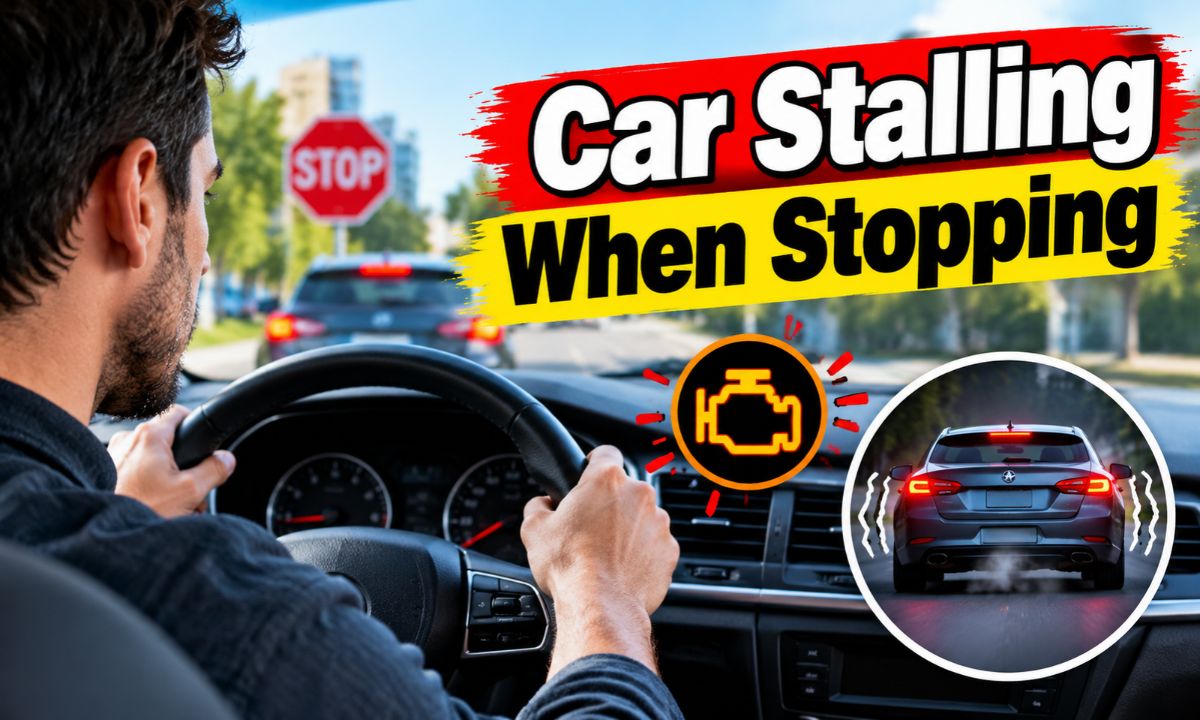
A car that stalls when stopping may have a dirty throttle body, a vacuum leak, a fuel problem, a bad sensor, or a transmission fault. Find the cause before replacing parts.
In the United States, a car that dies at a red light, stop sign, or busy intersection can turn a routine drive into a safety problem. The engine may run well on the highway but shut off as you slow down. This often happens when the engine cannot keep a steady idle or when a transmission fault places too much load on it.
The right fix depends on when the engine stops, whether the car shakes first, and whether the problem happens with the brake pedal, air conditioner, or gear shift. A dirty throttle body may need proper cleaning, while a vacuum leak, failing fuel pump, or transmission fault needs a different repair. These symptoms can overlap, so replacing parts without testing can waste money.
This guide explains 12 possible causes, the clues that help separate them, and the checks that make sense before visiting a repair shop. The steps focus on common gasoline-powered cars and light trucks sold in the US. Hybrid vehicles, diesel engines, and some newer models need model-specific diagnostic steps.
A car usually stalls at a stop when its engine cannot keep running at low speed. As you lift your foot from the gas pedal, the throttle closes and engine speed falls. The engine control system must then balance air, fuel, ignition, and engine load to keep the engine running.
If airflow is restricted, extra air leaks into the engine, fuel delivery weakens, or a sensor sends incorrect data, the engine may struggle to hold idle speed. An automatic transmission can also cause a stall if its torque converter clutch stays engaged as the car comes to a stop.
First, work out exactly when the engine dies. A stall as soon as you press the brake pedal suggests a different diagnostic path from a stall that happens only after the car stops in Drive. That timing is a useful clue, not proof of a failed part.
Look for idle control trouble, an air leak, a misfire, or a fuel mixture problem. A scan and inspection can help separate these possibilities.
The engine stops as you press the brake
A leaking brake booster or vacuum hose is one possibility, especially if the idle changes sharply with brake application. Because this may affect braking assistance, arrange prompt inspection.
The engine stops only in Drive
An idle problem under load or a torque converter clutch that fails to release may be involved. Transmission data and vehicle-specific tests are needed to tell them apart.
The engine stops when the air conditioner runs
The engine may not be compensating for the extra load. Throttle control, idle control, charging performance, and the air conditioning system may need testing.
Normal Automatic Engine Stop or a Real Stall?
Some newer cars have an automatic start-stop system. It shuts the engine off at a suitable stop to reduce fuel use and restarts it when the driver is ready to move. If the vehicle restarts as designed and displays no fault warning, this behavior may be normal.
A fault-related stall is different. The engine may shake, the dashboard may show warning lights, or the vehicle may fail to restart promptly. Check the owner’s manual to learn how your vehicle’s start-stop system should behave.
Likely normal
The engine stops smoothly under the conditions described in the owner’s manual and restarts as designed.
Needs diagnosis
The engine cuts out unexpectedly, idles roughly, stalls while moving, or fails to restart normally.
12 Causes of Car Stalling When Stopping and Their Fixes
The following 12 causes cover common engine, air, fuel, electrical, and transmission faults that can make a car stall at a stop. Start with the symptoms and basic checks, then use diagnostic results to decide what needs repair.
No single cause fits every car. Engine design, mileage, maintenance history, and the conditions surrounding the stall all affect the diagnosis. Some vehicles use an idle air control valve, while others manage idle through an electronic throttle body.
Source: carxplorer.com
Cause 1: Dirty throttle body
Carbon deposits can restrict airflow around the throttle plate. When you slow down, the engine may not get the air it needs to hold a steady idle. Other clues include rough idling, a low or unstable RPM reading, and hesitation as you come to a stop. The fix may be throttle body cleaning, followed by an idle relearn if the manufacturer requires one. Electronic throttle systems can be damaged by improper handling, so follow the correct service procedure.
Cause 2: Faulty idle air control valve
Some engines use an idle air control valve to regulate air when the throttle is closed. If the valve sticks, becomes restricted, or fails electrically, engine speed may drop too low at a stop. The car may also idle unevenly or struggle when an accessory adds load. A technician can check the valve and its control circuit, then clean or replace it if tests confirm a fault. Many newer vehicles do not use a separate valve.
Cause 3: Vacuum leak
A split hose, leaking intake gasket, or damaged vacuum connection can allow air into the engine without proper measurement. This can upset the air-fuel mixture, especially at idle. Possible clues include a hissing sound, rough idle, and an illuminated check engine light. A shop can use suitable leak-testing methods and scan data to find the source. Replace the damaged hose or seal rather than covering the leak with a temporary patch.
Cause 4: Brake booster or booster hose leak
The brake booster uses vacuum or another power-assist system to reduce the effort needed to press the brake pedal. On vacuum-assisted systems, a leaking booster diaphragm, check valve, or hose can introduce extra air into the engine as you brake. If the engine stumbles or dies when you press the pedal, and you hear a hiss near the pedal or engine bay, stop treating the issue as a routine idle problem. Have the booster system checked promptly, especially if the pedal feels unusually hard or braking assistance changes.
Cause 5: Dirty or faulty mass airflow sensor
The mass airflow sensor measures air entering the engine on vehicles that use this design. If its signal is inaccurate, the engine computer may supply the wrong amount of fuel. The result can be rough idle, hesitation, poor acceleration, or stalling as the engine slows down. A technician can compare sensor readings with expected values and check the wiring and intake system. Use only an approved cleaning method when cleaning is appropriate; ordinary solvents can damage a sensor.
Cause 6: Weak fuel pump or low fuel pressure
The fuel pump must supply enough fuel for the engine to run under changing conditions. A weak pump, restricted filter where serviceable, poor electrical supply, or another fuel delivery fault can cause the engine to stumble or stop. Other clues may include hard starting, loss of power under acceleration, or hesitation before the stall. A fuel pressure and delivery test can confirm whether supply is adequate. Do not replace a pump based on stalling alone, because air, ignition, and sensor faults can produce similar symptoms.
Cause 7: Dirty or failing fuel injectors
Fuel injectors meter fuel into the engine. A clogged injector, electrical fault, or poor spray pattern can disrupt combustion and cause a rough idle or misfire. The engine may shake before it stalls, and diagnostic data may point to one cylinder or a fuel mixture problem. Testing should check injector operation and related fuel conditions before cleaning or replacing components. Fuel additives are not a reliable fix for every injector problem.
Cause 8: Faulty crankshaft or camshaft position sensor
These sensors help the engine computer determine crankshaft or camshaft position and control ignition and fuel timing. If a signal drops out, the engine may shut off suddenly and may not restart until the fault changes or the part cools. A crankshaft sensor problem can sometimes cause a stall without much warning or rough idle first. A scan may reveal related codes, but a technician may also need to check live signal data, wiring, and connections. Replace a sensor only after the fault is confirmed.
Cause 9: Ignition system fault
Worn spark plugs, failing ignition coils, damaged wiring, or other ignition faults can cause misfires and unstable engine operation. The engine may shake at a stop, hesitate when accelerating, or show a flashing check engine light. A flashing light can indicate a misfire severe enough to damage the catalytic converter, so avoid continued driving and arrange diagnosis. The repair may involve plugs, coils, wiring, or another part of the ignition system, depending on the test results.
Cause 10: Stuck-open exhaust gas recirculation valve
The exhaust gas recirculation system sends a controlled amount of exhaust gas back into the engine under certain operating conditions. If its valve stays open when it should close, too much exhaust gas may enter at idle and make combustion unstable. The car may run roughly, hesitate, or stall as you stop. A technician can inspect the valve, its control system, and related passages. Cleaning or replacement is appropriate only when testing supports the diagnosis.
Cause 11: Failing alternator, weak electrical supply, or poor ground
The engine and its control systems depend on stable electrical power. An alternator that is not charging correctly, a damaged cable, or a poor ground can cause voltage problems that affect engine operation. Dim or flickering lights, battery warnings, slow cranking, or several unrelated warning lights may appear alongside the stall. A proper charging-system and voltage-drop test can identify the fault. A battery replacement alone will not solve an alternator or wiring problem.
Cause 12: Torque converter clutch or transmission fault
In many automatic transmissions, the torque converter allows the engine to keep running while the vehicle is stopped in gear. The torque converter clutch locks up under certain driving conditions to reduce slip. If it remains engaged as the car slows to a stop, it can load the engine much like stopping a manual-transmission car without disengaging the clutch. The engine may die just as the vehicle reaches a stop, yet restart normally afterward. A technician can review transmission codes and live data, then test the clutch control and related components. Transmission repairs should follow a confirmed diagnosis, not a guess.
A Note About Engine Computer and Software Faults
A faulty sensor is not the only reason the engine computer may receive bad information. Damaged wiring, loose connectors, poor grounds, or a control-system fault can also disrupt idle control. Some vehicles may have manufacturer service information or software updates that apply to a specific symptom and model.
If the common checks do not explain the stall, a technician can verify the vehicle identification number, inspect relevant service information, and test the affected circuit. Do not assume a computer needs replacement just because the engine stalls.
Useful evidence
Stored and pending codes, freeze-frame data, live sensor readings, wiring tests, and a repeatable description of the stall.
Avoid guesswork
Do not replace the engine computer or several sensors without confirming power, ground, wiring, and the suspected component.
How to Narrow Down the Cause Before Paying for Repairs
The most useful first step is to record the exact conditions that cause the engine to stop. You do not need to take the car apart to collect this information. A clear symptom description can help a repair shop choose the right tests and avoid replacing parts at random.
Do not deliberately recreate a dangerous stall in traffic. If the car has already shut off more than once, arrange safe transport or professional help instead of repeatedly driving it to see what happens.
Source: thecarbuzz.com
Step 1: Record when the stall happens
Note whether the engine stops while slowing down, when you press the brake, after the car reaches a complete stop, or when you shift into Drive. Record whether the engine is cold or warm and whether the air conditioner is running.
Step 2: Note the warning signs
Write down whether the engine shakes, the RPM drops suddenly, the dashboard lights flicker, or the engine cranks for a long time after the stall. Mention any recent repair, battery replacement, fuel fill-up, or maintenance work.
Step 3: Check for visible problems with the engine off
Park on level ground, apply the parking brake, and switch off the engine. When the engine is cool, look for an obviously loose intake duct, disconnected hose, damaged wire, or fluid leak. Keep hands and clothing away from belts, fans, and hot parts. Do not touch fuel lines or electrical connectors unless you know the correct procedure.
Step 4: Read diagnostic trouble codes
If you have a suitable scan tool and can use it safely, read stored and pending codes. Save the codes and available freeze-frame information before clearing anything. A code helps identify a system that needs testing; it does not automatically identify the failed part.
Step 5: Ask for targeted testing
Give the repair shop the symptom notes and scan results. Ask whether the diagnosis will include the intake and vacuum system, throttle or idle control, fuel delivery, ignition, electrical supply, and transmission operation as indicated by the symptoms.
What the Symptoms May Suggest
This table links common symptom patterns to the systems worth checking first. It is a guide for choosing a diagnostic direction, not a way to confirm a fault without testing.
Stalls at every stop with a rough idle
Start with throttle or idle control, vacuum leaks, mixture control, and ignition misfires.
Stalls only when the brake pedal is pressed
Prioritize the brake booster, vacuum hose, check valve, and related air leaks. Do not drive if braking assistance is in doubt.
Stalls only when stopping in Drive
Check idle control under load and investigate torque converter clutch operation where applicable.
Stalls with dim lights or battery warnings
Test charging output, battery connections, grounds, and power supply to the engine control system.
Stalls after warming up, then restarts later
Consider heat-related sensor, ignition, fuel delivery, or electrical faults. Record how long the engine must cool before it restarts.
What to Do If Your Car Stalls in Traffic
If the engine stalls in traffic, focus on control and getting out of danger rather than diagnosing the fault. The vehicle may still move from its own momentum, but steering and brake assistance can be reduced on some vehicles once the engine stops. The amount of assistance available depends on the vehicle and system design.
Do not assume the car is safe to keep driving just because the engine restarts. A repeat stall at an intersection or while turning can leave you exposed to other traffic. If the car stalls repeatedly, arrange roadside assistance or a tow.
Keep control of the vehicle
Hold the steering wheel firmly, signal if possible, and guide the car toward a safe place away from moving traffic. Avoid sudden maneuvers.
Use the brakes carefully
Press the brake firmly as needed. If power assistance has been lost, the pedal may feel harder and need more force. Do not pump the pedal unless your vehicle’s manual or a specific emergency procedure tells you to.
Turn on the hazard lights
Once you can do so safely, switch on the hazard lights to warn other drivers. Follow local road rules and seek roadside assistance when needed.
Do not restart in a dangerous location
If the vehicle is in an active lane or an unsafe area, prioritize moving to safety and contacting assistance. Restart only when the location and conditions make it safe.
Stop driving if serious warnings appear
Arrange help if the engine overheats, oil pressure warnings remain on while the engine runs, smoke appears, fuel smells strong, or the brakes or steering behave abnormally.
Can You Drive a Car That Stalls at Stoplights?
It is not wise to keep using a car that repeatedly stalls at stoplights. Even if it restarts, the next shutdown may occur in a turn lane, at a busy intersection, or while you are trying to cross traffic. The engine fault may also be linked to another issue that needs urgent attention.
If the car has stalled once and you cannot identify the cause, contact a repair shop for advice before continuing. If it stalls repeatedly or any braking, steering, overheating, fuel, or smoke warning appears, do not drive it to the shop. Arrange a tow or other safe transport.
Do not continue driving
The car repeatedly stalls, will not restart reliably, or has a braking, steering, oil pressure, overheating, smoke, or fuel-leak concern.
Get professional diagnosis soon
The car restarts and appears normal, but it has unexpectedly shut off at a stop. A mechanic should identify the cause before the problem becomes more dangerous.
Which Repairs May Be Needed, and What Affects the Cost?
Repair costs depend on the failed part, vehicle design, labor time, and local shop rates. A basic inspection or cleaning may cost less than replacing a fuel pump, repairing wiring, or opening a transmission. Without a confirmed diagnosis and vehicle details, a single price estimate would be unreliable.
Ask the shop to explain the test results, the recommended repair, and any additional work before authorizing the job. A clear diagnosis is especially important when several faults can create the same stalling symptom.
Cleaning and basic service
A throttle body may need cleaning if deposits are confirmed and the manufacturer’s procedure permits it. Some vehicles also need an idle relearn after service.
Hose, gasket, or vacuum repair
A leaking hose, intake seal, or brake booster component may need repair or replacement. A brake booster concern should be treated as a safety issue, not just an engine performance problem.
Sensor or ignition repair
A sensor, spark plug, coil, connector, or wiring repair should be based on test results. The labor can vary with the part’s location and how difficult it is to access.
Fuel system repair
A confirmed fuel pressure or injector problem may require further testing and replacement or cleaning of the affected component. Fuel system work can involve fire risks and is best left to a qualified technician.
Transmission diagnosis and repair
A torque converter clutch or related transmission fault may require scan testing and additional mechanical or hydraulic diagnosis. Do not approve a major transmission repair based only on the fact that the engine dies at a stop.
Questions to Ask the Repair Shop
You can make a repair visit more useful by asking for the evidence behind the recommendation. This helps you understand whether the shop has found the cause or is proposing a part based on a general possibility.
What test confirmed the fault?
Ask whether the diagnosis came from scan data, a pressure test, an air leak test, an electrical measurement, or a transmission test.
Could another fault cause the same symptom?
Ask whether the shop ruled out related causes before recommending an expensive repair.
Is a relearn or software procedure required?
Some electronic throttle or control system repairs require a vehicle-specific setup or relearn procedure.
How will the repair be confirmed?
The shop should explain how it will verify that the engine no longer stalls under the conditions that originally caused the problem.
Common Mistakes to Avoid When an Engine Stalls
The biggest mistake is replacing parts before identifying the system that has failed. A dirty throttle body, vacuum leak, faulty sensor, and transmission problem can all cause stalling, but they do not share the same repair. A part that is common on one model may not even exist on another.
Another mistake is clearing diagnostic codes before saving them. Codes and freeze-frame information may preserve clues about the conditions when the problem occurred. Clearing them too early can make the next diagnosis harder.
Source: cdn.thedailyautomotive.com
Do not replace the fuel pump based on one symptom
Test fuel pressure and delivery first. An idle control or air leak problem can look like a fuel problem.
Do not clean an electronic throttle body carelessly
Some throttle bodies need a specific cleaning method and an electronic relearn. Follow the service procedure for the exact vehicle.
Do not ignore the brake pedal clue
A stall linked to brake application can point to a vacuum leak in the brake assist system. Have it checked promptly, particularly if pedal effort changes.
Do not assume no warning light means no fault
Some faults do not switch on the check engine light right away. A scan, inspection, and symptom-based test may still be needed.
Do not keep driving to see whether the problem goes away
Repeated stalling can create a traffic hazard and may leave you with reduced steering or braking assistance. Arrange help if the fault repeats.
When DIY Troubleshooting Is Not Enough
A basic visual inspection and reading stored codes may be reasonable for a driver who has the right tools and understands the process. Fuel pressure testing, electrical circuit testing, brake booster diagnosis, and transmission control testing can require specialist equipment and training.
Never work beneath a vehicle supported only by a jack, open a hot cooling system, or work around fuel leaks and moving engine parts. If you are unsure how to perform a check safely, stop and use a qualified repair shop.
Seek prompt help
The engine stalls more than once, fails to restart, or loses power while driving.
Treat as urgent
The brake pedal becomes unusually hard, the vehicle overheats, a fuel leak is suspected, smoke appears, or a serious warning remains on.
Frequently Asked Questions
Q
Why does my car stall when I stop at a red light?
A car may stall at a red light because it cannot maintain a steady idle. Common causes include a dirty throttle body, an idle control fault, a vacuum leak, a fuel delivery problem, or an ignition issue. On an automatic vehicle, a torque converter clutch that does not release can also cause the engine to die as the car stops.
Record whether the engine shakes first, whether the problem happens with the air conditioner running, and whether the car restarts immediately. A scan and inspection can then help identify the actual fault.
Q
Why does my car stall only when I press the brake?
A vacuum leak in the brake booster, booster hose, or check valve can affect engine idle when you press the brake pedal. Other causes are possible, so the symptom alone does not prove the booster has failed.
If the engine dies when you brake or the pedal feels unusually hard, avoid driving and arrange a professional inspection. A fault in the brake assist system can affect safe braking.
Q
Can a bad battery cause my car to stall when stopping?
A weak battery alone is not the most direct explanation for a running engine that stalls at every stop. However, poor battery connections, a failing alternator, damaged grounds, or unstable electrical power can disrupt engine control and contribute to stalling.
Look for related signs such as dim lights, a battery warning, slow cranking, or other electrical problems. A charging-system test and voltage-drop checks can help separate a battery issue from an alternator or wiring fault.
Q
Why does my automatic car stall when I stop but restart right away?
An automatic car that stalls at a stop and restarts right away may have an idle control, throttle, vacuum, fuel, sensor, or transmission problem. If the engine dies mainly as the car comes to a stop in Drive, a torque converter clutch that stays engaged is one possibility.
Immediate restarting does not mean the problem is harmless. Save any diagnostic codes and arrange testing rather than continuing to drive in heavy traffic.
Q
Can low fuel make a car stall when stopping?
Yes, a very low fuel level can contribute to an engine stopping if the fuel pickup temporarily loses access to fuel, such as during a turn or on a slope. A weak pump or fuel delivery fault can also cause stalling, even when the tank is not empty.
If adding the correct fuel restores normal operation, record that clue, but do not assume it rules out a failing pump or another fault. If the engine continues to stall, have the fuel system checked.
Q
Will cleaning the throttle body stop my car from stalling?
Cleaning may help when confirmed deposits restrict airflow through the throttle body. It will not fix a vacuum leak, failing sensor, fuel delivery problem, ignition fault, or transmission issue.
Some vehicles require special cleaning steps or an idle relearn after service. Check the service information for your exact model or ask a technician to inspect the throttle body before paying for cleaning.
Q
Should I disconnect the battery to reset the check engine light?
No. Disconnecting the battery is not a good first step for diagnosing a stall. It may erase useful diagnostic information or reset learned settings, and it will not repair the underlying fault.
Read and save stored and pending codes, along with freeze-frame information when available. Diagnose the cause first, then clear codes only when appropriate as part of the repair procedure.
✦ Wrapping Up
Conclusion
Car stalling when stopping is often linked to an idle control, airflow, fuel, ignition, sensor, or transmission problem. The timing of the stall helps narrow the choices, especially when the engine dies as you press the brake or only when an automatic car stops in Drive. Still, symptoms alone cannot confirm which part has failed.
Start by recording the conditions, checking for obvious problems with the engine off, and saving any diagnostic codes. Use that information to guide a proper inspection rather than replacing several parts at once. If the engine repeatedly stalls, braking or steering feels abnormal, or smoke, overheating, or a fuel smell appears, stop driving and arrange help.
💡 Key Takeaway
Record when the engine stalls, whether the brake pedal or air conditioner changes the symptom, and any warning lights. Save diagnostic codes and have the cause confirmed before authorizing repairs.