A car that stalls while driving may have a fuel, ignition, electrical, sensor, or air supply problem. Pull over safely, restart only when conditions allow, and arrange a repair if the cause is unclear.
On American roads, an engine that suddenly stops can turn a routine trip into a serious safety risk. It may happen on an interstate, at a busy city junction, on a rural highway, or while slowing for a red light. Your first goal is to protect yourself and other drivers, not to find the broken part while traffic moves around you.
Car stalling while driving means the engine stops running when it should still be operating. You may lose engine power at once, and steering or braking may become harder, depending on the vehicle. Some cars restart right away, while others need time to cool or will not start again at all.
The cause can be simple, such as an empty fuel tank, or more serious, such as a failing fuel pump, damaged wiring, or a faulty engine sensor. The clues matter: whether the engine cuts out when hot, loses power first, stalls during a turn, or dies without warning can help narrow the cause. This guide explains what to do first, which checks are reasonable, and when a mechanic should take over.
What Does It Mean When a Car Stalls While Driving?
A stall occurs when the engine stops producing power and stops running. In a gasoline car, this can happen when the engine loses the fuel, spark, air, or timing signals needed for combustion. Diesel engines use a different ignition process, but they can also stall because of fuel delivery, electrical control, air supply, or mechanical faults.
An engine stall is not the same as every loss of power. A car that struggles to speed up while the engine keeps running may have a different problem from a car whose engine shuts off completely. A slipping transmission can also interrupt power transfer without stopping the engine itself.
Modern cars depend on electronic controls to manage fuel, ignition, and engine speed. A fault in one system can cause the engine to stop, trigger a warning light, or prevent the engine from restarting. Older vehicles may have different causes, so the make, model, engine type, and maintenance history all matter.
Source: thecarbuzz.com
Engine stops suddenly
The engine cuts out while the vehicle is moving, often with little warning. A fuel, ignition, electrical, or control-system fault may be responsible.
Engine sputters before stopping
The car may shake, hesitate, or lose power before the engine dies. These signs can point to fuel starvation, a misfire, or an air supply problem.
Engine dies at low speed
The engine may stop while slowing down, turning, or waiting at a traffic light. Idle control, air leaks, charging faults, or engine management issues may be involved.
Engine stalls and restarts later
A fault that changes with heat, vibration, or electrical load may be intermittent. The fact that the car restarts does not mean the problem is fixed.
Why a Stall Can Make Steering and Braking Harder
When an engine stops, some vehicles lose power assistance for the steering or brakes. Electric power steering may stop assisting if its electrical supply fails, while hydraulic systems may lose their normal engine-driven assistance. The exact effect depends on the vehicle design.
Most cars retain a mechanical braking connection, but the brake pedal may need much more force after stored power assistance is used up. Steering may also require more effort. Do not switch the ignition fully off while moving, because some vehicles may lock the steering or disable important systems.
Keep control
Hold the steering wheel firmly and guide the vehicle toward a safe stopping place.
Brake with steady pressure
Apply firm, controlled pressure. Do not pump the pedal unless your vehicle’s braking system or owner’s manual specifically calls for it.
Signal other drivers
Turn on the hazard lights as soon as you can do so safely and make your intentions clear.
What Should You Do When Your Car Stalls on the Road?
Your first response should be to reach a safe stopping place. A stalled car may still roll, but it may no longer respond as expected when you accelerate or turn. Focus on control and visibility before attempting a restart or diagnosis.
If you are on a U.S. interstate or another high-speed road, do not remain in a live traffic lane to investigate the engine. If you cannot reach the shoulder safely, keep control of the car and follow the safest available stopping path. Call for roadside assistance or emergency help if the vehicle is in a dangerous position.
Source: vehiclefreak.com
1. Guide the car away from traffic
Use the remaining momentum to move toward a shoulder, parking lot, or other safe area. Avoid sudden steering moves that could cause a collision.
2. Turn on the hazard lights
Make the vehicle easier for other drivers to see. If it is dark or visibility is poor, stay alert to nearby traffic and roadside hazards.
3. Stop and secure the vehicle
Once stopped, apply the parking brake and select Park in an automatic vehicle or the appropriate gear in a manual vehicle. Follow your owner’s manual.
4. Look for immediate danger
If you smell strong fuel, see smoke or flames, notice a major fluid leak, or hear severe mechanical noise, do not try to restart the engine. Move away when safe and contact emergency services if needed.
5. Decide whether a restart is reasonable
If the vehicle is safely parked and there are no signs of fire, fuel leakage, overheating, or serious mechanical damage, one restart attempt may help you assess the situation. Do not keep cranking the engine if it fails to start.
6. Arrange professional help
If the stall repeats, the engine will not restart, or a serious warning appears, arrange a tow or roadside assistance. A vehicle that stalls without warning should not be treated as safe simply because it starts again.
Should You Keep Driving After the Engine Restarts?
A restart does not confirm that the car is safe. An intermittent fuel pump, loose electrical connection, failing crankshaft sensor, or charging fault may work again for a short time and then fail without warning.
Do not continue driving if the engine stalls more than once, the oil pressure warning remains on while the engine is running, the engine overheats, or you see a charging warning with signs of electrical trouble. If the check engine light flashes or the engine runs very roughly, stop when safe and seek advice. A flashing check engine light can indicate a misfire that may damage the catalytic converter.
If the car stopped because it ran out of fuel and you have safely restored the fuel supply, the situation may be different. Even then, follow the vehicle manufacturer’s guidance and check for other symptoms before resuming a trip.
A brief stall with a known, corrected cause
A cautious return to driving may be reasonable if the cause is confirmed, the vehicle operates normally, and no warning remains. Seek assistance if anything seems uncertain.
An unexplained stall
Have the vehicle inspected before normal use, especially if it stalled at highway speed or in heavy traffic.
Smoke, fuel smell, or overheating
Do not restart the engine. Get to a safe location and request professional assistance.
The Most Common Causes of Car Stalling While Driving
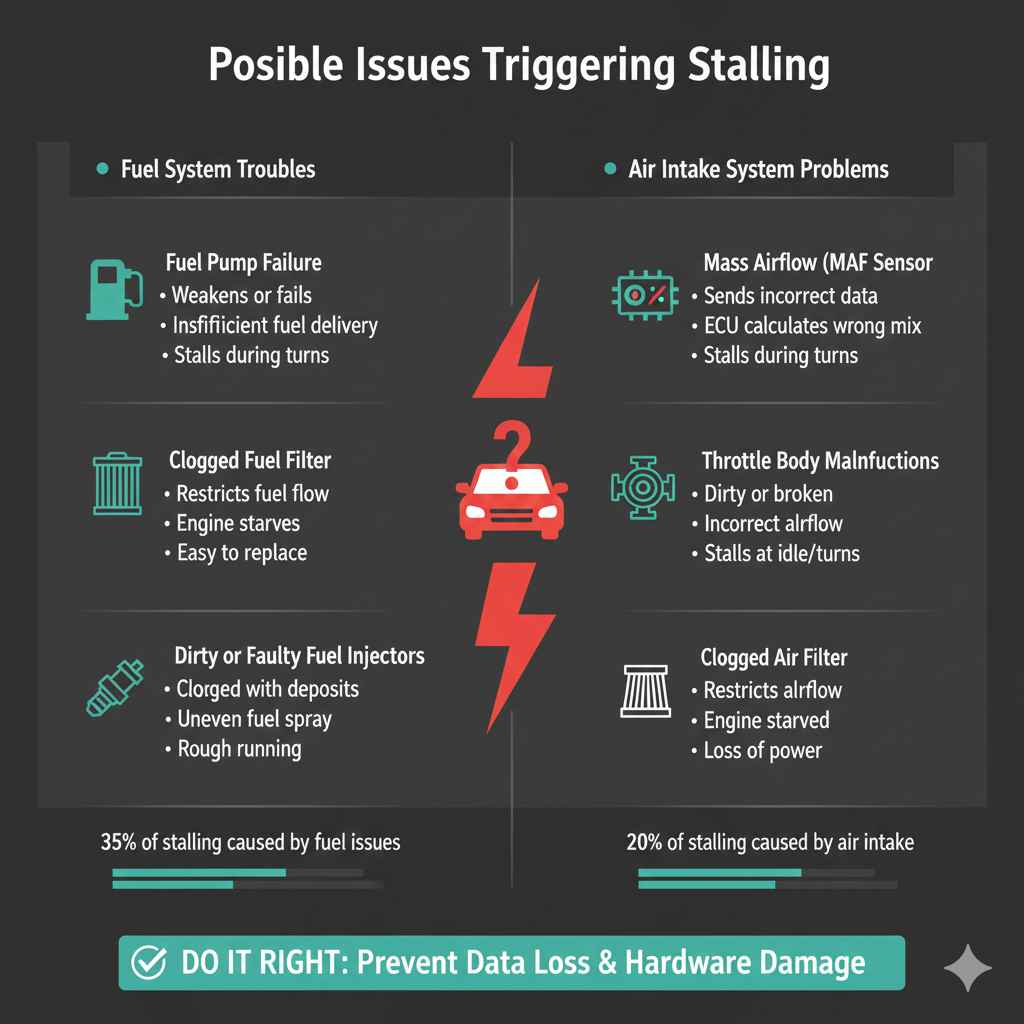
The most useful way to diagnose a stall is to match the symptoms with the system that may have failed. A car that sputters under load gives different clues from one that shuts off instantly with no warning. Several faults can produce similar symptoms, so a proper diagnosis may need scan data and electrical or fuel pressure tests.
The causes below are common possibilities, not a ranked failure-rate list. The best starting point depends on what happened before the engine stopped, what warning lights appeared, and whether the engine restarts after cooling.
Source: i.ytimg.com
Fuel delivery failure
A failing fuel pump, blocked filter where serviceable, faulty pump relay, damaged fuel line, or poor fuel supply can starve the engine. The car may hesitate under acceleration, sputter, lose power, and then stall.
Ignition system fault
Worn spark plugs, failed ignition coils, or damaged ignition wiring can cause misfires and rough running. Some faults become worse when the engine is hot or under load.
Crankshaft or camshaft sensor problem
These sensors help the engine computer track engine position and speed. If a signal drops out, the computer may lose the information needed to control fuel injection or ignition.
Alternator or charging system failure
A weak alternator, damaged drive belt, or poor electrical connection may cause the battery to lose charge while driving. Electronic controls can stop working correctly if system voltage falls too low.
Battery connection or wiring fault
Loose battery terminals, corroded connections, damaged grounds, or a failing power connection can interrupt electrical supply. A sudden cutout accompanied by flickering lights may be a clue.
Air intake or vacuum leak
Unmetered air entering the engine can upset the air-fuel mixture. A large vacuum leak, a damaged intake hose, or a faulty airflow sensor may cause rough idle, hesitation, or stalling.
Dirty throttle body or idle control problem
Some engines struggle to maintain idle speed when the throttle closes. Carbon buildup, a faulty electronic throttle system, or an idle control fault may cause the engine to die while slowing down.
Engine overheating
Severe overheating can cause poor operation and may lead to protective shutdown on some vehicles. A stall with a high temperature reading, steam, or coolant loss needs immediate attention.
Faulty engine computer or relay
A failed control module, fuel pump relay, ignition relay, or related circuit can interrupt engine operation. These parts should be tested before replacement because similar symptoms can have other causes.
Mechanical engine damage
Low oil pressure, a failed timing component, severe internal wear, or another mechanical fault can stop the engine. Loud knocking, sudden loss of power, or an engine that will not turn normally requires professional diagnosis.
Why a Car Can Stall Without Warning
An instant stall often suggests that a key system stopped working abruptly. Possible causes include loss of ignition power, a crankshaft sensor signal failure, a fuel pump stopping, or an electrical connection opening under vibration.
However, a sudden stall does not prove that the problem is electrical. A fuel pump can fail with little warning, and some mechanical faults can happen quickly. A scan tool, wiring checks, and tests matched to the symptoms help separate these possibilities.
Lights and dashboard also go dark
Check for a possible loss of main electrical power, a loose connection, or a charging system fault. Do not handle exposed wiring on the roadside.
Dashboard stays on but the engine stops
The fault may be in fuel delivery, ignition, engine position sensing, or engine management. The dashboard remaining lit does not identify one specific cause.
Engine sputters before it dies
Fuel supply, ignition misfires, or an incorrect air-fuel mixture may be worth checking first.
How to Diagnose a Car That Keeps Stalling
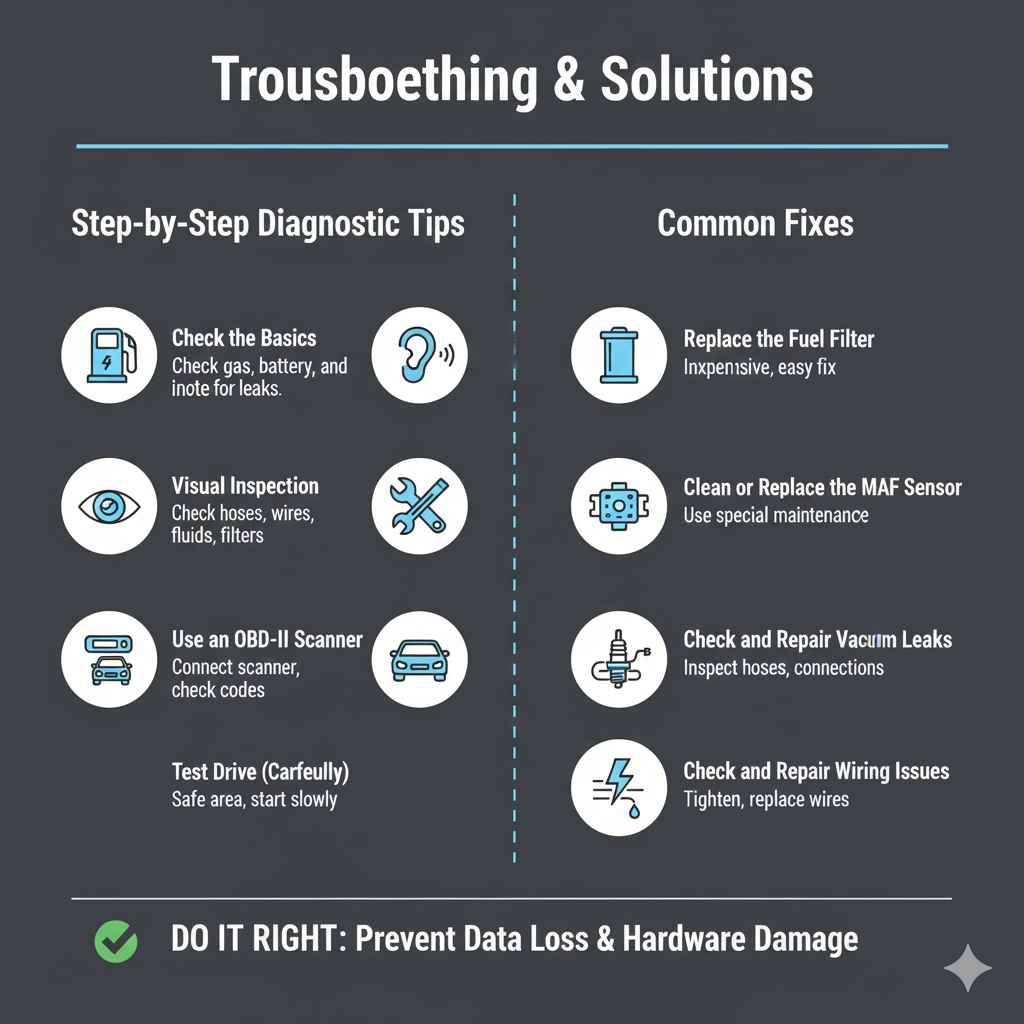
Start with the safest and simplest checks, then move toward tests that require tools or professional skills. Do not replace parts based on a guess. A fuel pump, sensor, or alternator can be expensive, and the wrong repair may leave the original fault untouched.
Before checking anything, park on level ground away from traffic, switch off the engine, set the parking brake, and let hot parts cool. Keep hands, clothing, and tools away from belts and fans. Electric cooling fans can start even when the engine is off, depending on the vehicle.
Source: i.ytimg.com
Step 1: Record the Conditions Before the Stall
The events just before a stall can narrow the search. Write down whether the engine was cold or hot, whether you were accelerating or slowing down, and whether the problem happened after a turn, at idle, or on a rough road.
Also note warning lights, unusual smells, sounds, recent repairs, and whether the engine restarted at once or only after a delay. These details can help a technician reproduce the problem instead of relying on guesswork.
Stalls during acceleration
Fuel delivery, ignition under load, intake restrictions, or sensor readings may be involved.
Stalls when slowing down
Idle control, throttle body operation, vacuum leaks, or charging problems may be worth testing.
Stalls after warming up
Heat-sensitive sensors, ignition components, wiring, or fuel delivery faults may be responsible.
Stalls over bumps or during turns
A loose electrical connection, damaged wiring, or another vibration-sensitive fault may be present.
Step 2: Check the Fuel Level and Recent Fueling
Confirm that the tank contains fuel. A faulty fuel gauge can show more fuel than the tank actually holds, and a low level may cause fuel pickup problems under some driving conditions.
If the stall started soon after a fill-up, tell the mechanic where and when you bought the fuel. Contaminated fuel is one possibility, but timing alone does not prove that the fuel caused the fault. Do not open fuel lines or attempt a roadside fuel pressure test.
Fuel gauge reads empty or behaves oddly
Add the correct fuel only when it is safe to do so, and arrange a gauge or fuel system check if the reading seems unreliable.
Strong gasoline or diesel smell
Do not start the engine or use ignition sources nearby. Move away from the vehicle if needed and arrange professional help.
Step 3: Look for Warning Lights and Obvious Problems
With the vehicle safely parked and the engine off, look for visible damage, loose intake hoses, obvious fluid leaks, or a damaged drive belt if it is accessible without reaching near moving parts. Do not touch hot components or exposed wiring.
Check the dashboard messages and warning lights. An oil pressure warning while the engine is running, a temperature warning, or signs of a major electrical failure should be treated seriously. Some lights normally appear after a stall because the engine has stopped, so the timing of the warning matters.
Oil pressure warning
If the light appeared while the engine was running, shut the engine off and do not restart until the cause is checked. Low oil pressure can damage the engine quickly.
Temperature warning
Stop driving and let the engine cool. Never remove a hot radiator cap or open a pressurized coolant reservoir.
Battery or charging warning
The charging system may not be supplying enough power. A technician can test the alternator, battery, belt, wiring, and connections.
Check engine light
Read the diagnostic trouble codes with a compatible scan tool. Keep the codes and freeze-frame data, if available, before clearing anything.
Step 4: Read Diagnostic Trouble Codes
An OBD-II scan tool can retrieve fault codes from many U.S. passenger vehicles built for the system. These codes may point toward a sensor circuit, misfire, fuel mixture, or other engine control issue. Some vehicles also store pending codes even when the warning light is off.
A code identifies a detected condition, not always the part that caused it. For example, a code related to an airflow sensor may result from a wiring fault, an air leak, or another problem that affects the reading. A good diagnosis checks the circuit and the surrounding system before replacing the named component.
Save the exact code
Record the full code and any freeze-frame information, including engine temperature and speed when the fault was detected.
Do not clear codes too soon
Clearing codes can remove useful diagnostic information and reset readiness monitors. Save the data before any reset.
Use vehicle-specific information
The correct test depends on the make, model, engine, and year. Follow the repair manual for the exact vehicle.
Step 5: Have Fuel, Spark, and Electrical Systems Tested
If the basic checks do not reveal the cause, a technician may test fuel pressure, ignition operation, sensor signals, charging voltage, wiring continuity, and engine grounds. The test order depends on the recorded symptoms and fault codes.
Fuel pressure testing may require special fittings and careful handling of pressurized fuel. Ignition systems can produce dangerous voltage, and hybrid vehicles may contain high-voltage circuits. These tests are not suitable for casual roadside troubleshooting.
Fuel pressure and delivery
Testing can show whether the pump and related system maintain the pressure required by the engine under the conditions that cause the stall.
Ignition and sensor signals
A technician can check for loss of spark or a signal that disappears as the engine warms up.
Charging and electrical supply
Testing can identify a weak alternator, excessive voltage drop, poor grounds, or an intermittent power connection.
Air intake and engine controls
Inspection and suitable tests can reveal intake leaks, throttle problems, or control faults that affect engine operation.
Why Does a Car Stall When It Is Hot but Restart When Cool?
A car that stalls after warming up may have a heat-sensitive fault. Electrical parts, sensors, ignition coils, and some fuel system components can behave differently as their temperature rises. Once the vehicle cools, the part may work again for a while, which can make the problem seem to disappear.
This pattern is a clue, not a diagnosis. A delayed restart can also follow fuel pressure loss, an overheated engine, or another fault that needs testing. Avoid repeatedly driving until the engine gets hot just to reproduce the problem, especially if it has already stalled in traffic.
Source: i.ytimg.com
Likely Causes of Heat-Related Stalling
A failing crankshaft position sensor is one possible cause when the engine cuts out hot and restarts after cooling. Ignition coils, relays, wiring connections, and fuel pumps can also develop intermittent faults. The exact cause depends on the vehicle and the signals or pressures present when the stall occurs.
A technician may need to test the vehicle while the fault is active. A scan tool that records live data can help, but some intermittent failures require an oscilloscope, electrical testing, or fuel pressure measurement to confirm.
Engine stops after a long drive
Record the temperature, driving time, speed, and warning lights. Ask for checks of heat-sensitive sensors, ignition components, fuel delivery, and electrical connections.
Engine cranks but will not start until it cools
The starter is turning the engine, but combustion is not starting. Fuel pressure, spark, engine position signals, and control power may need testing.
Temperature gauge rises before the stall
Treat overheating as a priority. Stop safely and do not restart until the engine has cooled and the cause has been assessed.
Why Does a Car Stall When Turning or Slowing Down?
A car that stalls during a turn or while slowing down may have trouble maintaining idle speed, a fuel supply issue, or an electrical fault. The steering system can also place an added load on the engine in some vehicles, although modern systems vary widely in design.
A stall during a turn deserves special attention because the driver may need steering assistance to avoid another vehicle or obstacle. Do not assume that turning the wheel is the root cause. It may simply reveal a fault that also exists under other conditions.
Source: cdn.thedailyautomotive.com
Stalling While Turning
If the engine stops as you turn, a loose electrical connection, poor engine ground, fuel pickup issue, or idle control fault may be involved. If the steering becomes unusually heavy before the engine stops, mention that detail to the technician. It may help distinguish a steering load issue from a general engine fault.
A sudden stall that happens only during sharp turns can also be affected by fuel level or the design and condition of the fuel supply system. Record whether the tank was nearly empty, but do not treat low fuel as the cause without further evidence.
Stalls on tight turns
Note fuel level, engine speed, warning lights, and whether the stall happens in both directions. A professional can check the fuel system, wiring, and idle response.
Stalls as the steering wheel turns at low speed
The engine may be struggling with an added load or may have an idle control fault. The exact explanation depends on the steering and engine design.
Stalling at Traffic Lights or When Braking
If the engine dies as you approach a red light, the cause may involve idle control, the throttle body, an intake leak, or a charging problem. A fault in the brake booster or its vacuum supply can also affect engine operation on vehicles that use engine vacuum for brake assistance.
Automatic transmission vehicles may stall if a torque converter clutch remains engaged when the vehicle slows to a stop. This is not the only possible cause, and the symptom can resemble an engine idle fault. A technician may need to compare engine speed, transmission data, and the conditions that trigger the stall.
Engine idles roughly before stopping
Ask for checks of intake leaks, throttle operation, idle control, and engine management data.
Engine stalls only when braking
Have the brake booster and vacuum supply checked, along with other engine control systems. Do not drive if brake performance has changed.
Automatic car stops as speed reaches zero
The technician may need to check idle control and transmission operation, including the torque converter clutch where applicable.
Why Does a Car Stall and Then Start Again?
A car that stalls and then starts again may have an intermittent fault rather than a permanent failure. The engine may restart because a sensor begins sending a signal again, an electrical connection makes contact, a fuel pump resumes operation, or a temperature-sensitive component cools down.
The restart is useful diagnostic information, but it is not proof of a minor problem. An intermittent stall can return at highway speed or in an intersection. Treat repeated unexplained stalls as a reason to stop driving and arrange a proper inspection.
Source: i.ytimg.com
What to Record When the Engine Restarts
Write down how long the engine had been running, whether the stall followed a bump or turn, and how long you waited before restarting. Record whether the starter cranked normally and whether the dashboard stayed lit.
A technician may use these details to plan tests that capture the fault while it is happening. If the problem occurs only on long trips, mention that pattern before the vehicle is tested. A short workshop idle test may not reproduce an intermittent highway stall.
Restarts immediately
An intermittent signal, power, ignition, or fuel delivery problem remains possible. Save any stored diagnostic codes.
Restarts after several minutes
A heat-sensitive sensor, ignition component, relay, or fuel system fault may be worth checking.
Starter clicks or does not turn the engine
Battery connections, battery condition, starter circuitry, or a mechanical issue may be involved. This is different from an engine that cranks but will not start.
Starter turns normally but the engine does not fire
The diagnosis may need to focus on fuel delivery, ignition, engine position signals, and engine management.
What Fixes Can Stop a Car From Stalling?
The correct repair depends on the failed system. A loose connection may need cleaning and proper tightening, while a failed fuel pump, damaged sensor circuit, or internal engine fault may require parts and more involved work. Diagnosis should come before replacement.
Some maintenance tasks can reduce the chance of stalling, but maintenance alone will not correct every fault. Follow the service schedule for the exact vehicle and use parts and fluids that meet the manufacturer’s requirements.
Source: carxplorer.com
Fuel System Repairs
If testing confirms a fuel delivery fault, the repair may involve a pump, relay, wiring, filter where separately serviceable, or another part of the supply system. The mechanic should verify that the replacement restores the required pressure and flow rather than relying only on the engine starting again.
Use the fuel grade and type listed in the owner’s manual. If contaminated fuel is suspected, a repair shop may need to inspect a fuel sample and determine whether draining or cleaning the system is necessary.
Confirmed weak fuel pump
Replace the failed component using the correct procedure and then verify fuel pressure and engine operation.
Blocked or restricted fuel supply
Identify the actual restriction and repair it. Not all modern vehicles have a routine external fuel filter that owners can replace.
Fuel contamination
Have the fuel and affected components assessed. Avoid starting the engine repeatedly if contaminated fuel may have reached the system.
Ignition and Sensor Repairs
A confirmed ignition fault may require a spark plug, coil, wiring, or connector repair. A sensor fault may need a new sensor, but the technician should also inspect the wiring, power supply, ground, and signal before deciding that the sensor itself has failed.
After a repair, the vehicle should be checked under conditions related to the original symptom. For example, a car that stalled after warming up should be assessed for correct operation at normal operating temperature, provided this can be done safely.
Misfire or weak spark
Test the ignition system and replace only the parts shown to be faulty.
Crankshaft or camshaft signal loss
Confirm the sensor signal and circuit condition before replacing the sensor.
Intermittent wiring fault
Repair damaged wires or connectors and confirm that vibration or temperature no longer interrupts the signal.
Air Intake, Throttle, and Idle Repairs
A damaged intake hose or vacuum leak may need repair, while a dirty throttle body may require cleaning under the correct service procedure. Some vehicles need an electronic throttle relearn or idle adaptation after cleaning or replacement. The manufacturer’s repair information should guide that work.
Do not spray random cleaners into the intake or move an electronic throttle plate without checking the service instructions. Incorrect cleaning methods can damage sensors, coatings, or electronic parts.
Air leak found
Repair the leaking hose, seal, or connection and confirm that engine readings return to the expected range.
Throttle body fault confirmed
Clean, service, or replace the unit according to the vehicle’s instructions, including any required relearn procedure.
Charging and Electrical Repairs
A charging fault may require an alternator, drive belt, battery connection, ground cable, or wiring repair. A battery that repeatedly goes flat may be a symptom of a charging problem rather than the original cause.
Voltage and circuit tests help identify where power is being lost. Replacing the battery alone will not solve a failed alternator or an intermittent main electrical connection.
Alternator fails testing
Repair or replace the alternator as appropriate, then confirm that the charging system works under the required conditions.
Poor battery or ground connection
Clean and secure the connection using the correct procedure, then check for damage or voltage drop.
How Much Does It Cost to Fix a Stalling Car?
Repair costs vary widely by vehicle, location, labor rate, part availability, and the actual fault. A simple connection repair may cost much less than replacing a fuel pump or repairing internal engine damage. There is no reliable single price for a car that stalls without knowing why it happens.
For U.S. drivers, ask the shop to separate diagnostic labor, parts, installation, taxes, and any additional testing. A written estimate should explain the confirmed fault and why the recommended repair addresses it. If the diagnosis is uncertain, ask what tests will be performed before expensive parts are replaced.
Source: i.ytimg.com
Basic inspection or diagnostic scan
The cost depends on the shop’s diagnostic fee and how much testing is needed. A code scan alone may not be enough to find an intermittent fault.
Sensor, relay, or wiring repair
The price depends on the part, access, and whether the fault requires additional circuit diagnosis.
Fuel pump or charging system repair
Parts and labor can be substantial when access is difficult or more than one component is damaged.
Internal engine or transmission repair
Costs may be much higher and can require detailed testing before a repair decision is made.
How to Avoid Paying for the Wrong Repair
Ask the technician to explain the test result that supports each proposed replacement. A diagnostic trouble code, a visual guess, or a temporary restart is not enough by itself to prove that a particular part has failed.
If the proposed repair is expensive and the evidence is unclear, a second opinion may help. Provide the second shop with the first shop’s codes and test results so the process does not need to start from scratch.
Request the test findings
Ask for relevant fuel pressure readings, charging tests, sensor data, or wiring test results when applicable.
Confirm the repair scope
Check whether the quote includes diagnosis, installation, required programming, and follow-up testing.
Ask about the warranty
Confirm the parts and labor coverage for the proposed repair before authorizing the work.
How to Prevent Your Car From Stalling Again
Preventive maintenance can reduce some causes of stalling, but it cannot stop every sudden component failure. The best plan is to follow the maintenance schedule for your vehicle, respond to new symptoms early, and repair confirmed faults before they cause a roadside breakdown.
Do not rely on a fixed mileage interval for every part. Spark plugs, filters, fluids, belts, and other service items have different requirements across engines and model years. Your owner’s manual or an approved maintenance schedule is the right guide.
Source: cdn.thedailyautomotive.com
Keep up with scheduled maintenance
Follow the service intervals for spark plugs, filters, fluids, belts, and other items listed for your exact vehicle.
Pay attention to early warning signs
Investigate repeated hesitation, rough idle, slow starting, flickering lights, or unexplained warning messages before the car stalls in traffic.
Keep enough fuel in the tank
Avoid routinely running the tank very low, especially if the vehicle has shown fuel pickup problems. Low fuel is not a cure for or a diagnosis of stalling.
Use the correct fuel and fluids
Check the owner’s manual for fuel grade, oil specification, coolant type, and other requirements.
Repair electrical faults promptly
Have loose connections, damaged wiring, charging warnings, and recurring battery problems checked rather than repeatedly resetting or ignoring them.
Keep useful records
Save service invoices, diagnostic codes, and notes about when the engine stalls. A clear repair history can help identify recurring faults.
What to Keep in Your Car for a Breakdown
A small roadside kit can help you manage a breakdown without attempting unsafe repairs. Keep supplies in a secure place where they will not interfere with pedals, airbags, or vehicle controls.
Items should support visibility, communication, and personal safety. They should not encourage you to stand in a live traffic lane or perform fuel and electrical repairs on the roadside.
Phone and charging cable
Use them to contact roadside assistance or emergency services and share your location.
Reflective vest and flashlight
These may help you stay visible when conditions allow you to exit the vehicle safely.
Roadside assistance details
Keep your provider’s contact information and insurance or vehicle assistance details accessible.
Basic emergency supplies
Water, a first-aid kit, and weather-appropriate supplies can help if assistance takes time to arrive.
Common Mistakes to Avoid When Troubleshooting
A stalling engine can tempt drivers to try quick fixes, but guessing can waste money or make the situation more dangerous. Safe diagnosis depends on the symptoms, test results, and the vehicle manufacturer’s repair guidance.
The goal is to identify the cause rather than make the engine run for a few more minutes. A temporary improvement does not prove that the vehicle is safe for another highway trip.
Source: i.ytimg.com
Replacing parts without testing
Do not replace the fuel pump, sensor, alternator, or ignition coil solely because it is a possible cause. Confirm the fault first.
Assuming a restart means the problem is gone
Intermittent faults can return without warning. Arrange an inspection after an unexplained stall.
Ignoring warning lights
Warning lights can indicate serious faults, particularly when paired with overheating, low oil pressure, smoke, or rough running.
Opening a hot cooling system
Hot coolant can escape under pressure and cause severe burns. Wait for professional help if the system may be hot.
Working near moving engine parts
Fans and belts can injure you. Keep clear of moving parts and do not run the engine in an unsafe location to reproduce a fault.
Disconnecting the battery to erase a warning
This may remove useful information or reset vehicle settings without repairing the cause. Save diagnostic data and follow the proper test procedure.
Continuing to drive a car that repeatedly stalls
A sudden loss of engine power can create a crash risk. Use a tow service if the fault remains unexplained or the vehicle is unsafe.
When You Should Call a Mechanic or Tow Service
Professional help is the safest choice when the engine repeatedly stalls, will not restart, or shows signs of overheating, fuel leakage, low oil pressure, or serious electrical trouble. The same applies when steering or braking assistance changes or the vehicle behaves unpredictably.
Tell the repair shop exactly what happened and whether the car is currently safe to move. If the engine stalled at highway speed, explain that detail even if it restarted. The shop can decide whether a tow, diagnostic scan, or further inspection is needed before the vehicle is driven again.
Tow the vehicle
Choose towing when the cause is unknown, the stall repeats, the engine will not start, or a serious warning or leak is present.
Request urgent help
If the car is stopped in a dangerous traffic location, or there is fire, smoke, or another immediate hazard, contact emergency services as appropriate.
Share useful details
Give the technician the vehicle identification details, symptoms, warning lights, diagnostic codes, recent repairs, and the conditions that caused the stall.
A Quick Decision Guide for a Stalling Car
Use this table to match the main symptom with a sensible next step. It is a starting point for diagnosis, not proof that one specific part has failed. If the vehicle presents an immediate safety risk, stop troubleshooting and arrange assistance.
Source: vehiclefreak.com
Engine sputters and loses power before stalling
Possible areas include fuel delivery, ignition, airflow, or engine management. Save any fault codes and arrange testing.
Engine stops suddenly but the dashboard stays on
Fuel delivery, ignition power, engine position signals, or control faults may be involved. A technician should test the system that failed.
Dashboard and engine both lose power
A main power connection, battery terminal, ground, or charging system fault may be involved. Do not handle damaged wiring on the roadside.
Engine stalls only when hot
A heat-sensitive electrical, ignition, sensor, or fuel system fault is possible. Record the temperature and restart delay.
Engine dies when slowing to a stop
Idle control, intake leaks, throttle operation, or transmission-related issues may need checking.
Engine stalls with an oil or temperature warning
Stop safely and do not restart until the serious warning has been assessed.
Engine stalls and will not restart
Arrange roadside assistance or a tow. Further testing may be needed to check fuel, spark, power, and mechanical condition.
The Most Useful Information to Give a Technician
A short, clear report can save diagnostic time. Include the speed, engine temperature, fuel level, warning lights, and whether the engine sputtered or stopped instantly. Explain whether the starter turned the engine during the restart attempt and how long you waited before trying again.
Mention any recent battery replacement, engine work, fuel stop, collision, water exposure, or electrical repair. These events do not automatically cause the stall, but they can help the technician decide which connections and systems to inspect first.
Vehicle details
Provide the year, make, model, engine type, mileage, and transmission type.
Stall conditions
Describe whether the fault happened at idle, during acceleration, while turning, during braking, or after a long drive.
Diagnostic evidence
Share stored codes, warning messages, repair records, and any safe observations made before the engine stopped.
Frequently Asked Questions
Q
Why does my car stall while driving but start again?
The engine may have an intermittent fuel, ignition, electrical, or sensor fault. A heat-sensitive part or loose connection may begin working again after a short wait, but the cause needs testing.
If the stall was unexplained, do not assume the car is safe because it restarted. Arrange an inspection, especially if the problem has happened more than once or occurred at highway speed.
Q
Can a bad battery cause a car to stall while driving?
Yes, an electrical supply problem can contribute to stalling, but a weak battery alone is not the most likely explanation for every moving-vehicle stall. If the alternator or charging system fails, the vehicle may eventually lose the electrical power needed by its engine controls.
Loose terminals, damaged grounds, and poor connections can also interrupt power. A battery and charging system test can help separate these problems.
Q
Why does my car stall when I slow down or stop?
Possible causes include a dirty throttle body, an idle control problem, a vacuum leak, an electrical fault, or a transmission issue on some automatic vehicles. The exact cause depends on whether the engine runs roughly before stopping and whether the stall happens only when the vehicle slows to a stop.
If the car repeatedly stalls at intersections, arrange a diagnosis rather than relying on repeated restarts. A sudden loss of power in traffic can be dangerous.
Q
Can low fuel make a car stall while driving?
Yes. If the tank is empty or nearly empty, the engine may not receive a steady fuel supply. A faulty fuel gauge can also make the remaining fuel level seem higher than it is.
If the tank has fuel but the engine still stalls, a failing pump, a restriction, a fuel supply fault, or another engine problem may be responsible. Do not assume that adding fuel will fix every stall.
Q
Is it safe to drive a car that stalls occasionally?
An unexplained stall is a safety concern because it can happen again during acceleration, turning, or highway travel. Steering or braking assistance may also change when the engine stops.
The safest choice is to arrange an inspection and use a tow if the vehicle repeatedly stalls, shows serious warning signs, or cannot be driven safely. A restart does not prove that the fault has gone away.
Q
Can bad spark plugs cause a car to stall while driving?
Worn or damaged spark plugs can cause misfires, rough running, hesitation, and loss of power. Severe ignition problems may contribute to stalling, although other faults can create similar symptoms.
A technician can inspect the plugs and test the ignition system before recommending replacement. Use the correct plug type and service interval for the engine.
Q
Why does my car stall when the engine gets hot?
A heat-sensitive crankshaft sensor, ignition component, relay, wiring fault, fuel pump problem, or overheating condition may cause a hot engine to stall. Some faults disappear temporarily when the vehicle cools.
Record the temperature and restart delay, and arrange testing while the fault can be reproduced safely. If the temperature gauge shows overheating or steam appears, stop and do not restart until the cause is assessed.
Q
Will an OBD-II scanner tell me exactly why my car stalled?
A compatible OBD-II scanner can reveal stored diagnostic trouble codes and, on some vehicles, useful data recorded when the fault occurred. This can narrow the search and help a technician choose the next test.
A code does not always identify the failed part. Wiring faults, air leaks, fuel problems, and other conditions can produce similar codes, so the results must be checked against the vehicle’s symptoms and service information.
✦ Wrapping Up
Conclusion
Car stalling while driving can result from a fuel delivery problem, ignition failure, electrical fault, bad sensor signal, airflow issue, overheating, or mechanical damage. The safest and most effective response is to get out of traffic, note the symptoms, and avoid repeated restart attempts when there are signs of a serious problem.
Begin with the conditions surrounding the stall and any warning lights or diagnostic codes. Use basic checks only when the car is parked safely and the inspection does not expose you to hot parts, fuel, moving components, or electrical hazards. If the engine stops without warning, stalls again, or will not restart, arrange professional diagnosis before returning to normal driving.
💡 Key Takeaway
If your car stalls while driving, move to a safe place, turn on the hazard lights, and assess immediate danger. Do not drive on if the cause is unknown and the stall may recur. Record the symptoms and arrange roadside assistance or a mechanic’s inspection.