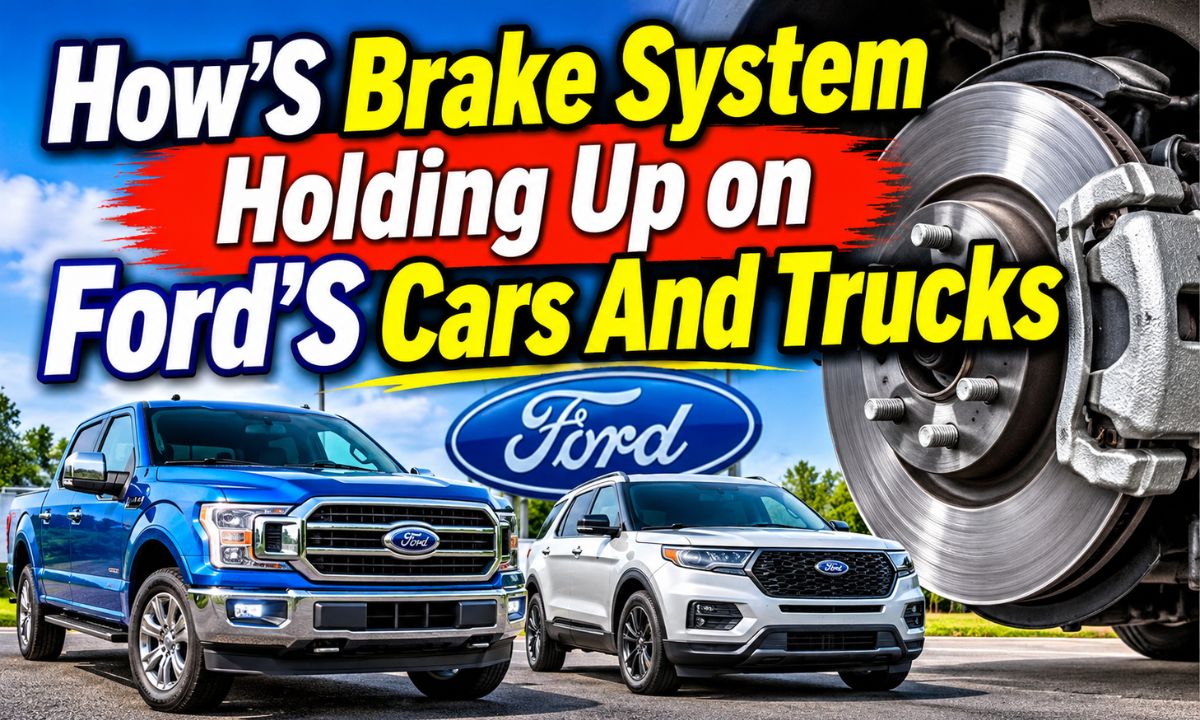
Ford brake systems offer several modern safety features, but reliability varies by model, year, maintenance, and specific component recalls.
For drivers across the United States, reliable brakes matter every day. Whether you drive a Ford F-150 through Texas, commute in a Ford Escape around Chicago, or use a Ford Super Duty to tow equipment across rural highways, your brakes must work when you need them. A dependable braking system is not just about stopping power. It also needs to respond well in rain, snow, traffic, and emergency situations.
So, how is the brake system holding up on Ford’s cars and trucks? The answer is mixed but not automatically negative. Ford uses modern braking technology, including anti-lock braking systems, electronic brake controls, and power-assisted braking. However, documented recalls and service concerns involving certain model years show that some components need close attention. These problems do not affect every Ford vehicle, and a recall affecting one model should not be treated as proof that the entire brand has poor brakes.
Recent safety records make this question worth examining. For example, certain 2025 Ford F-150, Bronco, Ranger, and Expedition vehicles were included in a 2025 recall involving the electronic brake booster. In February 2026, another recall covered certain 2025 Ford Transit vehicles because a brake pedal connection could separate. These are specific safety concerns, not evidence that every Ford vehicle has the same problem.
The best way to judge your Ford’s braking performance is to consider its model year, recall status, service history, and current symptoms. This guide explains how Ford brakes work, which documented concerns deserve attention, how to spot trouble, and when to seek professional help.
Ford’s braking systems are generally built around familiar and proven automotive technology. Most models use hydraulic disc brakes, electronic controls, and power assistance. The exact setup depends on the vehicle. A compact SUV, an electric crossover, a full-size pickup, and a heavy-duty work truck do not all use identical braking hardware.
There is no single reliability score that can fairly describe every Ford brake system. A well-maintained older vehicle may stop reliably for years, while a newer vehicle can still have a manufacturing defect or software-related issue. The condition of the individual vehicle matters more than the Ford badge alone.
Consumer Reports’ 2026 brand information gives useful background on Ford’s broader vehicle reliability, but overall brand reliability does not establish brake-specific performance. Brake systems need their own inspection and recall review. It would be misleading to use a general vehicle reliability ranking as proof that Ford brakes are either excellent or poor.
The main takeaway is that Ford’s braking technology is capable, but owners should pay attention to model-specific recalls and warning signs. A vehicle that stops smoothly, has no warning lights, and passes regular inspections is in a different position from one with a leaking brake line or an unresolved safety recall.
Modern braking technology
Many Ford vehicles include ABS, electronic brake-force control, stability control, and power-assisted braking. These systems help drivers maintain control during braking.
Different vehicle demands
An F-150 used for towing has different braking demands from a Mustang used for daily commuting. Vehicle weight, tires, load, and driving conditions all affect brake performance.
Model-specific concerns
Certain production batches have documented brake-related recalls. These should be checked by VIN rather than assumed to affect every vehicle of the same name.
Does Ford Use Reliable Brake Technology?
Ford uses established braking designs supported by electronic safety systems. Disc brakes convert motion into heat through friction between the brake pads and rotors. Hydraulic pressure moves the calipers, which press the pads against the rotors when the driver pushes the pedal.
ABS helps prevent the wheels from locking during hard braking. It can help the driver maintain steering control, especially on slippery roads. However, ABS cannot overcome poor tires, excessive speed, or unsafe road conditions.
Power assistance reduces the effort needed to press the pedal. Newer vehicles may use electronic brake boosters rather than relying only on older vacuum-assisted designs. This technology offers useful control features, but it also adds electronic parts that need proper diagnosis.
Hydraulic braking
Uses brake fluid to transfer pedal force to the wheel brakes.
Anti-lock braking
Helps prevent wheel lock during hard braking.
Electronic brake assistance
Helps provide braking support through electronic controls and booster components.
Recent Ford Brake Recalls and Documented Concerns
Recent recalls show why Ford owners should check their VIN instead of relying on general statements about brake reliability. A recall applies to specific vehicles and production groups. Two vehicles with the same model name and model year may not both be included.
One important example is NHTSA recall 25V488, announced in July 2025. It involved certain 2025 Ford F-150, Bronco, Ranger, and Expedition vehicles, along with the 2025 Lincoln Navigator. The reported concern involved the electronic brake booster module, which could malfunction and cause a loss of power brake assistance.
A later recall, NHTSA 25V823, announced in December 2025, addressed a related electronic brake booster concern in certain 2025 vehicles. The affected population and remedy must be considered separately from the earlier recall. Ford’s recall documentation describes replacement of the affected electronic brake booster as the remedy for the relevant vehicles.
Another serious example appeared in February 2026. NHTSA recall 26V090 covered certain 2025 Ford Transit vehicles. The brake pedal could disconnect from the brake booster pushrod because of a missing or improperly installed retaining connection. NHTSA listed 15,965 potentially affected vehicles and advised owners not to drive affected vehicles until the repair was completed.
These examples establish that real brake-related safety issues have occurred in specific Ford production groups. They do not establish a universal defect across Ford cars and trucks. The right response is to check the exact vehicle and make sure every applicable recall repair has been completed.
Source: vecteezy.com
2025 electronic brake booster recall
NHTSA recall 25V488 involved certain 2025 Ford F-150, Bronco, Ranger, and Expedition vehicles. A malfunction in the electronic brake booster could cause a loss of power brake assistance.
December 2025 brake booster recall
NHTSA recall 25V823 covered a smaller group of certain 2025 Ford and Lincoln vehicles involving the electronic brake booster module. Owners should check their VIN and repair status.
2025 Ford Transit pedal connection recall
NHTSA recall 26V090 covered certain Transit vehicles where the brake pedal could disconnect from the booster pushrod. Owners of affected vehicles were instructed not to drive until the repair was completed.
2022-2024 Expedition brake line concern
Recall 25S47 covered certain Ford Expedition and Lincoln Navigator SUVs. A front brake line could contact another component, potentially causing damage, a fluid leak, and reduced braking performance.
What Happened With the Ford Expedition and Navigator Brake Lines?
In May 2025, Ford announced a recall involving certain 2022-2024 Ford Expedition and Lincoln Navigator SUVs. The concern involved front brake lines that could contact an engine air cleaner outlet pipe. Continued contact could damage the line and cause brake fluid to leak.
The reported consequences included increased brake pedal travel, reduced braking performance, and the possibility of losing braking function. The Associated Press reported that the recall covered 223,315 Expeditions and 50,474 Navigators. Ford estimated that approximately one percent of the affected population had the defect.
Dealers were instructed to inspect the relevant components and replace the brake line or air cleaner outlet pipe when needed. The repair was provided without charge for vehicles covered by the recall.
This case is a useful reminder that a brake problem may begin with a part that is not normally considered a brake component. A nearby pipe or mounting issue can affect a brake line and create a serious safety concern.
Possible warning signs
A longer pedal stroke, reduced stopping performance, or a red brake warning light may indicate a problem.
Recommended response
Check the VIN for recall eligibility and arrange the required dealer inspection. Do not ignore suspected brake fluid loss.
Are These Recalls Proof That All Ford Brakes Are Unreliable?
No. A recall identifies a safety problem in a defined group of vehicles. It does not mean every vehicle from the same manufacturer has the defect. Some recalls involve a particular part, supplier, software version, assembly plant, or production date.
It is also important to distinguish a recall from a technical service bulletin. A recall addresses a safety defect or regulatory noncompliance and includes a defined remedy. A service bulletin provides repair information to dealers and does not automatically mean every listed vehicle is unsafe.
Owners should use official recall records, not social media reports or broad claims about a whole brand, to decide whether their vehicle needs attention.
Recall
A formal safety action for eligible vehicles, generally repaired without charge under the recall program.
Technical service bulletin
A manufacturer communication describing a known concern and possible repair procedure. It is not automatically a safety recall.
Common Brake Problems Ford Owners Should Watch For
Most brake problems give drivers some warning before they become severe. A new sound, change in pedal feel, vibration, or dashboard message can indicate that something needs attention. The important part is to identify the symptom early rather than waiting for the brakes to fail.
Some issues are related to normal wear. Brake pads become thinner with use, and rotors can develop uneven surfaces. Other problems, such as a damaged hydraulic line or a faulty electronic brake booster, need faster action.
A vehicle’s age, mileage, road conditions, and driving style affect wear. Stop-and-go traffic in cities such as New York or Los Angeles can increase brake use. Heavy towing, mountain driving, and repeated hard stops can also place more stress on the system.
Worn brake pads
Thin pads may produce squealing, grinding, or reduced braking performance. Grinding can mean the friction material is worn away and the metal backing is contacting the rotor.
Warped or uneven brake rotors
A vibration or pulsation through the pedal during braking can point to rotor thickness variation, uneven deposits, or other brake hardware problems.
Brake fluid leaks
Fluid near a wheel, a falling reservoir level, or a soft pedal can indicate a hydraulic leak. This is a serious concern.
Faulty brake booster
A failing booster may make the pedal feel unusually hard and increase the effort needed to slow the vehicle.
ABS sensor or electronic faults
A damaged wheel-speed sensor, wiring problem, or control module issue may activate the ABS warning light or affect electronic braking functions.
Why Does My Ford Brake Pedal Feel Soft?
A soft or spongy brake pedal can indicate air in the hydraulic system, a fluid leak, or another problem that prevents normal pressure from building. It should not be dismissed as ordinary brake wear.
If the pedal slowly sinks while you maintain steady pressure, a technician should inspect the master cylinder and the rest of the hydraulic system. A leaking brake line or wheel cylinder can also cause the pedal to feel unusual.
Do not attempt to solve a soft pedal by simply adding brake fluid. If the level is low, the cause must be found. Continuing to drive with a hydraulic problem can lead to a major loss of braking ability.
Soft pedal
May indicate air, a fluid leak, or a hydraulic fault.
Hard pedal
May indicate a power-assist problem or booster fault.
Sinking pedal
Requires prompt inspection for a master cylinder or hydraulic problem.
Why Do Ford Brakes Make Squealing or Grinding Sounds?
Brake noise does not always mean a major failure. Light squealing can occur because of moisture, surface rust, dust, pad material, or normal vibration. A vehicle parked outdoors after rain may make a brief noise when the brakes are first used.
However, persistent squealing may indicate worn pads or a hardware issue. Grinding is more concerning because it can mean the pads have worn down far enough for metal parts to contact the rotors.
If you hear loud grinding, notice reduced stopping power, or feel unusual vibration, stop driving when safe and arrange an inspection. Replacing worn pads early may help prevent more expensive rotor damage.
Brief noise after rain
May come from a thin layer of surface rust on the brake rotors.
Repeated high-pitched squeal
May indicate worn pads or vibrating brake hardware.
Metal-on-metal grinding
Needs immediate attention because the braking surface may be damaged.
Why Does My Ford Shake When I Apply the Brakes?
A shaking steering wheel or pulsating pedal during braking may be linked to uneven rotor thickness, brake deposits, loose components, or suspension problems. The location and timing of the vibration help a technician narrow down the cause.
For example, a vibration felt mainly through the steering wheel may point toward a front-end issue. A vibration felt through the seat or body may have a different source. These clues are useful, but they do not replace an inspection.
A technician should check rotor condition, pad contact, caliper movement, wheel fasteners, tires, and suspension parts before recommending a repair.
Front-end vibration
May involve front rotors, calipers, tires, or suspension components.
Brake pedal pulsation
Can be associated with rotor variation or normal ABS operation during an emergency stop.
How Ford’s ABS and Electronic Brake Systems Work
Ford’s ABS and electronic braking systems are designed to support vehicle control during braking. They do not replace the driver’s need to maintain a safe speed and distance. Understanding their purpose helps owners respond correctly when a warning appears.
ABS monitors wheel speed and can reduce brake pressure at an individual wheel when it detects a risk of wheel lock. This can help preserve steering control during hard stops. Drivers may feel a rapid pedal pulse or hear a mechanical sound when ABS activates.
Electronic stability control uses information from vehicle sensors to help manage unwanted movement. Depending on the vehicle, it can apply braking force to selected wheels and reduce engine power to help the driver maintain control.
Electronic brake boosters and related control modules are more complex than traditional mechanical assistance systems. A warning message may result from a sensor, wiring, software, or hardware problem. Proper diagnostic equipment is often needed to identify the actual cause.
Source: stock.adobe.com
ABS
Helps prevent wheel lock during hard braking and supports steering control.
Electronic stability control
Can apply selective braking to help reduce unwanted vehicle movement.
Electronic brake booster
Provides power assistance through electronically controlled components.
Brake-force distribution
Helps manage braking force between the wheels according to the vehicle’s design and operating conditions.
What Does the ABS Warning Light Mean?
An ABS warning light usually indicates a fault in the anti-lock braking function. According to Ford owner manual guidance, conventional braking may remain available when the ABS warning light is on by itself, but the anti-lock function may not work.
That does not mean the vehicle should be ignored. Have the system checked as soon as possible, especially before driving on wet, snowy, or slippery roads. The vehicle may not respond as expected during emergency braking.
If the red brake warning light appears with the ABS warning light, the situation is more serious. Follow the vehicle’s manual, stop in a safe place, and arrange professional assistance.
ABS light alone
Indicates an anti-lock system fault. Conventional braking may remain, but the vehicle needs inspection.
ABS and red brake lights together
Can indicate a more serious braking fault. Stop safely and do not assume normal braking is available.
What Does the Check Brake System Message Mean?
The Check Brake System message can have different causes depending on the Ford model and year. It may relate to a brake booster sensor, fluid level, electronic control fault, or another braking system issue.
A Ford service communication from February 2024 described a brake vacuum sensor concern on certain 2023-2024 F-250 and F-350 vehicles. In the affected group, water entering the sensor during factory testing could trigger a warning message and diagnostic trouble codes. The communication stated that the condition did not reduce stopping performance because the vacuum boost system remained functional.
That example shows why a dashboard message needs proper diagnosis. One warning can have different causes across different Ford models. Do not assume that a message is harmless just because another vehicle experienced a sensor-only issue.
Check the owner’s manual and arrange a diagnostic scan. If the pedal feels different, the brakes respond poorly, or a red warning remains active, do not continue driving.
Possible sensor problem
A faulty sensor or connection can trigger a brake system message.
Possible hydraulic problem
Low fluid or a leak can trigger a warning and may reduce braking performance.
Possible electronic fault
A control module or software issue may require a professional diagnostic procedure.
How Ford Brakes Compare Across Cars, SUVs, and Trucks
Ford uses different brake configurations across its vehicle range. Comparing a Mustang, Escape, Explorer, F-150, and Super Duty as though they have identical braking systems would be inaccurate.
Passenger cars and smaller SUVs generally have lower weight and different braking demands from large pickups. Trucks may carry heavy loads, tow trailers, or travel on steep grades. These conditions increase the need for correct brake maintenance and suitable replacement parts.
The best comparison is not which model has the strongest brakes based on its name. It is whether the braking system is appropriate for the vehicle’s weight, intended use, condition, and factory specifications.
Ford Mustang
A performance-oriented car may have brake hardware designed for stronger braking demands. Pad, rotor, tire, and fluid condition are important.
Ford Escape
A compact SUV used for commuting needs routine pad, rotor, tire, and fluid inspections.
Ford Explorer
A larger SUV carries more weight and may experience greater brake demand when fully loaded.
Ford F-150
A full-size pickup may tow or carry heavy loads. Owners should follow the truck’s towing and maintenance guidance.
Ford Super Duty
Heavy-duty trucks face demanding work conditions. Brake condition, trailer setup, and load limits deserve close attention.
Ford Transit
Commercial vans may accumulate substantial mileage and carry changing loads. Fleet owners should follow a consistent inspection schedule and check applicable recalls.
Are Ford F-150 Brakes Reliable for Daily Driving?
The Ford F-150 is designed for a wide range of tasks, from everyday commuting to towing and work use. Its brakes must handle changes in vehicle load and road conditions. Regular inspection is especially important for owners who frequently tow trailers or carry heavy cargo.
Certain 2025 F-150 vehicles were included in the electronic brake booster recalls discussed earlier. That does not mean every F-150 has a defective booster. Owners should check the VIN to see whether their individual truck is included.
A properly maintained F-150 with no unresolved recalls and no braking symptoms can continue to serve as a daily vehicle. Pay attention to pedal feel, unusual sounds, fluid condition, and any new dashboard messages.
For commuters
Monitor ordinary brake wear and have unusual pedal changes checked.
For towing
Follow the truck’s towing limits and inspect both vehicle and trailer braking systems.
For work trucks
Pay attention to repeated heavy braking, loaded driving, and service intervals.
Do Ford SUVs Have More Brake Problems?
There is not enough evidence to conclude that Ford SUVs as a category have more brake problems than Ford cars or trucks. Model-specific recalls are useful, but they cannot establish a general failure rate across the entire SUV range.
The 2022-2024 Expedition recall involving possible front brake line contact is an example of a specific SUV concern. It should not be applied to every Explorer, Escape, Bronco, or Expedition without checking the vehicle’s VIN and production details.
SUV owners should focus on their own vehicle’s service records, tire condition, brake pad wear, rotor condition, and open recalls.
Check model-year coverage
Do not assume a recall affecting one SUV applies to another.
Inspect under load
A fully occupied or loaded SUV may place different demands on the braking system.
How to Check Whether Your Ford Has an Open Brake Recall
Checking your Ford’s recall status is one of the most useful steps you can take to protect yourself. The National Highway Traffic Safety Administration provides a free VIN lookup for U.S. vehicles. Ford also provides an official recall lookup service.
A 17-character vehicle identification number is usually visible through the windshield on the driver’s side. You may also find it on the vehicle registration or insurance documents. Use the exact number because a model name alone cannot identify every eligible vehicle.
A VIN search can show unrepaired recalls associated with that particular vehicle. If a brake-related recall appears, read the instructions and contact an authorized Ford dealer to arrange the repair. Recall repairs are generally provided without charge for eligible vehicles.
Step 1: Find your VIN
Look at the lower driver’s side of the windshield or check your vehicle documents.
Step 2: Visit NHTSA
Open https://www.nhtsa.gov/recalls and enter your 17-character VIN.
Step 3: Review the results
Look for open recalls involving service brakes, hydraulic lines, electronic brake boosters, or brake controls.
Step 4: Contact Ford
Ask an authorized dealer to confirm the repair instructions and arrange service if your vehicle is affected.
Step 5: Keep the repair record
Save the completed recall paperwork and confirm that the repair has been recorded.
What If the VIN Search Shows No Open Recalls?
A result showing no unrepaired recalls is useful, but it does not certify that the braking system is in perfect condition. Normal wear, maintenance problems, and faults that have not resulted in a recall can still occur.
If you notice a soft pedal, grinding, a fluid leak, or a warning message, arrange an inspection even when the VIN search is clear. Recall checks and mechanical inspections serve different purposes.
Also ask a Ford dealer about applicable service communications if your vehicle has a repeated problem. A service bulletin may explain a known repair procedure even when no safety recall applies.
No open recall
Continue normal maintenance and investigate any braking symptoms.
Warning message remains
Arrange a diagnostic inspection rather than relying on the recall search.
How to Maintain Your Ford’s Brake System
Regular brake maintenance can help your Ford maintain predictable stopping performance. The best schedule depends on the model, driving conditions, and the maintenance information in the owner’s manual.
There is no single mileage interval that applies to every Ford. A truck used for frequent towing may need more frequent inspections than a car driven mostly on open highways. Stop-and-go traffic, steep roads, and harsh weather can also increase brake wear.
A qualified technician should inspect the full braking system, not just the pads. Hoses, lines, rotors, calipers, fluid, sensors, and electronic controls all contribute to proper operation.
Inspect brake pads
Check pad thickness and look for uneven wear. Replace pads according to the manufacturer’s specifications.
Check brake rotors
Inspect for scoring, corrosion, cracks, and thickness measurements outside the permitted limits.
Check brake fluid
Look for low fluid levels, leaks, and contamination. Use only the specified fluid type.
Inspect brake lines and hoses
Look for leaks, corrosion, cracking, damage, and contact with nearby parts.
Check electronic systems
Investigate ABS, brake booster, and stability control warnings using suitable diagnostic equipment.
How Often Should Ford Brake Fluid Be Changed?
Brake fluid service intervals vary by Ford model and year. Owners should check the maintenance schedule for their exact vehicle instead of following a universal time or mileage rule.
Brake fluid absorbs moisture over time. Excess moisture can reduce its ability to perform under high heat and may contribute to internal corrosion. A technician can inspect the fluid and determine whether replacement is due.
Do not mix different brake fluid types unless the owner’s manual specifically allows it. Using the wrong fluid can damage components and create a safety problem.
Follow the owner’s manual
Use the fluid type and service interval specified for the vehicle.
Check for leaks first
Replacing fluid will not repair a damaged hose, leaking line, or faulty master cylinder.
Does Towing Affect Ford Truck Brakes?
Yes. Towing adds weight and increases the energy that the braking system must manage. Repeated stops with a heavy trailer can produce more heat and place greater demands on the truck’s brakes.
Use the trailer braking equipment required for the setup and follow Ford’s towing instructions. Confirm that the trailer brake controller and trailer brakes operate correctly before traveling.
Avoid riding the brakes on long downhill roads. Follow safe downhill driving practices and use the vehicle’s approved engine braking or transmission features where appropriate.
Check trailer brakes
Make sure the trailer braking system and electrical connections work correctly.
Respect load limits
Stay within the truck’s rated towing, payload, and axle limits.
Watch for overheating
A burning smell, smoke, or major change in brake response requires a safe stop and professional inspection.
When Is It Unsafe to Drive a Ford With Brake Problems?
Some brake symptoms require the driver to stop using the vehicle immediately. The most important warning signs are a sudden loss of braking force, a pedal that sinks toward the floor, a major fluid leak, or a brake pedal that feels loose or disconnected.
A red brake warning light that remains on after the parking brake is released can indicate low fluid or a brake system fault. Ford owner manual guidance warns that driving with the brake warning lamp on can lead to reduced braking performance and longer stopping distances.
If you suspect that your vehicle cannot stop safely, do not drive it to a repair shop. Pull over in a safe location if possible, switch on the hazard lights, and arrange towing or emergency assistance.
A recall notice with a do-not-drive instruction must be treated seriously. For example, NHTSA recall 26V090 specifically instructed owners of affected 2025 Transit vehicles not to drive until the required repair was completed.
Stop driving immediately
If braking function is lost, the pedal becomes disconnected, or the vehicle cannot slow normally, stop safely and arrange towing.
Seek urgent inspection
A soft pedal, sinking pedal, suspected fluid leak, or red brake warning light needs prompt professional attention.
Arrange a diagnostic check
An ABS light or electronic brake warning needs investigation even if ordinary braking still seems normal.
Follow recall instructions
Do not drive a recalled vehicle when the manufacturer or NHTSA has issued a do-not-drive instruction.
Can You Drive With the ABS Light On?
Some Ford owner manuals explain that conventional braking may remain available when the ABS warning light appears by itself. However, the anti-lock function may be unavailable, which can affect control during emergency braking.
That is not permission to ignore the warning. Arrange an inspection as soon as possible and use extra care while getting professional assistance. If the red brake warning light also appears, or braking performance changes, stop safely and do not continue driving.
Always follow the instructions in the owner’s manual for your specific model and year because warning systems can differ.
ABS warning only
The conventional brake system may still function, but the anti-lock feature may not.
ABS plus brake warning
Treat the combination as a serious fault and arrange professional assistance.
What Ford Owners Should Ask a Brake Technician
A clear inspection report makes it easier to understand whether your Ford needs routine maintenance or a major repair. Do not settle for a vague statement that the brakes are bad. Ask the technician to identify the affected parts and explain the measurements or diagnostic codes behind the recommendation.
This is especially useful when a vehicle has an electronic brake warning. A warning message does not always identify the failed part. A proper scan and physical inspection can help separate a sensor fault from a hydraulic or mechanical problem.
What caused the warning light?
Ask for the diagnostic trouble codes and an explanation of what they mean.
How much pad material remains?
Ask for the measured pad thickness and whether wear is even across the wheels.
Are the rotors within specification?
Ask whether the rotor thickness and condition meet Ford’s requirements.
Is there a hydraulic leak?
Ask the technician to inspect the master cylinder, brake lines, hoses, calipers, and connections.
Are there open recalls or service actions?
Ask the dealer to check the VIN and explain whether any required repairs remain outstanding.
Can I safely drive the vehicle?
Ask for a clear answer based on the actual fault. If braking safety is uncertain, request towing instead.
Should You Use a Ford Dealer or an Independent Repair Shop?
Both authorized Ford dealers and qualified independent repair shops can perform many routine brake services. An independent shop may be suitable for pad, rotor, and hydraulic maintenance when it has the right tools, parts, and experience.
An authorized Ford dealer is a sensible choice for unresolved recalls, factory-specific diagnostic procedures, software updates, and warranty-related work. Recall repairs should be arranged through the authorized recall process.
Whichever shop you choose, ask for a written estimate, the parts being replaced, and the reason for the repair. Good documentation helps with future maintenance and resale.
Choose a Ford dealer
For recall repairs, Ford-specific software work, and concerns that require manufacturer procedures.
Choose a qualified independent shop
For routine brake inspections and repairs when the shop has the right equipment and experience.
What Is the Overall Outlook for Ford Brake Reliability?
The overall outlook is neither completely positive nor completely negative. Ford uses established braking technology and modern electronic safety systems. At the same time, documented recalls involving brake lines, electronic boosters, and pedal connections show that specific vehicles can have serious defects.
The most useful distinction is between brand-wide claims and individual vehicle evidence. A recall affecting a limited production group does not prove that every Ford car or truck is unreliable. Equally, a vehicle that has not been recalled should not be assumed to have perfect brakes.
Owners who check recalls, follow maintenance schedules, and respond quickly to warning signs have a clearer picture of their vehicle’s safety. This is especially important for commercial vans, heavy-duty pickups, and trucks used for frequent towing.
For anyone shopping for a used Ford, ask for maintenance records and check the VIN before buying. Have the braking system inspected by an independent qualified technician if the history is unclear. A clean recall result is useful, but a full mechanical inspection remains important.
Good technology does not prevent every defect
Modern ABS and electronic assistance improve braking control but cannot eliminate component or manufacturing failures.
Recalls need individual checks
VIN-specific records are more useful than broad claims about Ford’s entire vehicle lineup.
Maintenance matters
Brake pads, rotors, fluid, hoses, and electronic controls all need proper attention.
Safety comes first
Never ignore a sudden change in pedal feel, a fluid leak, or a serious brake warning.
Is a Used Ford Worth Buying?
A used Ford can be a reasonable purchase when its condition, maintenance history, and recall status are satisfactory. The exact model and year matter more than a general statement about the brand.
Before buying, check the VIN for open recalls, review the service history, and arrange a pre-purchase inspection. Ask the technician to inspect brake pads, rotors, calipers, hoses, fluid, and electronic brake systems.
If the seller cannot explain an active brake warning or refuses an independent inspection, consider walking away. Brake repairs can be expensive, but the greater concern is the safety of the vehicle.
Review service records
Look for documented brake inspections, repairs, and fluid services.
Check recall history
Confirm that applicable safety recall repairs have been completed.
Arrange an inspection
Have a qualified technician assess the complete braking system before purchase.
Research Notes and Important Evidence Limitations
This guide was prepared using U.S.-market manufacturer information, NHTSA recall documents, Ford owner manual guidance, and reporting from The Associated Press. The research date is November 5, 2026.
The reviewed evidence includes NHTSA recall 25V488, NHTSA recall 25V823, NHTSA recall 26V090, Ford recall information for the 2022-2024 Expedition and Navigator brake line issue, Ford’s February 2024 F-250 and F-350 brake vacuum sensor service communication, and Ford owner manual brake warning guidance.
The evidence establishes that specific Ford vehicles have experienced documented brake-related safety concerns. It does not establish the overall failure rate of every Ford braking system, the average stopping distance of all Ford models, or a brand-wide brake defect.
No independent hands-on brake testing was conducted for this article. No claim is made that the vehicles were personally inspected or driven. The discussion of symptoms and maintenance is general guidance and should not replace model-specific repair information or a professional inspection.
A useful competitor-content improvement is to separate recalls from ordinary maintenance issues, explain what different dashboard warnings mean, and give owners a clear VIN-check process. The next-question topics addressed here are brake pedal feel, towing demands, used-vehicle inspections, and when driving must stop.
DOCUMENTED
Official recall notices and Ford service communications identify specific components, vehicle groups, and remedies.
ANALYSIS
The effect of vehicle weight, towing, maintenance, and road conditions on brake demands is explained using established braking principles.
NOT ESTABLISHED
A universal Ford brake failure rate or a claim that every Ford model has the same braking problem.
NOT TESTED BY US
No first-hand road tests, workshop measurements, or comparative stopping-distance tests were performed.
Reader Question and Coverage Gap Map
The following questions are useful next steps inferred from the main topic and the reviewed technical information. They are not presented as verified search-volume findings or confirmed People Also Ask results.
Does my Ford have a brake recall?
Reader stage: ownership. Basis: inferred next need. Coverage: explained through the VIN lookup steps. Benefit: helps owners identify required safety repairs.
Can I drive with an ABS warning light?
Reader stage: troubleshooting. Basis: inferred next need. Coverage: explained with distinctions between ABS and red brake warnings. Benefit: reduces unsafe assumptions.
Why does my Ford brake pedal feel soft?
Reader stage: troubleshooting. Basis: inferred next need. Coverage: explained through hydraulic and booster symptoms. Benefit: helps identify urgent problems.
Do Ford truck brakes need more maintenance when towing?
Reader stage: maintenance. Basis: inferred next need. Coverage: explained through load, heat, and trailer braking. Benefit: supports safer towing.
Should I buy a used Ford with a brake warning?
Reader stage: purchase decision. Basis: inferred next need. Coverage: explained through recall checks and pre-purchase inspections. Benefit: helps avoid an unsafe purchase.
Frequently Asked Questions
Q
Are Ford brake systems reliable?
Ford brake systems use established hydraulic and electronic technology, but reliability varies by model, year, condition, and maintenance. Specific Ford vehicles have been included in brake-related recalls, so owners should check their VIN and service history. A well-maintained vehicle without unresolved safety concerns can still provide dependable braking.
Q
Which Ford models have had documented brake recalls?
Certain Ford F-150, Bronco, Ranger, Expedition, Transit, and Super Duty vehicles have appeared in documented brake-related safety actions. Certain 2022-2024 Expedition models were included in a brake line recall, while certain 2025 vehicles were affected by electronic booster or brake pedal connection concerns. Not every vehicle in these model ranges is affected. Check the exact VIN for eligibility.
Q
What causes a Check Brake System warning on a Ford?
Possible causes include low brake fluid, a hydraulic fault, a brake booster sensor problem, or an electronic control issue. The exact cause depends on the vehicle and diagnostic codes. If the warning appears while driving, follow the owner’s manual and arrange professional inspection. If braking performance changes or a red warning remains active, stop safely and arrange assistance.
Q
Can I drive my Ford with the ABS light on?
Some Ford owner manuals explain that conventional braking may remain available when the ABS light appears by itself. However, the anti-lock braking function may be unavailable. Have the system checked promptly. If the red brake warning light also appears or the pedal feels abnormal, do not continue driving.
Q
How long do Ford brake pads last?
There is no single lifespan for all Ford brake pads. Their service life depends on vehicle weight, driving habits, traffic, road conditions, towing, and pad material. Frequent city driving and heavy towing can increase wear. Have the pads inspected according to the maintenance schedule and replace them when they reach the manufacturer’s service limit.
Q
Does Ford fix brake recall problems for free?
Eligible safety recall repairs are generally provided without charge through an authorized Ford dealer. The exact repair depends on the recall and the vehicle’s VIN. Contact Ford or a dealer to confirm eligibility and arrange service. A normal repair that is not covered by a recall may have a separate cost.
Q
Why does my Ford make noise when braking?
Possible causes include moisture, surface rust, worn pads, vibrating brake hardware, or damaged rotors. A brief noise after rain may disappear after normal brake use. Persistent squealing or grinding needs inspection. Grinding, especially when combined with reduced stopping power, should be treated as urgent.
Q
Are Ford truck brakes strong enough for towing?
Ford trucks are designed for specific towing and load limits, but safe braking depends on the correct vehicle configuration, trailer brakes, maintenance, and driving conditions. Follow the owner’s manual and do not exceed the rated limits. Inspect the truck and trailer braking systems before towing.
Q
Should I buy a used Ford with an ABS warning light?
It is better to identify and repair the problem before buying. An ABS warning may indicate a sensor, wiring, or control module fault, and the anti-lock function may not be available. Arrange a diagnostic inspection, check open recalls, and obtain a written repair estimate before making a purchase decision.
Q
How can I check whether my Ford has an open brake recall?
Find the 17-character VIN and enter it into the official NHTSA recall lookup at https://www.nhtsa.gov/recalls. You can also use Ford’s official recall service. Review any open brake-related recalls and contact an authorized dealer to arrange the required repair.
✦ Wrapping Up
Conclusion
So, how is the brake system holding up on Ford’s cars and trucks? The fairest answer is that Ford uses modern braking technology, but some specific models and production groups have experienced documented safety concerns. Recent recalls involving electronic brake boosters, brake lines, and pedal connections show why owners should pay attention to their vehicle’s individual history.
These concerns should not be used to label every Ford car, SUV, or truck as unreliable. The condition of the braking system, completed recall repairs, driving habits, and maintenance records all matter. A Ford that has been properly maintained and has no unresolved safety defects is not in the same situation as a vehicle with a known hydraulic leak or a disconnected pedal assembly.
Whether you own a Mustang, Escape, Explorer, F-150, Super Duty, or Transit, make brake inspections part of regular vehicle care. Pay attention to warning lights, unusual sounds, changes in pedal feel, and reduced stopping performance. Check your VIN through NHTSA and contact Ford if a safety recall applies.
The most important point is simple: never take chances with a braking problem. Good maintenance, prompt diagnosis, and completed safety recalls help protect you, your passengers, and everyone sharing the road.
💡 Key Takeaway
Find your Ford’s 17-character VIN, check it at https://www.nhtsa.gov/recalls, confirm that all brake-related recalls are complete, and arrange a professional inspection if you notice any change in braking performance.