

A weak battery can cause some very strange problems. A car may click but not start. A flashlight may look fine until you switch it on. I learned that guessing wastes more time than grabbing a multimeter.
Learning How to Test a Battery with a Multimeter gives you a quick way to check battery voltage and spot many common problems. Below, I’ll show the simple method, explain the readings, and cover the mistakes that can throw off your test.
How to Test a Battery with a Multimeter Before You Start
Before testing, check what type of battery you have. The test is simple, but the voltage setting must match the battery.
For a common car battery, you will test DC voltage. Most car batteries are 12-volt lead-acid batteries. AA, AAA, and other small batteries have much lower voltage.
You do not need an expensive meter. A basic digital multimeter works well for a simple voltage test.
What You Need for the Test
Keep the setup simple. You mainly need the battery and a multimeter.
| Item | Why You Need It |
| Digital multimeter | Measures battery voltage |
| Battery | The power source you want to check |
| Clean probes | Give a better contact |
If the battery is in a car, turn the engine off before testing. Turn off lights, the radio, and other electrical loads too.
I also like to wait a few minutes after turning the car off. This helps the battery settle before I take the reading.
Set the Multimeter to DC Voltage
Look for the V symbol with a straight line or a DC voltage setting. Do not choose the current setting.
For a 12-volt car battery, select a range that can read above 12 volts. On a manual meter, the 20V DC range is a common choice.
Plug the black lead into COM. Plug the red lead into the V socket.
That small detail matters. I once spent more time checking the battery than checking my meter settings. The battery was fine. My setup was not.
How to Test a Car Battery with a Multimeter
Testing a car battery takes less than a minute once the meter is ready.
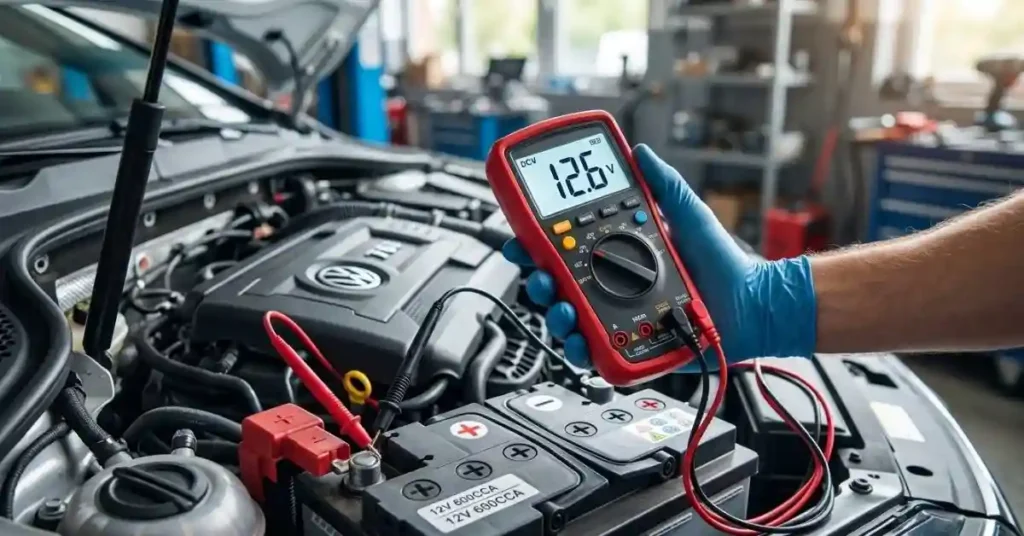
Place the black probe on the negative battery terminal. Place the red probe on the positive terminal. Make sure each probe touches clean metal.
The meter will show the battery’s voltage.
| Reading | General Meaning |
| About 12.6V or more | Well charged at rest |
| About 12.4V | Partly charged |
| About 12.2V | Low charge |
| Below 12.0V | Very low charge |
These numbers are useful guides, not a complete battery diagnosis. A battery can show a decent voltage and still fail under load.
Check the Battery at Rest
A resting voltage test is most useful when the battery has not been charging or running a load.
For a typical flooded or AGM 12V lead-acid battery, around 12.6 to 12.8 volts often indicates a full charge at rest. The exact value can vary with battery type, temperature, and recent use.
If I see 12.2V, I do not instantly call the battery bad. I first consider its state of charge.
That is one of the biggest lessons I learned from battery testing: low voltage does not always mean a dead battery.
It may simply need charging.
Check the Battery Terminals Too
Look closely at the battery terminals while you test.
Loose or dirty terminals can cause starting problems even when the battery itself is healthy. Corrosion can also make electrical contact poor.
| What You See | What It Can Mean |
| Clean, tight terminals | Good connection |
| White or blue crust | Corrosion |
| Loose cable | Poor connection |
Do not confuse a bad connection with a bad battery. Both can create similar symptoms.

How to Test a Battery with a Multimeter Under Load
A resting voltage test is useful, but it does not tell the whole story.
A battery can sit at a normal voltage and still struggle when a starter motor demands a lot of current. That is why a load test or starting-voltage check can reveal problems that a resting test misses.
If you are testing a car battery, watch the multimeter while the engine starts.
Have someone crank the engine while you watch the display. Keep your hands and loose clothing away from moving engine parts.
Watch for a Large Voltage Drop
A healthy battery should maintain enough voltage during cranking to operate the starter and vehicle electronics.
A common rule of thumb is that a 12V lead-acid battery should generally stay above about 9.6V during a short cranking test at around 70°F (21°C). Temperature and battery type can change the result.
| Cranking Reading | What to Check |
| Around 10V or higher | Often a better sign |
| Near 9.6V | Borderline area |
| Well below 9.6V | Battery or connection needs attention |
Do not treat one number as a final diagnosis.
A cold battery may show a bigger voltage drop. A weak starter can also affect cranking behavior. Bad cables and connections can cause voltage loss too.
This is where I stopped relying on a single multimeter reading. I started looking at the whole picture.
How to Test a Small Battery with a Multimeter
The same basic method works for AA, AAA, C, D, and many other batteries.
Set the multimeter to DC voltage. Touch the red probe to the positive end and the black probe to the negative end.
The exact voltage depends on the battery chemistry.
A fresh alkaline AA or AAA battery is usually around 1.5 volts when new. A rechargeable NiMH cell is usually around 1.2 volts.
| Battery Type | Typical Nominal Voltage |
| Alkaline AA/AAA | 1.5V |
| NiMH rechargeable AA/AAA | 1.2V |
| 9V alkaline | 9V |
| Lithium-ion cell | About 3.6–3.7V |
Nominal voltage is not the same as the exact voltage you will see on your meter.
A fresh alkaline battery can read above its stated 1.5V. A used battery will read lower.
Test the Battery Outside the Device
If possible, remove the battery from the device before testing it.
This gives you a cleaner reading. It also prevents the device from affecting the measurement.
For a battery-powered remote, for example, I would rather test the cells directly than guess from how the remote behaves.
What Different Battery Readings Can Tell You
Multimeter readings become much more useful when you compare them with the symptoms.
A low reading can point to a discharged battery. A normal reading with poor performance may point to another issue.
| Battery Symptom | Possible Cause |
| Low voltage | Discharged or weak battery |
| Normal voltage, poor starting | Weak battery, cables, or starter |
| Voltage drops fast | Battery may have poor capacity |
| Normal voltage, device fails | Device or connection problem |
This is why I avoid saying, “It reads 12 volts, so the battery is good.”
That statement sounds simple, but it leaves out too much.
Why a Battery Can Show Good Voltage and Still Be Bad
This is one of the most confusing parts of battery testing.
Voltage tells you electrical potential. It does not directly tell you how much current the battery can deliver or how much capacity it has left.
A worn car battery may show a reasonable resting voltage after charging. But when the starter asks for a large amount of current, the voltage may fall sharply.
Surface Charge Can Mislead You
A battery that was just charged may show a higher voltage than its true resting state.
This is sometimes called surface charge.
If I test a battery right after charging, I take the reading with caution. Letting the battery rest can give a more useful result.
Turning on the vehicle’s headlights for a short time can also remove some surface charge, but follow the battery and vehicle maker’s guidance when doing this.
Compare Before and After Charging
If a battery reads low, charge it fully and test it again after it rests.
This simple comparison can tell you much more than one quick reading.
If the voltage rises after charging and then holds reasonably well, the battery may have simply been discharged.
If it quickly drops again without a load, further testing may be needed.
Common Multimeter Mistakes I Had to Stop Making
The hardest part of battery testing is often not the battery. It is avoiding small testing errors.
Here are the ones worth remembering.
| Mistake | Better Approach |
| Using AC voltage | Select DC voltage |
| Wrong probe socket | Red lead goes in the voltage socket |
| Testing dirty terminals | Touch clean metal |
| Reading after charging | Let the battery rest |
| Trusting one reading | Compare voltage with symptoms |
I also learned not to press the probes too hard. You only need good contact.
And never place the probes across a battery while the meter is set to measure current. That can create a short circuit and may damage the meter or battery.
Can You Test a Battery Without Removing It?
Yes. For many car batteries, you can test the voltage while the battery remains installed.
This is often easier.
With the engine off, touch the probes to the battery terminals and read the resting voltage. You can then watch the meter during cranking if the setup is safe and you have someone helping.
You can also test charging voltage with the engine running.
Check the Alternator Too
A battery that keeps going flat may not be the real problem.
With the engine running, a typical 12V charging system may show roughly 13.5 to 14.8 volts at the battery, though the correct range varies by vehicle and charging system.
| Test | Typical Area to See |
| Engine off | Around 12.6V when fully charged |
| Engine cranking | Often stays above about 9.6V |
| Engine running | Often around 13.5–14.8V |
Modern vehicles can use smart charging systems, so do not judge every vehicle by the same fixed number.
If the running voltage seems wrong, the charging system, battery connections, or battery itself may need more testing.
How to Test a Battery with a Multimeter Safely
Battery testing is easy, but batteries can still be dangerous.
Car batteries can deliver very high current. Lead-acid batteries can also produce hydrogen gas during charging.
Keep sparks, flames, and cigarettes away from the battery.
Do not place metal tools across the terminals. Remove jewelry that could accidentally bridge a terminal and metal ground.
A Few Safety Habits I Always Use
- Wear eye protection when working around lead-acid batteries.
- Keep the probes from touching each other across the battery.
- Use the correct meter socket and voltage setting.
- Do not test a damaged or leaking battery.
- Keep sparks and flames away from charging batteries.
- Follow the battery maker’s safety instructions.
If the battery is swollen, cracked, leaking, or badly damaged, stop testing it and deal with the battery safely.
When a Multimeter Test Is Not Enough
A multimeter is excellent for checking voltage. It is not a complete battery tester.
If you need to know whether a car battery can deliver its rated starting power, a proper battery analyzer or load tester gives more useful information.
Modern electronic battery testers can also estimate battery condition using conductance or other methods.
If your car still will not start after the battery shows normal voltage, look beyond the battery.
Possible causes include:
- Loose battery terminals
- Corroded cables
- Bad ground connection
- Starter motor problems
- Charging-system faults
- Electrical drains
- Fuel or ignition problems
The multimeter helps narrow the problem down. It does not magically name the failed part.
My Simple Battery Testing Routine
When I want a quick answer, I follow the same order every time.
First, I inspect the battery and terminals. Then I set the meter to DC voltage and check the resting voltage. If the reading is low, I consider the battery’s state of charge before blaming the battery.
If the battery is charged but the car still struggles, I watch the voltage during cranking. After that, I check charging voltage with the engine running if needed.
That order saves time because each test gives me another clue.
| Step | What I Check |
| 1 | Battery condition and terminals |
| 2 | Resting voltage |
| 3 | Cranking voltage |
| 4 | Charging voltage |
| 5 | Connections and other faults |
Final Thoughts
Learning How to Test a Battery with a Multimeter is one of those small skills that becomes useful again and again. The key is not just reading the number. Look at the battery’s condition, charge level, connections, and behavior under load.
My biggest lesson is simple: do not diagnose a battery from one voltage reading alone. Use the multimeter as a clue, compare readings, and check the rest of the electrical system when the results do not make sense.

FAQs About How to Test a Battery with a Multimeter
1. How do you test a battery with a multimeter?
Set the meter to DC volts. Touch red to positive and black to negative. Read the voltage. A 12V car battery near 12.6V is well charged.
2. What voltage should a 12V car battery show?
A fully charged 12V car battery often reads about 12.6V at rest. A reading near 12.2V means the battery has a low charge.
3. Can a multimeter tell if a battery is bad?
A multimeter can show low voltage or a large voltage drop. But a load test may be needed to confirm a weak car battery.
4. Can you test a car battery without removing it?
Yes. You can test a car battery in place with a multimeter. Keep the engine off for a rest test, then check voltage while the engine cranks.
5. What does a low battery reading mean?
A low multimeter reading often means the battery has a low charge. Charge it, let it rest, and test again before calling it bad.
To Get More About Home, Car Tools Product You Can Visit Our Site. If You Found our Posts Helpful Leave a Comment Below