

When I started looking closely at high-mileage motor oil, one thing became clear: buying oil based only on the brand or price can be a mistake. Your engine needs the right viscosity and specifications first. After that, the high-mileage formula can make a lot more sense.
In this Mobil 1 High Mileage Motor Oil Review, I’m looking at the 5W-30 version and what it really offers for older vehicles. I’ll cover its high-mileage formula, current specifications, oil-change claims, real-world use, common mistakes, and whether I think it is a smart choice for a car with 75,000 miles or more.
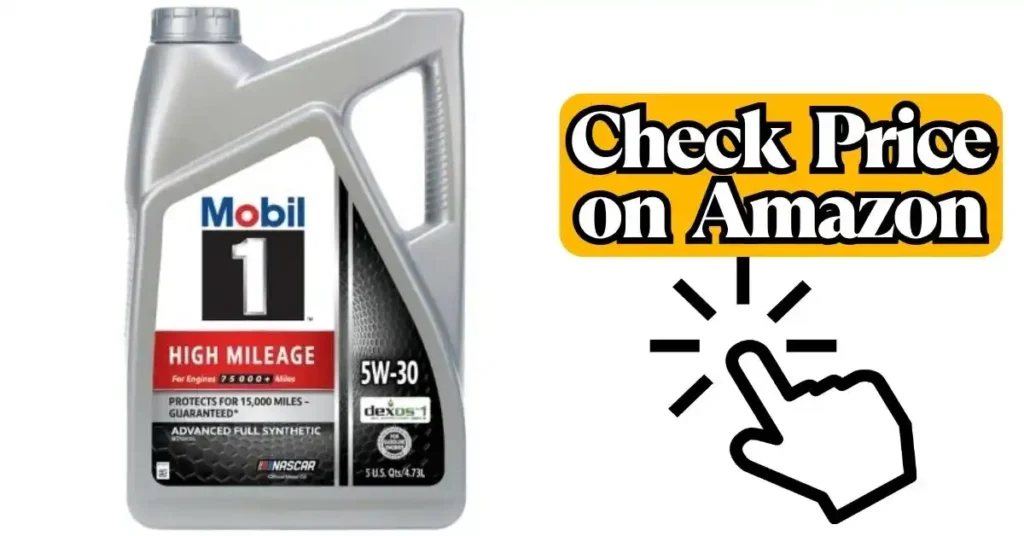
What Is Mobil 1 High Mileage Motor Oil?
Mobil 1 High Mileage is a full synthetic motor oil made for gasoline engines with more than 75,000 miles. The 5W-30 version is designed for cars, SUVs, light vans, and light trucks that call for SAE 5W-30 oil.
What caught my attention is that Mobil does not market this as simply “oil for old cars.” The formula is aimed at some of the problems that can become more important as an engine ages, such as deposits, leaks, and general wear. Mobil also says the oil contains additives that help fight sludge.
| Product Detail | What I Found |
| Oil type | Full synthetic |
| Viscosity | SAE 5W-30 |
| Target mileage | 75,000+ miles |
| Engine type | Modern gasoline engines |
| Claimed protection | 15,000 miles or 1 year |
One important point is easy to miss. High mileage does not automatically mean you should use 5W-30. Your owner’s manual still decides the correct viscosity and required specifications.
That was one of the first lessons I would keep in mind with any motor-oil purchase: mileage tells you what type of formula may help, but it does not tell you which viscosity your engine needs.
Why the 75,000-Mile Mark Matters
The 75,000-mile number is not a magic point where an engine suddenly becomes old.
Think of it more as a useful guide. As a vehicle racks up miles, seals, internal parts, and deposits can become bigger concerns. Mobil designed its High Mileage line around engines that have passed this point.
Does High Mileage Oil Fix an Old Engine?
No. This is one of the biggest misconceptions I would clear up before buying it.
High-mileage oil can support an aging engine, but it cannot repair worn piston rings, damaged seals, a failing bearing, or a mechanical oil leak.
| Problem | What High-Mileage Oil Can Do |
| Minor seal-related concerns | May help support seals |
| Sludge and deposits | Contains additives to help fight sludge |
| Mechanical damage | Cannot repair damaged parts |
| Low oil level | Cannot replace the need to check oil |
So if your engine is losing a quart of oil every few hundred miles, I would not treat a different oil as the complete solution. Find the reason for the oil loss first.
Mobil 1 High Mileage 5W-30: What Does 5W-30 Mean?
The “5W-30” on the bottle tells you the oil’s viscosity grade.
The first number, 5W, relates to how the oil behaves in colder conditions. The 30 describes its viscosity at normal engine operating temperature.
You do not need to become an oil expert to understand this. The simple rule is to use the viscosity listed by your vehicle manufacturer.
| If Your Manual Says | What I Would Do |
| 5W-30 | Mobil 1 High Mileage 5W-30 may be suitable |
| 0W-20 | Do not switch to 5W-30 just because the engine has high miles |
| 5W-20 | Check the exact required specifications before changing |
| Another grade | Use the manufacturer’s recommended grade |
This is where I think many online oil discussions go wrong. Someone may say, “My car has 150,000 miles, so thicker oil is better.” That is not a rule I would follow.
The engine designer knows the clearances, oil passages, and operating needs of that engine. Start there.
What Specifications Does Mobil 1 High Mileage 5W-30 Meet?
This is one of the strongest parts of the current product.
Mobil’s current information lists the 5W-30 High Mileage formula as meeting or exceeding API SQ and API SQ Resource Conserving, along with API SP and ILSAC GF-7A. The 5W-30 version also has a GM dexos1 license and is recommended for several Ford specifications.
| Specification | Why It Matters |
| API SQ | Current gasoline-engine oil performance category |
| ILSAC GF-7A | Current fuel-efficient gasoline-engine oil standard |
| GM dexos1 | GM licensing for applicable engines |
This is also why I would avoid relying on an old product description when researching motor oil. Specifications can change as formulations and industry standards move forward.
For a vehicle under warranty, I would always compare the exact requirement in the owner’s manual with the current bottle and technical data.
How Well Does It Protect a High-Mileage Engine?
This is where the product makes the most sense.
Mobil says the High Mileage formula is designed to help extend engine life in vehicles with more than 75,000 miles. It also says the oil contains additives that help fight sludge and is designed to help prevent leaks.
Sludge Protection
Sludge is one of those things you may never think about until it causes trouble.
Old oil, heat, deposits, and poor maintenance can all contribute to engine contamination. A quality oil with a strong additive package can help keep the engine cleaner.
Still, I would not use “sludge protection” as an excuse to ignore maintenance. Fresh oil and the correct change interval matter more than any marketing phrase on a bottle.
What About Oil Leaks?
The high-mileage formula is also aimed at helping older engines with seal-related concerns.
But there is a big difference between helping with minor seal issues and repairing an actual leak.
If oil is dripping onto your driveway, I would inspect the engine instead of hoping a high-mileage oil will solve it.
How Long Can Mobil 1 High Mileage 5W-30 Last?
Mobil currently states that this oil protects for 15,000 miles or one year, whichever comes first, under its stated guarantee.
That sounds impressive, but this is where I would slow down.
It does not mean every car should automatically go 15,000 miles between oil changes.
Mobil itself says owners should follow the vehicle’s oil-life sensor or the oil-change interval in the owner’s manual, especially when the vehicle is under warranty.
| Driving Situation | My Approach |
| Normal commuting | Follow the manufacturer’s interval |
| Heavy towing or severe use | Follow the severe-service schedule |
| Vehicle under warranty | Follow the manual or oil-life system |
| Older car with unknown history | Monitor oil level and condition closely |
I have learned that longer oil intervals are useful only when they match the vehicle and driving conditions. A big mileage number on the bottle should never replace the owner’s manual.
What I Like About Mobil 1 High Mileage Motor Oil
The more I look at this product, the more I see it as a balanced option rather than a gimmick.
It Is a Full Synthetic
The full synthetic base gives it a strong starting point for modern engine protection.
It Is Made for Higher-Mileage Vehicles
This is the main reason to choose it over a basic motor oil. Mobil specifically positions the product for engines beyond 75,000 miles.
The Current Specifications Are Strong
API SQ, ILSAC GF-7A, and GM dexos1 licensing give the 5W-30 version useful modern credentials where those specifications apply.
It Is Available in Several Viscosities
Mobil’s High Mileage range includes 0W-20, 5W-20, 5W-30, 10W-30, and 10W-40. That gives owners more options while still keeping the high-mileage focus.
| Strength | Why It Matters to Me |
| Full synthetic | Good fit for modern gasoline engines |
| High-mileage formula | Designed around 75,000+ mile vehicles |
| Current specifications | Easier to match with newer requirements |
| Sludge-fighting additives | Useful for long-term engine cleanliness |
| Multiple viscosity options | More choice for different vehicles |
Where Mobil 1 High Mileage 5W-30 Falls Short
No motor oil is perfect for every engine.
The biggest limitation is simple: 5W-30 must be the correct grade for your vehicle.
The second limitation is that high-mileage oil cannot fix mechanical problems.
And there is another point worth considering. Mobil sells an Extended Performance High Mileage version that claims up to 25,000 miles of protection, compared with 15,000 miles for the regular High Mileage product.
That does not automatically make the regular High Mileage oil a poor choice. It simply gives buyers another option.
Mobil 1 High Mileage vs Regular Mobil 1
This is probably the comparison I would make before buying.
Both products are full synthetic oils, and both have strong modern specifications. The main difference is the focus of the High Mileage formula.
| Feature | Mobil 1 High Mileage | Regular Mobil 1 |
| Full synthetic | Yes | Yes |
| Designed for 75,000+ miles | Yes | No |
| Sludge-fighting additives | Yes | Yes |
| High-mileage focus | Yes | General engine protection |
If your car has 90,000 or 150,000 miles and the required viscosity is available, I see a clear reason to consider the High Mileage version.
If your car has lower mileage and your manufacturer calls for the same viscosity and specifications, regular Mobil 1 may be perfectly reasonable.
Mobil 1 High Mileage vs Extended Performance High Mileage
This is another choice that can cause confusion.
The regular High Mileage product claims protection for 15,000 miles or one year. Mobil’s Extended Performance High Mileage line claims up to 25,000 miles or one year, whichever comes first.
| Product | Stated Protection |
| Mobil 1 High Mileage | 15,000 miles or 1 year |
| Mobil 1 Extended Performance High Mileage | 25,000 miles or 1 year |
I would not pay extra just to chase the bigger number, though.
If your vehicle’s maintenance schedule calls for an earlier oil change, follow that schedule. The longer protection claim is useful when it matches your vehicle and driving needs.
Common Mistakes I Would Avoid
There are a few mistakes that are easy to make when shopping for high-mileage oil.
Mistake 1: Choosing Oil by Mileage Alone
Your vehicle’s mileage does not tell you whether it needs 5W-30.
Mistake 2: Assuming Thicker Oil Is Always Better
A thicker oil is not automatically better for an older engine. Use the grade specified by the manufacturer.
Mistake 3: Treating Oil as an Engine Repair
If you have a serious leak, smoke, low oil pressure, or unusual engine noise, investigate the problem.
Mistake 4: Ignoring the Oil Level
Even excellent synthetic oil cannot protect an engine if there is not enough of it.
| Mistake | Better Approach |
| Pick oil based only on mileage | Check viscosity and specifications |
| Use thicker oil automatically | Follow the owner’s manual |
| Expect oil to repair leaks | Diagnose the mechanical problem |
| Never check the dipstick | Check oil level regularly |
Is Mobil 1 High Mileage Motor Oil Good for Older Cars?
Yes, if the viscosity and specifications match the engine.
That qualification is important.
For a gasoline vehicle with more than 75,000 miles that calls for 5W-30, this product makes a lot of sense. It combines a full synthetic formula with a high-mileage focus and current industry specifications.
I especially like that the product is not trying to solve every problem with one claim. It is still motor oil. Its job is to lubricate and protect the engine. Good maintenance is what turns that protection into long-term value.
Is Mobil 1 High Mileage 5W-30 Worth It?
For the right vehicle, I would say yes.
My biggest takeaway from researching this oil is that the high-mileage label is useful, but it should not be the only reason you buy it. The real question is whether your vehicle calls for 5W-30 and whether the required specifications match.
| Question | My Answer |
| Good for 75,000+ miles? | Yes |
| Full synthetic? | Yes |
| Good for every vehicle? | No |
| Can it fix an oil leak? | No |
| Does it have modern specifications? | Yes |
| Is it worth considering? | Yes, for compatible engines |
If your vehicle fits the application, I think this is one of the more sensible high-mileage oils to consider.
Final Thoughts on My Mobil 1 High Mileage Motor Oil Review
The biggest lesson here is simple: don’t choose motor oil by mileage alone. Start with the owner’s manual, confirm the viscosity and specifications, and then look at whether a high-mileage formula makes sense.
For a compatible gasoline engine with 75,000 miles or more, Mobil 1 High Mileage 5W-30 has a strong combination of full synthetic protection, high-mileage additives, and current API and ILSAC credentials. Mobil states that it is designed to protect for up to 15,000 miles or one year, but your vehicle’s own maintenance schedule should still guide your oil changes.
My honest view is that this oil is best seen as good preventative maintenance, not a repair product. If the engine is healthy, the viscosity is correct, and the specifications match, Mobil 1 High Mileage is a solid option for keeping a higher-mileage vehicle on the road.
To Get More About Home, Engine Oil Product You Can Visit Our Site. If You Found our Posts Helpful Leave a Comment Below