
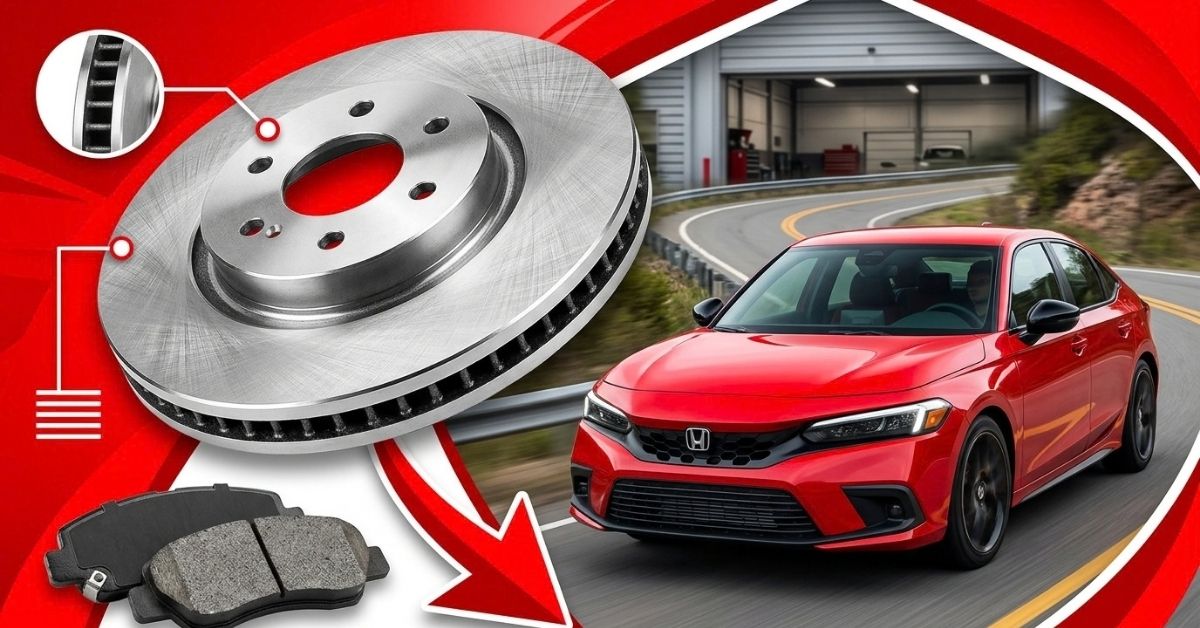
When I first looked into what brake rotors Honda uses, I found that the answer is not simply “Honda rotors.” The exact rotor depends on the model, year, trim, engine, and axle. Honda uses several different brake disc designs across its cars and SUVs.
The useful part is that Honda does follow a clear pattern. Genuine Honda rotors are made to the vehicle’s factory brake setup. Most Honda vehicles use ventilated front disc brakes, and many use four-wheel disc brakes.
What Brake Rotors Does Honda Use?
Honda uses vehicle-specific Genuine Honda brake discs, also called rotors. Most front rotors are ventilated, while rear rotors can be solid or ventilated depending on the Honda model and trim.
The rotors are generally iron-based brake discs built around the size, thickness, cooling, and fitment Honda designed for that vehicle.
| Honda rotor detail | What it means |
| Front design | Usually ventilated disc |
| Rear design | Varies by model |
| Material | Typically cast iron |
| Fitment | Vehicle and part-number specific |
This is one thing I would not guess when buying brakes. A rotor can look almost identical to another Honda rotor and still be wrong for the car.
Honda’s parts catalog shows many different rotor part numbers. For example, one genuine front rotor fits certain 2023–2026 HR-V models, while another fits a wide range of older and newer Honda vehicles.
Does Honda Use Cast Iron Brake Rotors?
Yes. Honda brake rotors are generally made from cast iron or a similar iron-based material.
That makes sense for a brake rotor. Cast iron handles the repeated heat from braking well and gives the pads a stable friction surface.
Aftermarket listings that cross-reference Honda OE numbers also commonly identify these applications as cast iron. For example, replacement rotors matching Honda applications for the Accord and Civic are listed as cast iron.
| Rotor material | Common use |
| Cast iron | Standard passenger-car brake rotors |
| Carbon-ceramic | High-end performance applications |
| Steel-only designs | Not typical for Honda car disc rotors |
So if you’re wondering whether a Honda needs some unusual exotic rotor material, the answer is usually no.
Why Does Honda Use Vented Front Rotors?
Honda uses ventilated front disc brakes to help control heat.
A ventilated rotor has internal fins between its two braking surfaces. As the rotor spins, air moves through these passages and carries heat away. Honda says this design helps reduce brake fade.
This matters because the front brakes often handle a large share of the braking work.
I used to think “vented” mostly meant a performance upgrade. It does not. On many normal Hondas, it is simply the factory design.
| Rotor type | Main advantage |
| Solid | Simple and often suitable for lighter-duty rear brakes |
| Vented | Moves heat away more effectively |
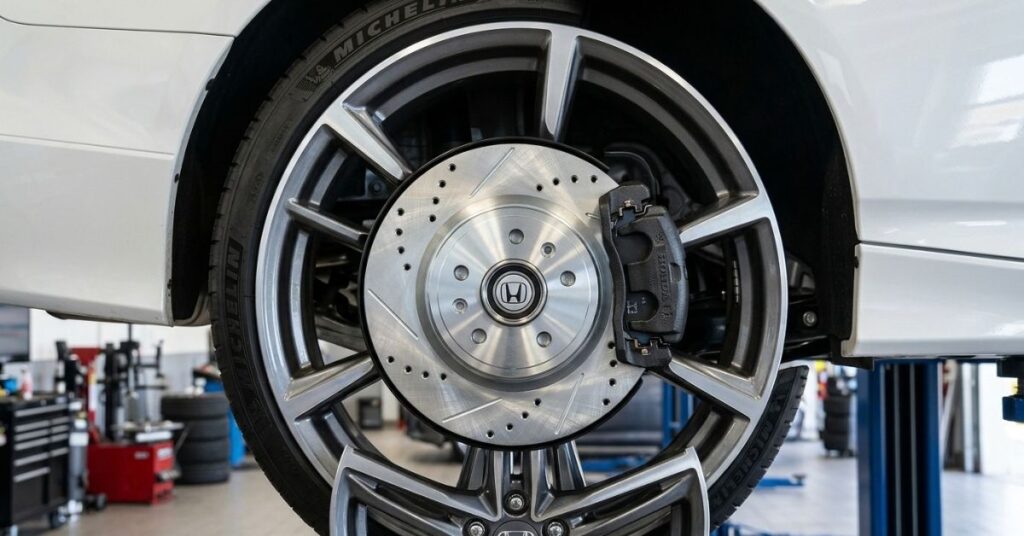
| Drilled | Adds holes through the rotor surface |
| Slotted | Adds grooves across the braking surface |
Honda’s standard design is not automatically drilled or slotted. Those are usually aftermarket design choices, not something you should assume came from the factory.
Are Honda Rear Rotors Solid or Vented?
It depends on the Honda.
Some Honda rear brakes use solid rotors. Others use different designs based on vehicle size, brake requirements, trim, and model year.
For example, a genuine Honda rear rotor for certain 2016–2026 Civic applications is listed as a solid rotor, with an 8 mm minimum thickness noted for that specific part.
That is why I would never order a “Honda rear rotor” without checking the exact application.
| Question | Correct approach |
| Front or rear? | Check the axle |
| Solid or vented? | Check the exact application |
| Rotor size? | Match the OE specification |
| Thickness? | Match the vehicle’s specification |
Does Honda Make Its Own Brake Rotors?
This is where the answer gets a little more complicated.
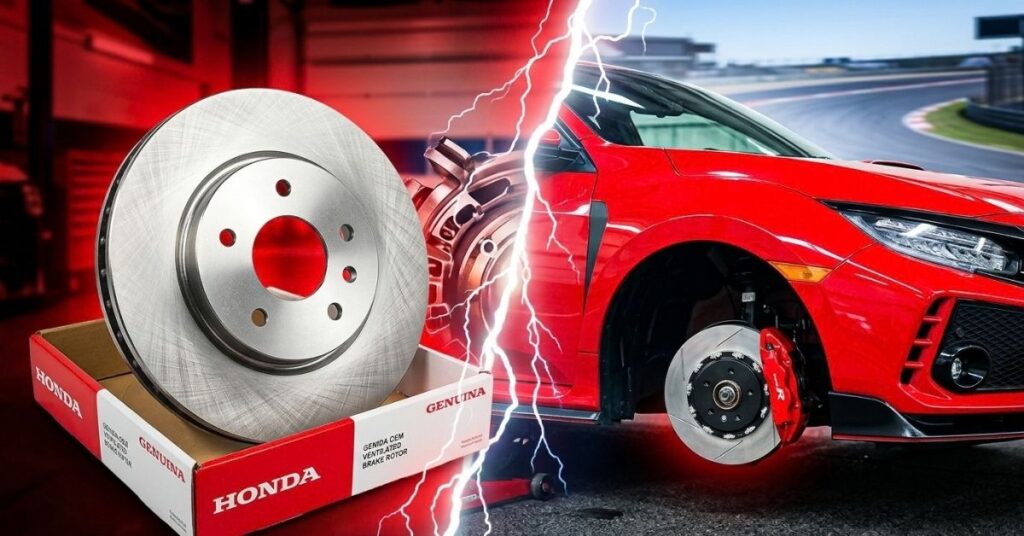
A Genuine Honda rotor is a Honda-branded replacement part intended for a specific Honda vehicle. But that does not mean Honda necessarily melts the iron and manufactures every rotor in a Honda-owned factory.
Automakers commonly work with specialized brake suppliers. Akebono, for example, identifies Honda among its OEM customers and says it supplies braking products to vehicle manufacturers.
So I would be careful with claims such as “every Honda rotor is made by supplier X.” The supplier can vary by application, production period, and market.
| Claim | What I would trust |
| “Genuine Honda rotor” | Honda part number and catalog |
| “Made by a specific supplier” | Supplier documentation |
| “Same as factory rotor” | Verified OE cross-reference |
| “Fits my Honda” | VIN or exact vehicle fitment |
The Honda part number is more useful than trying to identify the factory supplier from the casting.
What Is the Difference Between Honda OEM and Aftermarket Rotors?
This is probably the most useful question when you’re actually buying brakes.
A Genuine Honda rotor is designed as the factory replacement for a specific Honda application. An aftermarket rotor is made by another company and may also meet or exceed the required specifications.
That does not mean every aftermarket rotor is equal.
Some are basic replacement discs. Others have corrosion-resistant coatings, different finishes, or performance features.
| Rotor choice | What you get |
| Genuine Honda | Factory-specific Honda replacement |
| Quality aftermarket | Vehicle-specific alternative |
| Performance aftermarket | Extra design features for specific uses |
Honda itself recommends using parts designed for the specific model and year rather than assuming parts can be swapped between models.
Are Aftermarket Rotors as Good as Honda Rotors?
A good aftermarket rotor can work very well. The key is choosing one that matches the vehicle’s required dimensions and brake design.
This is where I think brake shopping gets unnecessarily confusing. A cheap rotor may look like a bargain until you deal with poor fit, surface problems, corrosion, vibration, or short service life.
On the other hand, you do not necessarily need an expensive drilled and slotted rotor for a Honda that spends its life commuting.
What Should You Look for in a Honda Brake Rotor?
I would focus on fit and specifications before brand names.
The important measurements include rotor diameter, thickness, height, center bore, bolt pattern, and whether the rotor is solid or vented.
The exact requirements vary by Honda.
| Specification | Why it matters |
| Diameter | Must match the brake assembly |
| Thickness | Must match the caliper and pad setup |
| Center bore | Helps the rotor seat correctly |
| Bolt pattern | Must match the wheel hub |
| Venting | Must match the brake design |
A rotor that is only slightly different can cause problems. This is why “it looks the same” is not enough.
Honda’s parts listings repeatedly tell buyers to verify fitment by vehicle or VIN.
Do Honda Rotors Come in Pairs?
Usually, no.
This caught my attention because people sometimes assume that ordering a rotor means getting two.
Genuine Honda rotor listings commonly specify a quantity of one. For example, Honda’s 45251-TBA-A00 front brake disc is listed as one rotor, while the rear 42510-TBA-A00 is also sold separately.
| Order quantity | What it means |
| 1 rotor | One wheel position |
| 2 rotors | Both sides of one axle |
| 4 rotors | All four wheel positions |
For normal brake service, replacing both rotors on the same axle is usually the practical approach when both need replacement.
Honda Rotor Problems I Would Not Ignore
A brake rotor does not need to be completely destroyed before it needs attention.
You may notice vibration, noise, uneven braking, or a visible ridge around the rotor.
But here’s a mistake worth avoiding: don’t automatically blame every brake vibration on a warped rotor.
Other brake and wheel issues can create similar symptoms.
| Symptom | Possible cause |
| Steering wheel shakes while braking | Front brake or wheel issue |
| Pedal pulsates | Rotor thickness variation or related brake issue |
| Grinding sound | Worn pad or damaged brake surface |
| Blue or dark rotor spots | Excessive heat |
| Deep grooves | Worn pad or debris |
A proper inspection matters more than simply buying new rotors.
Sometimes the rotor is fine and the real problem is a stuck caliper, worn suspension part, bad wheel bearing, uneven pad wear, or another issue.
Should You Buy Genuine Honda Rotors?
There is no single answer for every Honda owner.
Genuine Honda rotors make sense when you want the factory-specified replacement and do not want to spend time comparing aftermarket specifications.
A quality aftermarket rotor can also make sense when it has the correct application and comes from a reputable manufacturer.
| Situation | Sensible approach |
| Factory replacement | Genuine Honda rotor |
| Normal daily driving | Quality OE-style aftermarket |
| Performance driving | Purpose-built performance rotor |
| Unsure about fitment | Verify by VIN |
I would not pay extra for drilled or slotted rotors just because they look more serious. For a normal street Honda, the factory-style design is often exactly what the brake system was built around.
What Honda Rotor Should You Buy for Your Car?
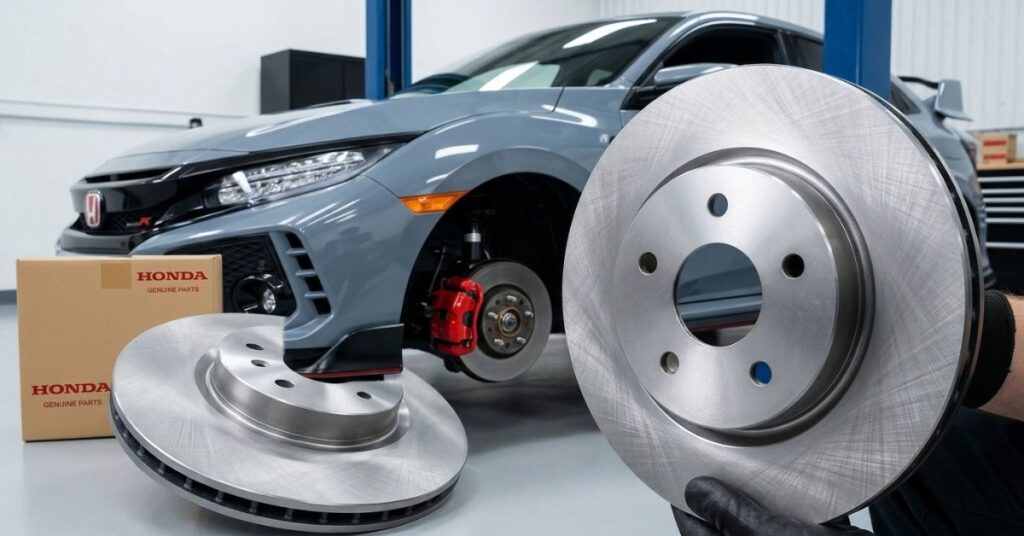
The safest answer is: buy the rotor that matches your exact Honda model, year, trim, and brake configuration.
Don’t search only for “Honda Civic rotor” or “Honda Accord rotor.” There can be several brake setups within one model family.
For example, Honda’s catalog contains different genuine rotor part numbers for different generations and applications. One front rotor can fit a group of Accord models, while another rotor fits a different group of vehicles.
Use the VIN When You Are Unsure
If I were ordering an expensive brake job, this is the step I would not skip.
A VIN-based lookup can reduce the chance of ordering a rotor that looks right but belongs to another trim.
| Buying method | Risk |
| “Looks like mine” | High |
| Model and year only | Moderate |
| Model, year, trim, and engine | Lower |
| VIN verification | Best for exact fitment |
Even Honda’s parts listings encourage VIN or vehicle selection to confirm fitment.
Myths About What Brake Rotors Honda Uses
There are a few claims about Honda brakes that sound convincing but are too broad.
| Myth | Reality |
| All Hondas use the same rotors | Rotor specifications vary |
| Every Honda rear rotor is solid | Rear design varies |
| Honda uses drilled rotors from the factory | Standard factory rotors are not generally drilled |
| Genuine Honda means Honda makes every rotor itself | OEM supply can involve specialist suppliers |
| Any Honda rotor can fit another Honda | Fitment must be verified |
The biggest lesson here is simple: Honda is not one brake system.
A Civic, Accord, CR-V, Pilot, HR-V, and Ridgeline can all have different rotor specifications. Even different trims or model years can use different parts.
Final Thoughts
So, what brake rotors does Honda use? Honda uses vehicle-specific disc brake rotors, with ventilated front rotors being a common factory design. Rear rotor construction varies by model and application. The rotors are generally iron-based, and the exact diameter, thickness, venting, and part number depend on the vehicle.
The part I would pay the most attention to is fitment. Don’t choose a rotor just because the listing says “fits Honda.” Check the exact model, year, trim, axle, and preferably the VIN. That small step can save a lot of brake-job frustration later.
FAQs About What Brake Rotors Does Honda Use?
1. What brake rotors does Honda use?
Honda uses model-specific disc rotors, often cast iron. Front brakes often use vented rotors. Rear rotor types vary by Honda model, year, and trim.
2. Does Honda use vented brake rotors?
Yes, many Honda models use vented front brake rotors. The vents help move heat away. Rear brakes may use solid or vented rotors based on the model.
3. Are Honda OEM rotors better than aftermarket rotors?
Honda OEM rotors match the factory brake system. Good aftermarket rotors can also work well. Check the size, type, and fit for your Honda before buying.
4. Does Honda make its own brake rotors?
Honda sells Genuine Honda brake rotors made for its cars. Honda also works with brake suppliers. The supplier can vary by model, year, and market.
5. How do I choose the right Honda brake rotor?
Check your Honda model, year, trim, and axle. Using the VIN is even safer. Match the rotor size, thickness, and type before you order.
To Get More About Home, Car Accessories Product You Can Visit Our Site. If You Found our Posts Helpful Leave a Comment Below