
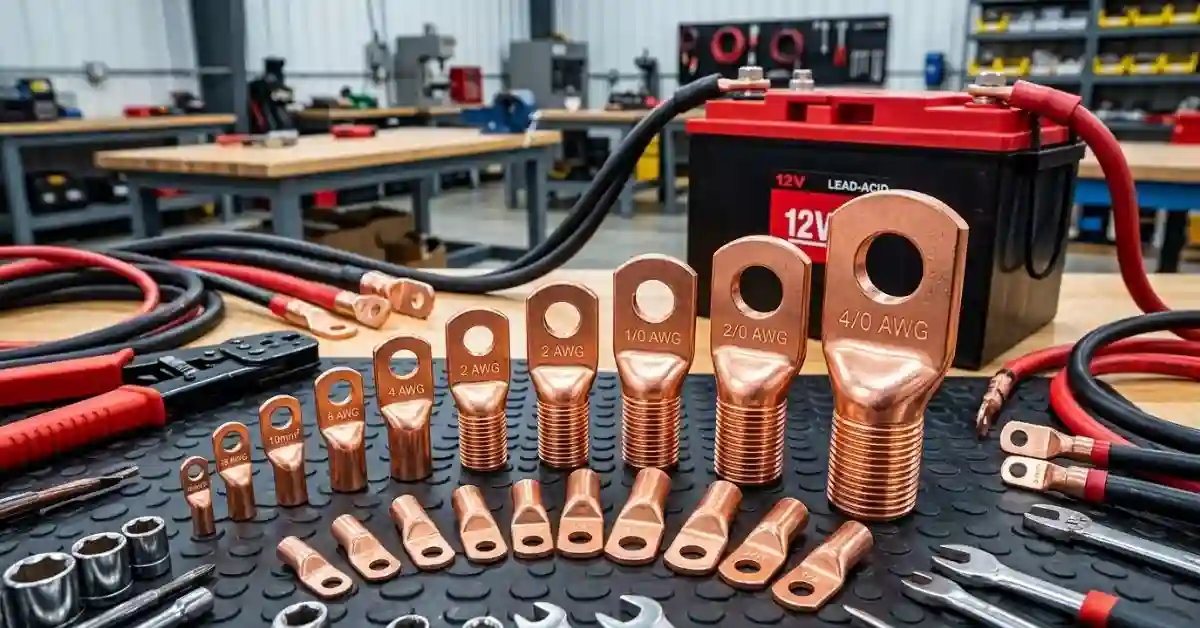
When I first looked at battery lugs, I expected the sizing to be simple. It was not. A lug can look right but still have the wrong cable size, stud hole, or fit for the battery terminal.
So, when asking what size are battery lugs, it helps to look at more than one measurement. In this guide, I’ll break down the sizes, explain how lug measurements work, and show you how to choose the right one without guessing.
What Size Are Battery Lugs?
Battery lugs come in many sizes because they must match both the battery cable and the terminal or stud they connect to. The two key measurements are the cable opening and the mounting hole.
The cable opening must fit the wire snugly. The hole must fit the battery post, terminal stud, or bolt. If either one is wrong, the connection can be weak or unsafe.
| Lug measurement | What it tells you | Why it matters |
| Cable entry size | Wire size the lug accepts | Must match cable gauge |
| Stud hole size | Bolt or terminal size | Must fit the connection point |
| Lug barrel length | How far cable enters | Affects crimp quality |
A battery lug may therefore be described by something like 4 AWG with a 5/16-inch hole. The first part refers to the cable. The second refers to the mounting hole.
That simple distinction cleared up a lot of confusion for me.
How Battery Lug Sizes Are Measured
The tricky part is that battery lug sizes use two different sizing systems. Cable size is often given in AWG, while the lug hole may be listed in inches or millimeters.
Battery lug size by cable gauge
AWG stands for American Wire Gauge. With AWG wire, a smaller number means thicker wire.
For example, 2 AWG is thicker than 8 AWG. Large battery systems often need thick cables because they carry high current.
| Cable size | General use |
| 8 AWG | Smaller power and battery connections |
| 4 AWG | Medium-to-high current systems |
| 2 AWG | Heavy battery cables |
| 1/0 AWG | Very high current applications |
These are common examples, not rules for every setup. The correct cable depends on current, cable length, voltage, and the equipment being powered.
Battery lug hole size
The second number is usually the hole diameter.
You may see sizes such as:
- 1/4 inch
- 5/16 inch
- 3/8 inch
- 1/2 inch
Metric sizes are also common, such as 6 mm, 8 mm, 10 mm, and 12 mm.
| Hole size | Common equivalent |
| 1/4 inch | About 6.35 mm |
| 5/16 inch | About 7.94 mm |
| 3/8 inch | About 9.53 mm |
| 1/2 inch | About 12.7 mm |
The hole size needs to match the stud or bolt. Do not assume that a larger hole is better.
What Are the Most Common Battery Lug Sizes?
There is no single standard battery lug size. The right size depends on the cable and connection.
In automotive, marine, RV, solar, and battery-bank work, you will often see lugs for cable sizes ranging from small automotive wire up to very large battery cable.
| Cable size | Typical lug hole options |
| 8 AWG | 1/4–3/8 inch |
| 4 AWG | 5/16–3/8 inch |
| 2 AWG | 5/16–1/2 inch |
| 1/0 AWG | 3/8–1/2 inch |
These ranges are only a quick guide. Always check the actual lug specification before buying.
I learned this the hard way when I assumed two lugs for the same cable gauge would have the same mounting hole. They did not.
How Do I Know What Size Battery Lug I Need?
The easiest method is to measure the cable and the terminal point separately.
First, identify the cable size. If the cable is marked, you may see something like 4 AWG, 2 AWG, or 1/0 AWG.
Then measure the bolt or stud where the lug will sit.
| What to check | What to measure |
| Cable | AWG or conductor diameter |
| Terminal stud | Stud or bolt diameter |
| Lug opening | Inside hole diameter |
| Connection type | Post, stud, or bolt |
Do not choose a lug based only on the outside size of the copper ring. That can be misleading.
Measure the cable before buying
If the cable has printing on its jacket, use that first. It is much easier than trying to measure the copper by eye.
If the size is unknown, a wire gauge tool can help identify the conductor size.
One common mistake is measuring the entire cable, including the insulation. That does not tell you the AWG size of the conductor.
Measure the battery stud or bolt
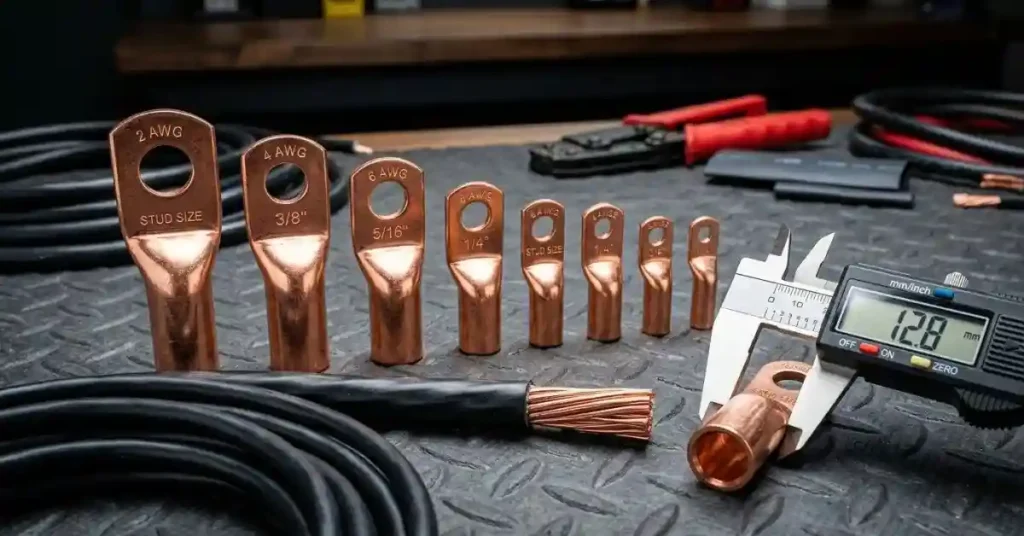
A digital caliper makes this quick.
Measure the diameter of the threaded stud or bolt. Then choose a lug with a matching hole.
For example, if your connection uses a 5/16-inch stud, look for a lug with a 5/16-inch mounting hole.
Do not force a 1/4-inch lug onto a 5/16-inch stud.
Battery Lug Size vs. Battery Terminal Size
These terms sound similar, but they are not the same thing.
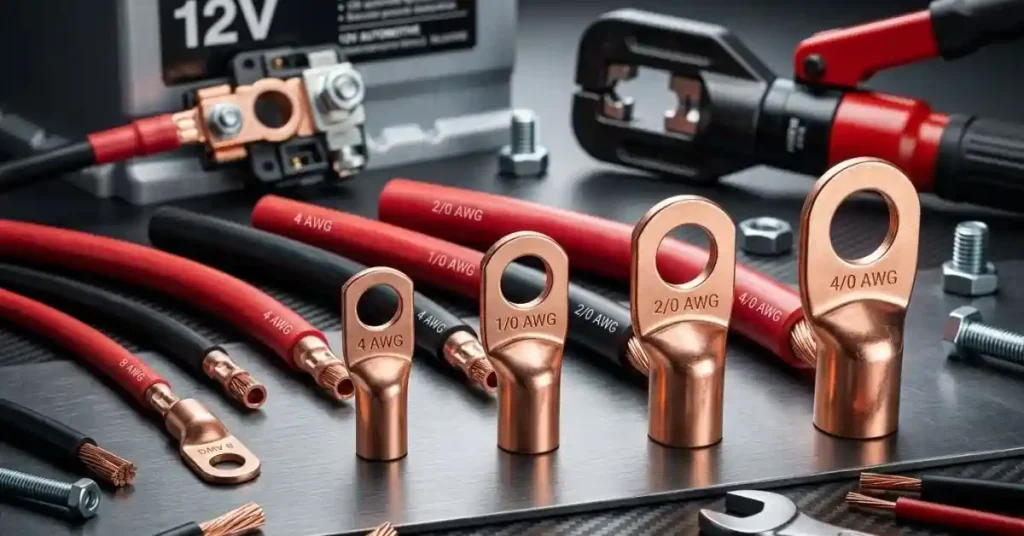
A battery terminal connects to the battery post. A battery lug is usually crimped onto the cable and then attached to a stud, bolt, or terminal.
That difference becomes important when replacing cables.
| Part | Main job |
| Battery terminal | Connects to battery post |
| Battery lug | Connects cable to stud or terminal |
| Battery cable | Carries electrical current |
A battery can have a large terminal while the cable lug itself has a different mounting-hole size. This is why I always check the actual connection point rather than relying on the battery’s general size.
Does a Bigger Battery Lug Carry More Current?
Not automatically.
A larger lug can accept a larger cable, but current capacity depends on the complete electrical system. Cable size, cable length, conductor material, connection quality, and the expected current all matter.
Cable size matters more than the ring size
A large-looking ring does not magically make a small cable capable of carrying more current.
For example, putting a small cable into an oversized lug does not turn it into a heavy-duty cable.
| Situation | Result |
| Correct cable and lug | Good mechanical and electrical fit |
| Lug too small for cable | Cable may not fit or crimp well |
| Lug too large for cable | Poor crimp can result |
| Wrong hole size | Lug may not mount correctly |
This is one of the biggest lessons I took from working with battery connections: the whole connection has to match.
What Happens If You Use the Wrong Battery Lug Size?
Using the wrong lug can cause anything from a poor connection to excessive heat.
A loose connection increases resistance. High resistance at a high-current battery connection can create heat.
Common signs of a bad lug connection
You may notice:
- The lug moves after installation.
- The cable pulls out easily.
- The connection becomes hot.
- There is visible corrosion.
- Electrical equipment behaves inconsistently.
- The cable shows damage near the crimp.
| Problem | Likely cause |
| Cable slips from lug | Poor or wrong crimp |
| Lug will not fit stud | Hole is too small |
| Lug moves on stud | Hole or hardware mismatch |
| Hot connection | Resistance or poor contact |
A hot battery connection should not be ignored, especially in a high-current system.
Crimp Lug or Solder Lug: Which Size Should I Use?
For many battery cables, crimp-style lugs are the practical choice. The lug is placed over the stripped cable and compressed with the correct crimp tool.
Soldering is sometimes used in electrical work, but the correct method depends on the application and lug design.
Match the lug to the crimp tool
This is another place where I would not improvise.
A lug designed for a particular cable size needs the right crimp method. A cheap crimp that only squeezes the barrel slightly may not create a reliable connection.
| Approach | Main concern |
| Correct crimp | Requires the right tool |
| Wrong crimp tool | May leave a weak connection |
| Undersized lug | Cable may not enter properly |
| Oversized lug | Crimp may not hold the cable |
After crimping, give the cable a firm pull. The cable should stay firmly locked in the lug.
Common Mistakes I Would Avoid With Battery Lugs
Battery lug sizing looks simple once you understand it, but several small mistakes can cause trouble.
Mistake 1: Matching only the hole size
A 5/16-inch hole does not tell you what cable the lug accepts.
Always check both the cable gauge and the hole size.
Mistake 2: Guessing the cable size
Cable insulation can make wire look much thicker than its actual conductor.
Use the printed cable marking or a proper gauge tool.
Mistake 3: Using a loose mounting hole
A slightly larger hole may fit, but that does not mean it is the correct choice. The lug should sit properly on the stud or bolt.
Mistake 4: Ignoring the lug material
Copper lugs are common for battery connections. Tinned copper is also widely used, especially where corrosion resistance matters.
Mistake 5: Making a poor crimp
Even a correctly sized lug can fail if the cable is not crimped properly.
Copper, Tinned Copper, and Aluminum Battery Lugs
The material of the lug also deserves attention.
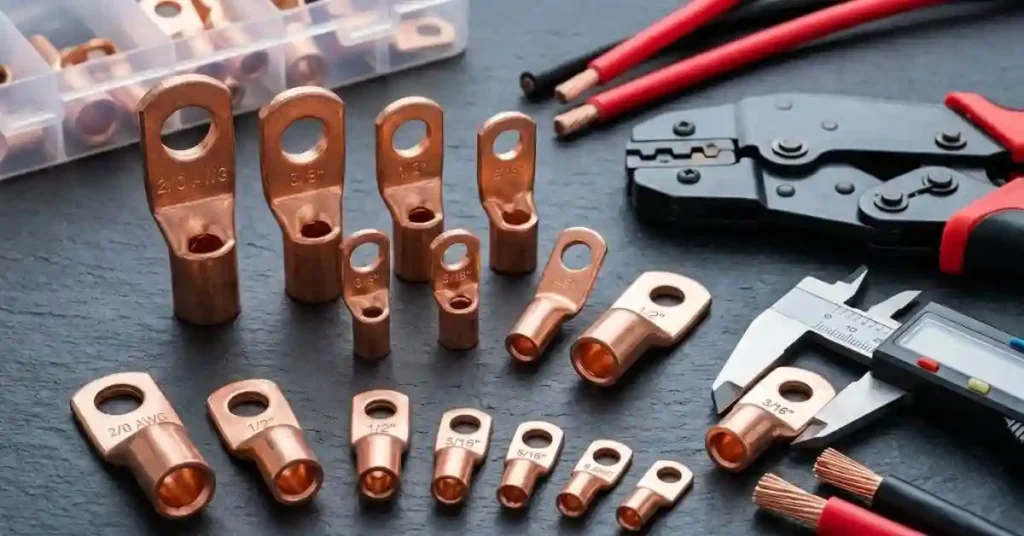
Copper lugs are popular because copper has good electrical conductivity. Tinned copper adds a protective tin coating that can help in environments where corrosion is a concern.
| Lug material | Common benefit |
| Copper | Good conductivity |
| Tinned copper | Better corrosion resistance |
| Aluminum | Lightweight and application-specific |
For marine, outdoor, and other damp environments, corrosion protection becomes especially important.
I would also check whether the lug is designed for the exact cable type. Do not assume every metal lug works with every conductor.
How to Read a Battery Lug Size Chart
A lug size chart may look confusing at first because it can list several numbers.
Usually, you want to find three things:
- Cable size
- Stud or hole size
- Lug dimensions
For example, a listing might say 2 AWG, 3/8-inch hole.
That means the lug is designed for 2 AWG cable and has a mounting hole intended for a 3/8-inch stud or bolt.
| Marking | Meaning |
| 8 AWG | Cable size |
| 2 AWG | Thicker cable size |
| 1/0 AWG | Very thick cable size |
| 5/16 in | Lug hole size |
The key is not to treat all the numbers as cable sizes.
Battery Lug Sizing for Cars, RVs, Boats, and Solar Systems
The application can change the type of lug you need.
Automotive batteries often use battery terminals and cable ends designed for starting systems. RVs and solar systems may use larger cables and ring terminals connected to bus bars, breakers, inverters, or battery studs.
Marine setups also place more emphasis on corrosion resistance.
| Application | What to pay attention to |
| Car | Cable gauge and battery terminal |
| RV | Cable size and high-current connections |
| Marine | Corrosion resistance |
| Solar | Cable size, current, and terminal hardware |
The important point is that application does not replace measurement. Even if you know the lug is for a car or solar battery, check the actual cable and connection.
A Simple Battery Lug Size Checklist
Before ordering a lug, I use a quick mental checklist.
Cable: What gauge is it?
Hole: What size is the stud or bolt?
Material: Is copper or tinned copper more suitable?
Crimp: Do I have the right crimp tool?
Environment: Will the connection face moisture or corrosion?
Space: Will the lug physically fit around the terminal?
That takes less than a minute and can prevent a frustrating return or a bad connection.
Final Thoughts on What Size Are Battery Lugs
The main lesson is that there is no single answer to what size are battery lugs. Battery lugs are sized by both the cable they accept and the hole used for the mounting stud or bolt.
When I size one, I check those two measurements first. Then I look at the lug material, crimp method, and the environment where it will be used. That approach is much more reliable than judging the lug by appearance.
If you are unsure, measure the cable and terminal before buying. A few minutes with a wire gauge tool or caliper can save you from ending up with a lug that looks right but simply does not fit.
Frequently Asked Questions
1. What size are battery lugs?
Battery lugs come in many sizes. The main sizes match the cable gauge and bolt hole. Common cable sizes include 8, 4, 2, and 1/0 AWG.
2. How do I know what size battery lug I need?
Check the cable gauge first. Then measure the bolt or stud. The lug must match both the cable size and the hole size for a firm fit.
3. What is the most common battery lug size?
There is no single common size. Many battery lugs use 1/4, 5/16, or 3/8-inch holes. Cable sizes vary by the power needs of the system.
4. Does battery lug size affect current flow?
Yes, but lug size alone does not set current flow. The cable size, lug fit, crimp, and connection all affect how well current can pass.
5. Can I use a bigger battery lug?
Only if it fits the cable and terminal well. A large lug on a small cable may not crimp well. Always match the lug to both sizes.
To Get More About Home, Car Tools Product You Can Visit Our Site. If You Found our Posts Helpful Leave a Comment Below