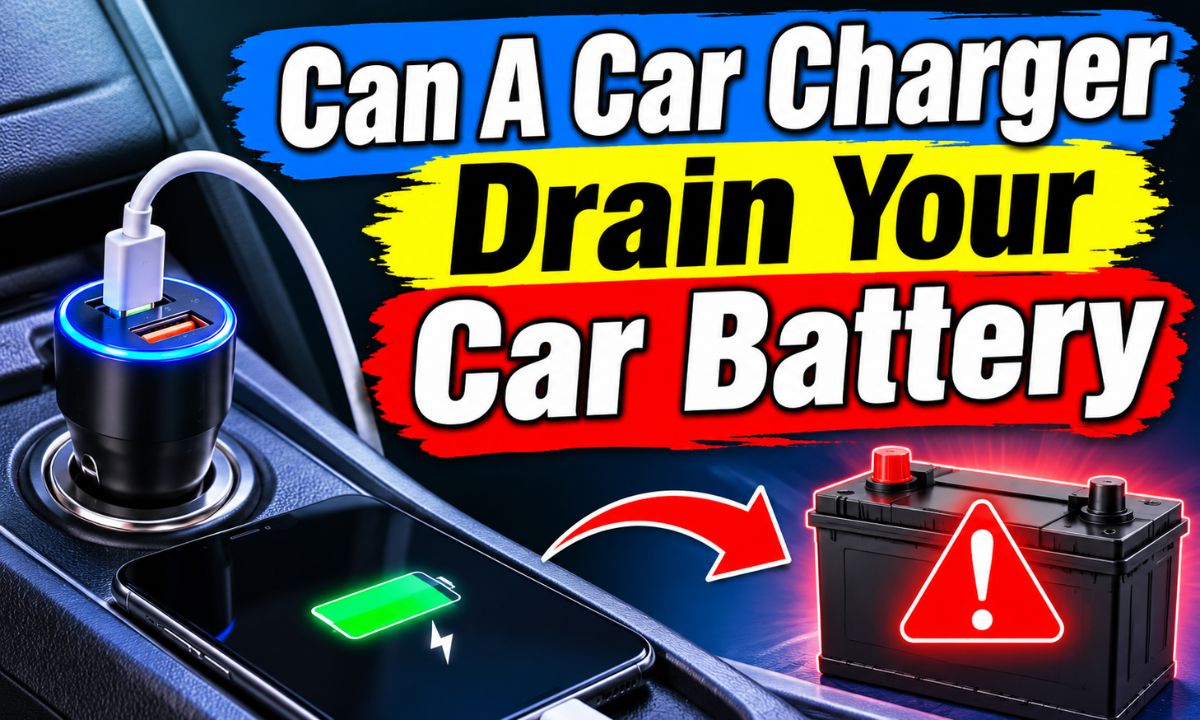
Yes, a car charger can drain your battery if your vehicle’s 12V outlet stays powered after the engine is off. The risk depends on the outlet, charger, connected device, and parking time.
For drivers across the United States, a car phone charger is a handy way to keep a phone ready for navigation, calls, and music. Most drivers plug one into the dashboard and leave it there. But after parking at home, work, or an airport, a fair question comes up: can that small charger slowly drain the car battery?
The answer depends on how your vehicle powers its outlets. Some cars shut off their 12V sockets when the ignition is off. Others keep one or more outlets active, even when the vehicle is locked. In the second case, a charger can keep drawing a small amount of power. A phone, dash cam, or other device left connected can use much more.
The good news is that a charger left in the socket does not always mean a dead battery. You can check whether your outlet stays live, learn which devices use power while parked, and take a few simple steps to protect the battery. This guide explains how to do that without guessing or buying extra equipment.
A car charger can drain the battery by taking power from the vehicle while the engine is off. This can happen when the charger is plugged into a 12V outlet that stays active after you turn off the ignition. The charger may use a small amount of power even when no phone is attached.
A car battery stores electrical energy for starting the engine and running vehicle systems. When the engine runs, the alternator supplies power and helps recharge the battery. When the engine is off, the battery supplies power to any active electrical loads.
This small use of power is called a parasitic draw. Some draw is normal because the car needs to keep systems such as its clock, alarm, and computer memory active. An accessory that stays on adds to that load.
A charger does not need to be charging a phone to use power. Some models have indicator lights, internal circuits, or other parts that remain active whenever they receive power. The amount varies by charger design, so there is no single drain rate for every model.
Empty charger
A plugged-in charger may use a small standby current if the outlet remains live.
Phone connected
The charger can draw more power while charging a phone, especially if the phone battery is low or the screen stays on.
Other accessories connected
A dash cam, portable cooler, or other device may use far more power than a basic phone charger.
What Is Standby Power?
Standby power is the small amount of electricity a device uses while it is plugged in but not doing its main job. A USB car charger may still have an active circuit or glowing LED when no phone is connected.
One published test of a USB car charger measured a standby draw of 14.2 milliamps. That was a measurement of one charger, not a standard for all products. It shows why the charger model and the outlet’s power state both matter.
Small does not mean zero
A low current can add up over a long period if the vehicle remains parked.
Results vary
Different chargers can use different amounts of standby power. Do not assume one test applies to your charger.
Why the Engine-Off Condition Matters
When the engine is running, the alternator normally supplies the power used by the car’s electrical systems. When the engine is off, the battery must supply any load that remains active.
That is why leaving a charger plugged in during a short stop may have little effect, while leaving a device connected for weeks can create a problem. Long parking time gives even a small electrical load more time to use stored energy.
Does Every Car Charger Drain the Battery When the Car Is Off?
No. The charger can draw power only when it receives power from the vehicle or another source. If your car shuts off its 12V outlet when you switch off the ignition, a charger in that outlet normally stops drawing power.
Some vehicles use ignition-controlled outlets. Others have always-on outlets that remain powered when the car is parked. A vehicle may also have a mix of both types, so the front outlet and rear outlet may behave differently.
The owner’s manual is the best place to check the design of your vehicle. Look for sections called Power Outlets, Auxiliary Power, USB Ports, or Electrical Accessories. The manual may state whether each outlet works in the OFF, ACC, or ON position.
For example, a Ford owner’s manual describes 12V outlets that work in accessory mode or when the vehicle is on and turn off when the vehicle is switched off. A Ram owner’s manual also describes battery-fed outlets that can remain powered with the ignition off and warns owners to remove connected equipment.
Ignition-switched outlet
Power stops after the vehicle shuts down. An idle charger in that socket should not continue using the car battery.
Always-on outlet
Power remains available while parked. A plugged-in charger or connected device may continue to draw current.
Delayed shutoff
Some vehicles keep selected ports active for a short period after shutdown. This may be part of the vehicle’s normal design.
How to Tell Whether Your 12V Outlet Stays On
You can make a basic check without taking apart the dashboard. First, park in a safe place, turn off the engine, remove the key or switch off the vehicle, and close the doors. Follow your owner’s manual because some cars need time to shut down their electronic systems.
After the vehicle has settled, check whether a device connected to the outlet still receives power. A phone charging symbol or an illuminated charger light can give you a clue. However, a light on the charger alone does not prove that the phone is receiving useful charging power.
For a clearer check, use a simple 12V accessory with a power indicator or ask a qualified technician to test the outlet. Do not insert loose metal objects or probe the socket with improvised tools.
Check the manual first
This avoids confusion caused by delayed power shutoff or different outlet designs.
Wait before checking
Some vehicle systems remain active for a short time after the doors close.
Check each outlet
Do not assume all USB ports and 12V sockets in the same car work in the same way.
How Much Battery Power Does a Car Charger Use?
The amount depends on the charger’s standby current, the device connected to it, and how long the vehicle remains parked. A charger with no phone attached may use much less power than one charging a phone or running another accessory.
Current is measured in amperes or milliamperes. One ampere equals 1,000 milliamperes. Battery capacity is often listed in amp-hours, or Ah. These values help explain how a small electrical load can add up over time.
Here is a hypothetical calculation using a 14.2 mA standby draw. Convert that figure to amperes by dividing it by 1,000. The result is 0.0142 A. If the charger stays powered for 24 hours, it uses about 0.341 Ah.
Over seven days, the same hypothetical load would use about 2.39 Ah. This is a simple estimate, not a promise about how long your car will start. It does not include the vehicle’s normal electrical draw, battery age, temperature, or the effect of a battery that is not fully charged.
One-day estimate
0.0142 A multiplied by 24 hours equals about 0.34 Ah.
Seven-day estimate
0.0142 A multiplied by 168 hours equals about 2.39 Ah.
Important limit
This calculation describes one measured charger under one test. It is not a universal figure for car chargers.
Why This Calculation Does Not Predict a No-Start Date
A car battery cannot always give up its full rated capacity and still start the engine. The battery also needs enough power to crank the engine, and its usable capacity changes with age, temperature, condition, and state of charge.
The car itself uses some power while parked. The alarm, keyless entry system, clock, and electronic control units may remain active. A charger adds to that normal load if its outlet stays powered.
A healthy battery may handle a small extra draw during normal daily use. The same draw can become more serious when the vehicle sits unused for a long time or the battery is already weak.
Battery age
An older battery may have less usable capacity than it had when new.
Weather
Cold conditions can reduce a battery’s ability to deliver starting power.
Parking time
A car left unused for weeks faces a different risk from one driven every day.
Which Car Accessories Can Drain the Battery Faster?
A basic phone charger is often a smaller load than an accessory that runs continuously. The real concern is not just the plug. It is the device using the power and how long it stays active.
A phone that is already full may need little charging current, while a low phone battery can make the charger work harder. A dash cam in parking mode may keep recording or watching for movement. A portable cooler or powered light can use much more energy.
Vehicle makers warn against leaving electrical accessories connected for long periods when the engine is off. The Ram owner’s manual specifically warns that some connected accessories can use battery power even when they are not in use. It also notes that higher-power devices can discharge the battery more quickly.
USB phone charger
Usually a modest load, but it can still use standby power on an always-on outlet.
Dash cam
Parking mode may keep the camera and its sensors active after the car is off.
Portable cooler
A powered cooler can use much more energy than a small USB charger.
Interior or accessory lights
Lights that remain on can use power for as long as the circuit stays active.
Inverter
An inverter can supply power to larger devices and may place a heavy load on the battery.
Can a Dash Cam Drain a Car Battery Overnight?
Yes, a dash cam can drain a battery if it stays active while the car is parked. The risk depends on the camera’s power use, parking mode, battery protection settings, and the condition of the vehicle battery.
Some dash cams use a hardwire kit with a low-voltage cutoff. This feature is designed to stop the camera when the vehicle battery reaches a set voltage. It can reduce the risk, but it does not make every installation safe in every vehicle.
Follow the camera maker’s wiring instructions. If you are unsure which fuse or circuit to use, have a qualified installer fit the kit. Never assume a dash cam uses power only while driving.
Check parking mode
Find out whether the camera records continuously, wakes on motion, or shuts down after a set period.
Check battery protection
Confirm that the cutoff feature is installed and set according to the camera and vehicle instructions.
Watch for warning signs
Slow cranking or repeated low-battery warnings may mean the parked load needs attention.
Can a Phone Left Connected Drain the Battery?
A phone left connected to an always-on car outlet can use more power than an empty charger. The amount depends on the phone’s battery level, charging speed, screen use, and other active features.
A phone that reaches full charge may reduce its charging demand, but that does not mean the charger or phone uses absolutely no power. For long parking periods, unplug both the cable and the charger.
How to Prevent a Car Charger From Draining Your Battery
The easiest way to prevent unwanted drain is to remove accessories when you park for a long time. If your outlet switches off with the ignition, the risk from an idle charger is much lower. If it stays live, unplug the charger and any connected device.
You do not need to remove every accessory after every short drive. The goal is to avoid leaving a live electrical load connected while the vehicle sits unused. This matters most during long trips, airport parking, seasonal storage, or periods when you rarely drive.
Unplug the charger
Remove it from an always-on outlet when you leave the car parked for an extended period.
Disconnect the phone
Do not leave a phone connected to a powered outlet after you exit the vehicle.
Review dash cam settings
Turn off parking mode or use a correctly installed battery protection system if the camera does not need to run while parked.
Use the right outlet
If the vehicle has both switched and always-on outlets, use the switched outlet for accessories that do not need power while parked.
Read the owner’s manual
Follow the vehicle maker’s limits for outlet use and accessory power.
What to Do Before Leaving Your Car for Several Days
If you plan to leave your car at home or at a US airport for several days, take a minute to check every connected accessory. Remove the USB charger, phone cable, dash cam plug, and any other device that does not need to remain active.
Make sure interior lights are off and all doors, the trunk, and the glove box are fully closed. If the car has a keyless entry system, follow the owner’s instructions for storing the key fob during long periods of non-use.
For a vehicle that will sit for weeks or months, consider a suitable battery maintainer. Choose one that matches the battery type and follow its safety instructions. A maintainer is not the same as leaving a phone charger plugged into the dashboard.
Before parking
Unplug accessories that do not need to stay on.
During storage
Use a suitable battery maintainer if recommended for the vehicle and battery.
Before driving again
Check for warning lights, battery issues, or signs of damage before using the vehicle.
How to Troubleshoot a Car Battery That Keeps Going Flat
If your battery keeps losing charge, do not blame the phone charger without checking other causes. A weak battery, charging-system fault, light left on, or electrical problem can create the same symptom.
Start with simple and safe checks. Remove all nonessential accessories, confirm that the interior lights turn off, and inspect the battery terminals for visible corrosion or loose connections. Do not touch damaged wiring or attempt a repair if you are unsure how to work safely around a car battery.
If the battery still goes flat, arrange a battery and charging-system test. A technician can also measure parasitic draw after the vehicle’s electronic systems have had time to enter their normal sleep state.
Slow engine cranking
A weak or discharged battery is one possible cause. A poor connection or starter problem can also create this symptom.
Clicking when starting
The battery may not have enough power to operate the starter, but a faulty connection or starter system is also possible.
Battery warning light
The charging system may not be working as intended. Have it checked rather than assuming the charger caused the problem.
Battery goes flat repeatedly
A parasitic draw, weak battery, charging fault, or another electrical issue may be present.
Step 1: Remove All Extra Electrical Loads
Unplug the phone charger and disconnect other accessories that are not needed. If you have a dash cam, check whether it remains active after the engine stops. Leave the vehicle parked with all doors closed and observe whether the problem returns.
If the battery stays charged after the accessories are removed, one of those devices or its power circuit may be involved. This does not prove which device caused the drain, so test one accessory at a time if the problem is safe to investigate.
Step 2: Check the Battery Condition
A battery near the end of its service life may lose starting ability even when the electrical draw is normal. A battery that has been deeply discharged may also need a proper recharge and test.
Look for a swollen case, cracks, leaks, or signs of damage. Do not charge or jump-start a visibly damaged battery. Seek professional help because damaged batteries can present serious safety risks.
Step 3: Test for Parasitic Draw
A parasitic draw test checks how much current the vehicle uses while it is switched off. The test must account for systems that remain awake for a period after shutdown. Testing too soon can produce a misleading result.
A qualified technician can use the correct procedure and equipment to find an abnormal load. Avoid placing a multimeter in series with the battery unless you know the correct method. A wrong connection can damage the meter, blow its fuse, or create a safety hazard.
Step 4: Check the Charging System
The alternator normally helps recharge the battery while the engine runs. If the alternator or its control system is not working correctly, the battery may not recover the power used during starting and driving.
A battery and charging-system test can help separate a weak battery from a charging fault. If the car needs frequent jump-starts, arrange an inspection instead of relying on repeated boosts.
Does a Car Charger Drain the Battery Faster in Cold Weather?
Cold weather can make a battery less able to start the engine. It does not automatically make every car charger draw more current, but it can make an existing battery problem easier to notice.
A battery that works well in mild weather may struggle when temperatures fall. If the battery is already weak and a live accessory continues to use power while parked, the chance of a no-start problem can rise.
Before a cold-weather trip, check the battery’s condition and remove accessories that remain powered when the car is off. If the engine cranks slowly or the battery warning light appears, have the vehicle checked.
Cold reduces starting ability
A battery may deliver less starting power in low temperatures.
Long parking adds risk
A live charger or other accessory can keep using stored energy while the vehicle sits.
Battery health matters
A weak battery has less reserve for both normal parked loads and engine starting.
Common Mistakes to Avoid
A few common assumptions can lead to battery trouble. The biggest mistake is treating every car’s power outlet as if it works the same way. Outlet behavior varies by vehicle, model year, trim, and sometimes by socket location.
Another mistake is focusing only on the charger while ignoring devices connected to it. A dash cam or other accessory may use far more power than the charger itself. A battery that is already weak may also fail even when the extra load is small.
Assuming every outlet shuts off
Check the manual and test the specific outlet you use.
Assuming an empty charger uses no power
Some chargers still use standby current while powered.
Leaving a dash cam in parking mode without checking its settings
Confirm how the camera gets power and whether its low-voltage cutoff works as intended.
Trying to fix repeated battery drain by replacing the charger alone
A weak battery, alternator issue, light, or electrical fault may be the real cause.
Using a high-power accessory with the engine off
Devices such as coolers and inverters can use battery power quickly. Follow the vehicle’s limits.
Testing electrical circuits with improvised tools
Do not probe sockets or battery wiring with loose metal objects. Use suitable equipment or get professional help.
When Should You Ask a Mechanic for Help?
Ask a qualified mechanic or automotive electrician for help if the battery repeatedly goes flat, the vehicle will not start after a proper recharge, or you notice electrical faults that cannot be explained by a plugged-in accessory.
Professional help is also the right choice if the battery case is swollen, cracked, leaking, or unusually hot. Do not try to open, repair, or charge a damaged battery.
A technician can test the battery, alternator, and parked electrical draw. This is more useful than replacing random parts because it helps identify the actual cause.
Repeated dead battery
Arrange a battery and parasitic-draw test.
Charging warning or electrical faults
Have the charging system and wiring inspected.
Visible battery damage
Stop using the battery and seek professional service.
Uncertain wiring
Have a qualified installer check hardwired accessories and fuse connections.
Frequently Asked Questions
Q
Can I leave my car charger plugged in overnight?
Usually, it is fine if your vehicle switches off the 12V outlet when the ignition is off. If the outlet stays powered, the charger may continue to use battery power. Unplug it overnight if you are unsure how your outlet works.
Q
Will a car charger drain the battery if no phone is connected?
It can. Some USB car chargers use a small amount of standby power while plugged into a live outlet. The amount varies by model. An ignition-switched outlet removes this concern after it shuts off.
Q
How long can a car sit with a charger plugged in?
There is no safe time limit that applies to every vehicle and charger. The answer depends on standby current, other parked loads, battery health, temperature, and whether the outlet stays live. For long-term parking, unplug the charger and other nonessential accessories.
Q
Does a USB port drain a car battery when the engine is off?
It depends on the vehicle. Some USB ports stop supplying power when the car shuts down, while others may stay active for a period or remain powered. Check the owner’s manual and test the port after the vehicle has fully shut down.
Q
Can a fast car charger damage my car battery?
A compatible fast USB charger does not normally damage the car battery just because it supports fast phone charging. The important issue is the power it draws from the vehicle and whether the outlet stays active while parked. Use a charger designed for your vehicle’s outlet and follow its instructions.
Q
Why does my car battery die even when I unplug the charger?
The charger may not be the cause. Common possibilities include an aging battery, a charging-system fault, a light that stays on, a faulty electronic module, or another accessory connected to a live circuit. A battery and parasitic-draw test can help identify the cause.
Q
Should I remove my car charger every time I park?
You do not usually need to remove it after every short stop if the outlet switches off with the ignition. If the outlet stays live, unplug it when leaving the vehicle for a long period. Removing it is also a simple precaution when you are unsure.
✦ Wrapping Up
Conclusion
A car charger can drain your car battery, but it does not happen in every vehicle. The key factor is whether the 12V outlet or USB port stays powered after the engine is off. If the outlet shuts down with the ignition, an idle charger normally stops drawing power.
If your outlet remains live, even an empty charger may use standby current. A connected phone, dash cam, cooler, or other accessory can add a larger load. Long parking periods, cold weather, and a weak battery can make the risk more serious.
The best approach is simple: check your owner’s manual, confirm how your outlets work, and unplug nonessential accessories before long periods of parking. If your battery keeps going flat, arrange a proper battery and charging-system test rather than assuming the charger is always to blame.
💡 Key Takeaway
Turn off the car, wait for its systems to shut down, and check whether your 12V outlet still has power. If it does, unplug the charger before leaving the vehicle parked for an extended period.
5 thoughts on “Can A Car Charger Drain Your Car Battery: What To Know”

5 thoughts on “Can A Car Charger Drain Your Car Battery: What To Know”