
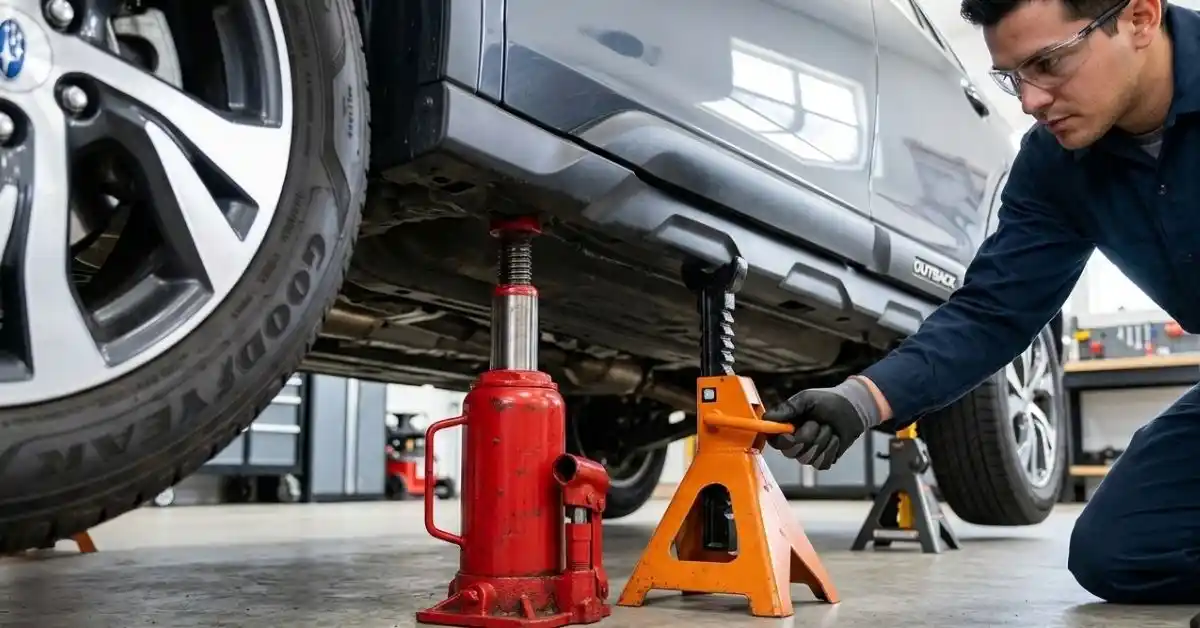
I used to think a bottle jack was safe as long as it could lift the vehicle without trouble. That sounds reasonable, but there is an important difference between lifting a vehicle and safely supporting a vehicle.
So, are bottle jacks safe? Yes, they can be safe when used correctly, on a suitable surface, within their rated capacity, and with proper support. But a bottle jack should not be treated as a substitute for jack stands. OSHA says a jack must be rated for the load, used on a firm foundation, and secured after lifting.
After looking closely at how these jacks are meant to be used, the biggest lesson is simple: the jack is mainly a lifting tool. Once the vehicle is up, the load needs proper support.
Are Bottle Jacks Safe for Lifting a Vehicle?
Bottle jacks are safe for lifting when the jack, vehicle, lifting point, surface, and load all match the job.
A bottle jack has a small base and a vertical hydraulic ram. That makes it compact and useful in many situations. It can lift a heavy load with fairly little effort.
But that same design has limits.
A bottle jack is not meant to make an unstable vehicle safe simply because it can lift it. The vehicle can still move, the jack can shift, or the hydraulic system can lose pressure.
| Bottle jack feature | What it means in practice |
| Hydraulic lifting | Makes heavy loads easier to raise |
| Small footprint | Needs a firm, stable surface |
| Rated capacity | Must be greater than the load being lifted |
| Vertical ram | Works best when the load is centered |
OSHA requires jacks to have a sufficient rated capacity and says the base should be blocked when there is no firm foundation. After a load is raised, it must be cribbed, blocked, or otherwise secured.
That last point is the one I would never ignore.
Why a Bottle Jack Should Not Support You
This is where many people get into trouble.
A hydraulic bottle jack can hold a vehicle up while everything is working correctly. But hydraulic pressure is not the same thing as mechanical support.
A small leak, damaged seal, bad valve, shifted jack, or other failure can change the situation quickly.
NIOSH guidance says not to work under a vehicle supported only by a service jack. It recommends using car stands or other supports before going underneath.
A vehicle falling even a short distance can cause severe crushing injuries.
| Situation | Safer approach |
| Changing a tire | Follow the vehicle manual and use the specified lifting point |
| Working beside a raised vehicle | Keep clear of possible movement |
| Working underneath | Use properly rated jack stands |
| Long repair job | Fully support the vehicle before starting |
I think of it this way: the bottle jack lifts the vehicle; the jack stands hold it.
That simple distinction removes a lot of confusion.
What Makes a Bottle Jack Safe?
There is no single feature that makes a bottle jack safe. Safe use comes from several things working together.
The jack has enough capacity
Never choose a jack simply because its number sounds large.
Check the vehicle’s weight and the jack’s rated capacity. Also consider how the load is distributed. You may not be lifting the whole vehicle with one jack, but you still need enough capacity for the load placed on that jack.
OSHA specifically requires the jack’s rated capacity to be sufficient to lift and sustain the load.
The lifting point is correct
This is one of the easiest things to get wrong.
The lifting point must be strong enough and suitable for the jack. Do not place the bottle jack under a random piece of sheet metal because it looks convenient.
Your vehicle owner’s manual is the best starting point for finding approved lifting points.
The ground is firm and level
A bottle jack can become much less stable on soft, uneven, sloped, or loose ground.
OSHA guidance says the jack base should rest on a firm foundation. Its safety guidance also stresses a firm, level surface and proper alignment.
| Surface | My concern |
| Concrete floor | Usually a good choice |
| Firm asphalt | Can work, depending on conditions |
| Gravel | Greater risk of movement |
| Soft soil | Poor choice |
| Steep slope | Avoid |
A flat garage floor is very different from soft dirt beside a roadside.
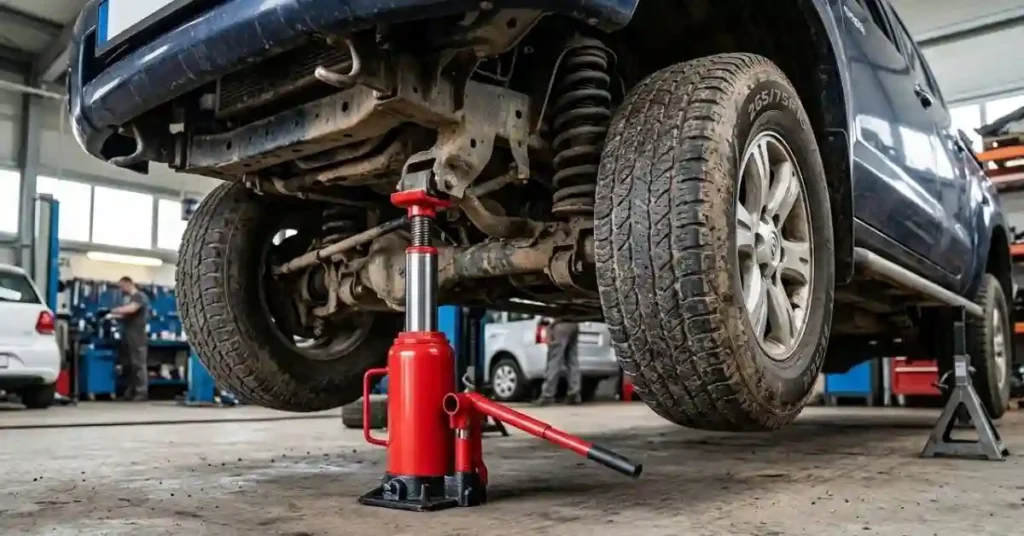
How to Use a Bottle Jack More Safely
I would keep the process simple. There is no benefit in rushing a lifting job.
1. Park on a firm, level surface
Put the vehicle in Park if it has an automatic transmission. Apply the parking brake.
For a manual transmission, follow the vehicle manufacturer’s instructions for securing the vehicle.
Chock the wheels that remain on the ground.
NIOSH guidance recommends setting the parking brake and chocking the wheels before raising a vehicle.
2. Find the correct lifting point
Check the owner’s manual.
Do not guess based on where another vehicle has its lifting point. Different vehicles use different structures.
3. Check the bottle jack
Look for leaks, damaged parts, bent components, or unusual operation.
A jack that looks questionable is not worth testing under a heavy vehicle.
OSHA says jacks should be inspected based on their service conditions and that jacks that are out of order should not be used until repaired.
4. Position the jack straight
The jack should sit properly under the lifting point.
The saddle should make good contact with the approved lifting area. OSHA’s jack guidance calls for the jack to be correctly centered and for the lift force to be applied evenly.
5. Raise the vehicle slowly
Do not pump the jack as fast as possible.
Watch the vehicle and jack as the vehicle rises. If the jack starts leaning, shifting, or behaving strangely, stop.
A slow lift gives you time to notice problems.
6. Install properly rated jack stands
Once the vehicle reaches the needed height, place the stands at the manufacturer’s recommended support points.
Then lower the vehicle onto the stands.
A Torin bottle jack manual, for example, instructs users to transfer the load immediately to an appropriately rated pair of jack stands after lifting.
| Step | Safety check |
| Before lifting | Firm surface and wheel chocks |
| During lifting | Jack stays centered |
| At working height | Rated jack stands installed |
| Before going underneath | Vehicle resting on stands |
Only after the vehicle is properly supported should you consider getting underneath it.
Bottle Jack Mistakes That Can Turn Dangerous
Most problems are not caused by the basic idea of a bottle jack. They come from using it in a way it was never designed for.
Mistake: Using the jack as a stand
This is probably the biggest mistake.
A hydraulic jack is designed to lift. That does not make it the correct long-term support for a person working underneath a vehicle.
Mistake: Using too small a jack
A jack working close to its limit is not something I would choose when a properly rated option is available.
The rated capacity matters.
Mistake: Ignoring the surface
A strong jack on a weak surface is still a bad setup.
If the base sinks or shifts, the jack can move out of position.
Mistake: Lifting from the wrong place
A vehicle may have strong structural areas and weaker body panels. The wrong contact point can cause damage or an unstable lift.
Mistake: Working under a vehicle that is only on a jack
This is the habit I would avoid completely.
NIOSH guidance specifically says never work under a vehicle supported only by a service jack.
| Mistake | Better habit |
| Jack only | Add rated jack stands |
| Soft ground | Use a firm, level surface |
| Guessing the lift point | Check the vehicle manual |
| Ignoring leaks | Inspect before use |
| Rushing the lift | Raise it slowly |
What If the Bottle Jack Starts Leaking?
A hydraulic leak is not something I would ignore.
If you see hydraulic oil around the jack, stop using it until the problem has been properly addressed.
The same applies if the jack slowly lowers while holding a load, fails to lift normally, or behaves differently from usual.
OSHA requires jacks that are out of order to be tagged and kept out of service until repaired.
A common temptation is to think, “It still works.”
That is not a good safety test.
| Warning sign | What to do |
| Oil leak | Stop using the jack |
| Bent part | Remove it from service |
| Slow lowering | Do not trust it for lifting |
| Damaged saddle | Replace or repair it |
| Strange pumping action | Stop and inspect |
Never crawl underneath a vehicle to investigate a jack problem while that jack is the only support.
Are Bottle Jacks Safer Than Floor Jacks?
This is not really a simple safer-versus-less-safe comparison.
Both types can be useful. Their designs simply suit different jobs.
A bottle jack is compact and can provide substantial lifting force. A floor jack has a larger base and wheels and is often easier to position around a vehicle.
| Comparison | Bottle jack | Floor jack |
| Storage | Very compact | Takes more space |
| Lifting style | Vertical | Rolls under vehicle |
| Base | Smaller | Wider |
| Portability | Easy to carry | Heavier and bulkier |
What matters most is using the right jack for the load and following its instructions.
A bottle jack is not automatically unsafe because it is small. A floor jack is not automatically safe because it is larger.
The setup still matters.
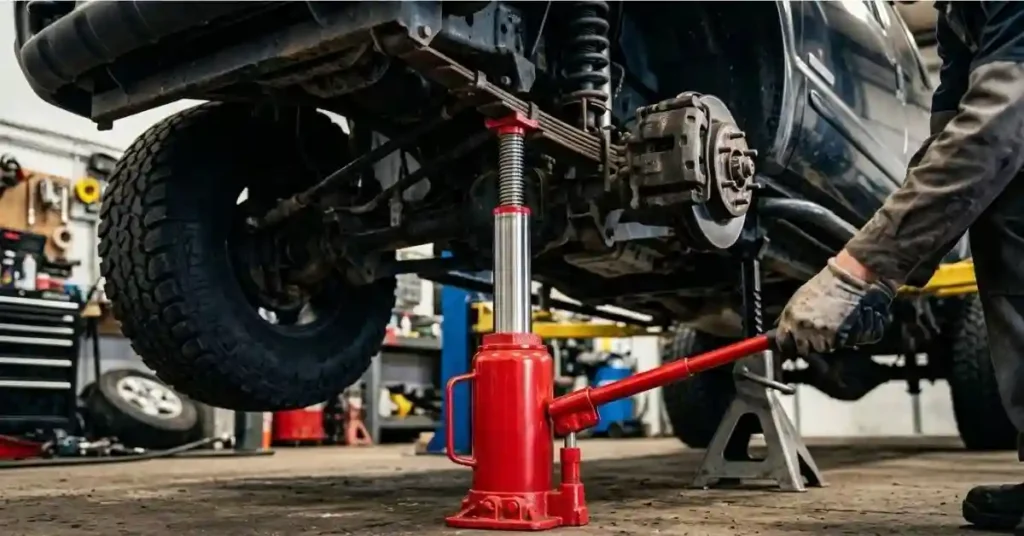
Can a Bottle Jack Be Used on an SUV or Truck?
Yes, if the jack is specifically rated and suitable for that vehicle and lifting point.
This is where capacity becomes especially important.
A heavy SUV or truck may require a higher-capacity jack than a small car. The vehicle manufacturer’s instructions should also be followed because lifting points can vary.
For larger vehicles, stability becomes even more important. NIOSH guidance advises using equipment that is tested, rated, and suitable for the work, while also stressing firm ground and wheel chocks.
I would not choose a bottle jack for a heavy vehicle simply because the jack happens to fit underneath it.
When Should You Avoid Using a Bottle Jack?
There are situations where I would stop rather than try to make the setup work.
Avoid using it when:
- The ground is soft or badly uneven.
- The vehicle is on a significant slope.
- You cannot identify a proper lifting point.
- The jack capacity is uncertain.
- The jack is damaged or leaking.
- The vehicle cannot be properly supported.
- You need to work underneath but do not have suitable jack stands.
- The jack does not sit squarely under the load.
CDC/NIOSH vehicle-repair guidance says not to proceed when safe working conditions cannot be met.
That is good advice for home garages too.
Bottle Jack Safety: A Simple Pre-Lift Check
Before touching the handle, I like the idea of doing a short mental check.
It takes less time than dealing with a problem afterward.
Ask these five questions
Is the surface firm and level?
If not, stop and find a better location.
Is the jack rated for the load?
Check the actual rating. Do not guess.
Am I using the correct lifting point?
Confirm it in the vehicle manual.
Are the wheels secured?
Apply the parking brake and use wheel chocks as appropriate.
Do I have proper support for the vehicle?
If you need to work underneath, have correctly rated jack stands ready.
| Check | Safe answer |
| Surface | Firm and level |
| Capacity | Adequate for the load |
| Lift point | Manufacturer-approved |
| Wheels | Secured and chocked |
| Under-vehicle work | Jack stands installed |
A Few Bottle Jack Myths I Had to Rethink
There are a few ideas about jacks that sound logical until you look at what can actually go wrong.
Myth: “If the jack holds for five minutes, it is safe.”
Not necessarily.
A jack can appear stable and still have a mechanical or hydraulic problem. A vehicle should be properly supported before anyone works underneath it.
Myth: “A higher capacity jack is always safer.”
Capacity matters, but it is only one part of the setup.
A high-capacity jack placed on soft ground or a bad lifting point can still create a dangerous situation.
Myth: “The jack only needs to lift one wheel.”
Even when lifting one end or one corner, you still need to consider the vehicle’s movement and the load transferred through the jack.
Myth: “Jack stands are optional for quick repairs.”
A quick repair can still go wrong quickly.
The recommended practice is to support the vehicle before going underneath.
My Biggest Takeaway About Bottle Jack Safety
The thing that changed my view of bottle jacks was realizing that the jack itself is only one part of the safety system.
The surface matters. The lifting point matters. The load rating matters. Wheel chocks matter. Jack stands matter. The condition of the equipment matters.
And your position matters too.
A properly rated bottle jack on a firm, level surface can be a useful lifting tool. But I would never confuse “it can lift the vehicle” with “it can safely support me underneath the vehicle.”
Final Thoughts
So, are bottle jacks safe? Yes, when they are used for their intended purpose and used correctly. They are not inherently unsafe simply because they use hydraulic pressure or have a compact design.
The biggest lesson is to use the bottle jack to lift, then transfer the vehicle’s weight to properly rated supports before doing work underneath. Inspect the jack, follow the vehicle manufacturer’s lifting points, secure the wheels, and never improvise when the setup does not feel right. OSHA and NIOSH guidance both support these basic principles.
A few extra minutes spent setting everything up properly can make a huge difference. With jacking, slow and careful is not overkill. It is simply good practice.
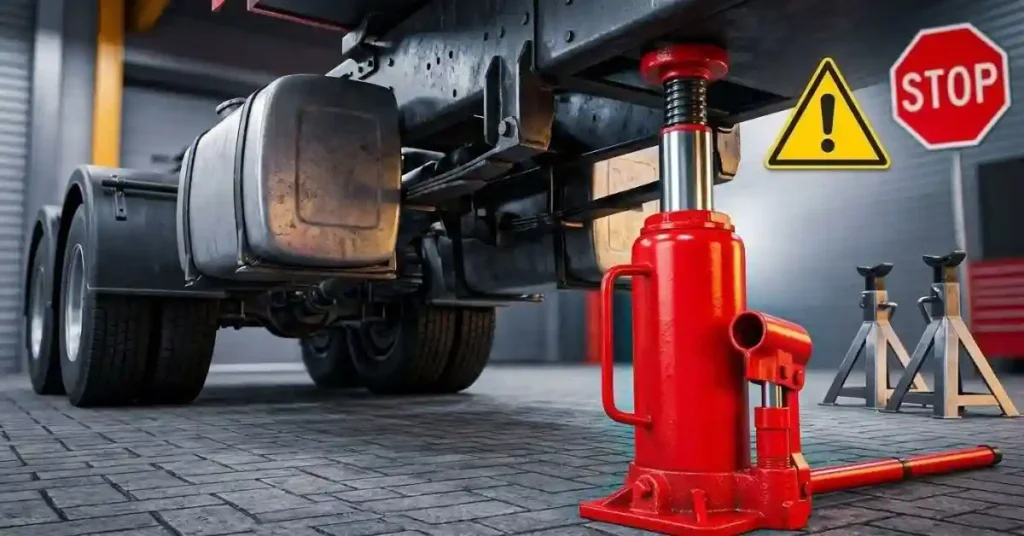
FAQs: Are Bottle Jacks Safe?
1. Are bottle jacks safe for cars?
Yes, bottle jacks can lift cars safely when used right. Use a firm floor, the right lift point, and a jack that can hold the load. Never work under a car held only by a jack.
2. Can you work under a car with a bottle jack?
No. A bottle jack is for lifting, not safe support. Use strong jack stands before you go under a car. Check that the stands sit firm and hold the load.
3. Are bottle jacks safer than floor jacks?
Both can be safe when used right. Bottle jacks are small and lift up. Floor jacks have a wide base and roll. Pick the right jack for the car and job.
4. How much weight can a bottle jack lift?
A bottle jack can lift only up to its rated load. Check the label or guide before use. Pick a jack that suits the load and lift point of your car.
5. Can a bottle jack fail while holding a car?
Yes. A leak, bad part, or shift can cause a jack to fail. Check the jack before use. Keep the car on rated jack stands before you work under it.
To Get More About Home, Car Accessories Product You Can Visit Our Site. If You Found our Posts Helpful Leave a Comment Below