
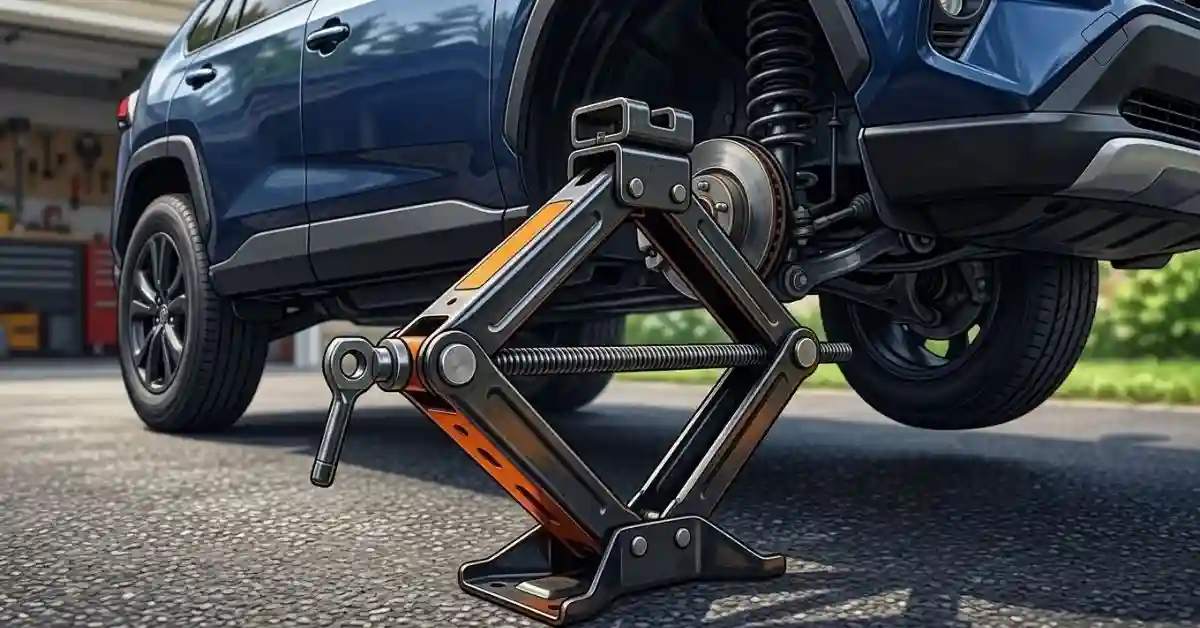
A scissor jack looks simple, but the little tool uses a clever bit of mechanical advantage. When I first looked closely at one, the part that stood out to me was the long screw in the center. A few turns of that screw can make the jack open upward and lift a heavy load.
So, how does a scissor jack work? It uses a threaded screw and two pairs of linked arms. Turning the screw changes the distance between the arms. As the arms move inward, the jack rises. When the screw turns the other way, the arms move apart and the jack lowers.
That basic idea is easy to understand. The interesting part is why a small turning force can create a much larger lifting force. Once you see how the screw and arms work together, the whole design makes much more sense.
How Does a Scissor Jack Work Mechanically?
A scissor jack converts rotary motion into lifting motion. The handle turns a threaded screw, while the screw controls the movement of the jack’s linked arms.
Think of the arms like two pairs of folding supports. They form a diamond shape when viewed from the side. The center screw runs between them.
| Part | Main job |
| Threaded screw | Converts turning force into movement |
| Scissor arms | Move upward or downward |
| Base and saddle | Spread and support the load |
When the screw rotates, its threads move a threaded nut or moving section along the screw. That movement pulls the lower parts of the arms closer together.
As the lower points move closer, the diamond-shaped arms become taller.
That is the key idea.
You are not directly pushing the vehicle upward with the handle. Instead, the screw slowly changes the shape of the scissor mechanism. The geometry does the lifting.
Why the Screw Can Lift So Much
The screw is the part that gives the jack its mechanical advantage.
A screw is basically an inclined plane wrapped around a shaft. Each turn moves the load only a small distance, but the turning force can be much easier to apply than a direct lifting force.
This creates a trade-off:
- Less effort is needed at the handle.
- The jack moves slowly.
- Many turns may be needed to create useful vertical movement.
That slow movement is not a flaw. It is part of the design.
A scissor jack is built for controlled lifting rather than speed.
What Happens Inside a Scissor Jack?
Once I broke the mechanism down into individual parts, the design became much easier to understand.
The screw does not simply push against the car. It controls the position of the scissor arms.
The arms then transfer that movement into vertical motion.
| Movement | What the mechanism does |
| Screw turns one way | Arms move toward a taller shape |
| Screw turns the other way | Arms move toward a flatter shape |
| Screw stops | The threaded system holds its position |
The exact design can vary between jacks. Some use slightly different nuts, pins, saddles, or screw arrangements.
But the basic principle remains the same: the threaded screw controls the geometry of the linked arms.
Why the Arms Form a Diamond
The diamond shape is more than a visual feature.
Imagine two crossing supports connected at several points. When the lower ends move closer together, the crossing arms must rise. When those ends move apart, the arms become shorter.
This is similar to opening and closing a pair of scissors.
That is where the name “scissor jack” comes from.
The arms do not need a motor or hydraulic pump. The screw provides the controlled movement, and the linked arms turn that movement into height.
Why a Scissor Jack Feels So Strong
A common question is how such a small jack can support a large vehicle.
The answer is mechanical advantage.
The handle gives you leverage. The screw gives you another form of mechanical advantage. The scissor geometry then converts the screw’s movement into lifting force.
This does not mean every small jack can safely support every vehicle.
The load rating still matters.
| Factor | Why it matters |
| Jack capacity | Determines the intended load range |
| Screw condition | Affects smooth movement and strength |
| Arm condition | Damaged arms can weaken the structure |
One lesson I think is easy to miss is that “it can lift a car” does not mean “it can lift any car.”
A jack is a mechanical device with a defined capacity and intended use. The vehicle maker’s instructions and the jack’s own rating should always be treated as the authority for that specific setup.
What Parts Make a Scissor Jack Work?
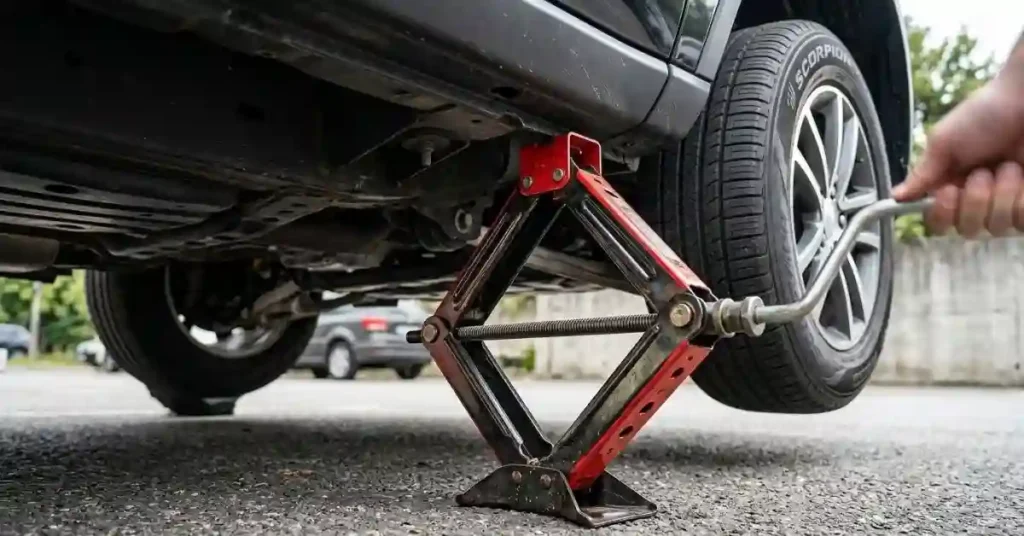
A typical scissor jack has several simple parts working together.
The Threaded Lead Screw
The lead screw is the heart of the mechanism.
Its spiral threads engage with a matching threaded component. As the screw rotates, the threads force that component to move along the screw.
Because the movement per turn is small, the jack can make controlled changes in height.
The Scissor Arms
The arms create the lifting structure.
They are usually made from strong metal and connected with pivot points. These pivots let the arms change angle as the screw moves.
The arms are designed to carry the load through the structure rather than relying on the screw alone.
The Saddle
The saddle is the upper contact area.
It connects the jack to the vehicle at the intended lifting point. Its shape may vary depending on the vehicle and jack design.
This is one reason it is important not to assume that any convenient spot under a vehicle is a suitable contact point.
The Base
The base spreads the jack’s load onto the surface below.
A larger, stable base can help the jack remain properly positioned, but it does not make an unsuitable surface safe.
Vehicle manuals commonly specify a level, solid surface for the jack. Toyota, for example, instructs users to position its jack on a level and solid place.
Scissor Jack vs. Hydraulic Jack
The biggest difference is how the lifting force is created.
A scissor jack uses a mechanical screw. A hydraulic jack uses fluid pressure.
| Comparison | Scissor jack | Hydraulic jack |
| Main mechanism | Threaded screw | Hydraulic fluid |
| Typical movement | Slow | Often faster |
| Design | Compact and simple | Usually larger |
| Common role | Emergency or compact use | Workshop and general lifting |
A scissor jack can be useful because it is compact and relatively simple.
A hydraulic floor jack can offer faster lifting and a different form of mechanical advantage, but it is usually much larger.
Neither design should be judged only by how strong it looks. Capacity, condition, correct placement, and the manufacturer’s instructions all matter.
Why Does a Scissor Jack Move Slowly?
This is one of the first things people notice.
The reason is simple: the screw has a small amount of movement for each rotation.
That gives you control.
Imagine trying to lift a heavy object directly with a large amount of force. That would require significant effort. The screw lets you trade speed for mechanical advantage.
| Design choice | Result |
| Small movement per turn | More turns required |
| More mechanical advantage | Less turning force |
| Slow lifting | Better control of height |
This is why a compact scissor jack can feel slow compared with powered or hydraulic lifting equipment.
The slowness is actually part of the mechanical design.
Common Scissor Jack Problems I Would Watch For
While researching these mechanisms, one thing becomes clear: simple does not mean maintenance-free.
The jack depends on several metal parts staying in good condition.
Rust, damaged threads, bent arms, worn pivot points, or other visible damage can affect how the mechanism behaves.
| Problem | Possible concern |
| Bent arm | Structural strength may be affected |
| Damaged threads | Screw movement may become unreliable |
| Heavy rust | Metal parts may be weakened |
| Sticking movement | Mechanism may not operate normally |
A jack that suddenly feels rough, crooked, or unusually difficult to move deserves attention.
I would not treat strange movement as something to “push through.” A lifting device is not the place for guesswork.
Common Myths About How Scissor Jacks Work
There are a few easy misunderstandings around these small jacks.
| Myth | Reality |
| The screw alone holds the whole load | The screw and scissor structure work together |
| Any metal point under a car will work | Vehicles have specific lifting points |
| More lifting height is always better | Extra height can reduce stability |
| A small jack is automatically weak | Capacity depends on its design and rating |
One especially important point is height.
A vehicle does not become safer just because it is lifted higher. A Dodge Journey owner’s manual archived by NHTSA warns against raising the vehicle higher than necessary and notes that greater height can reduce stability.
That is a useful mechanical lesson: more movement is not always better movement.
Why Correct Jack Placement Matters
The scissor mechanism can work exactly as designed and still be unsafe if the jack is not placed where the vehicle manufacturer intended.
This is where many people focus too much on the jack and not enough on the vehicle.
The vehicle’s structure has specific areas designed to accept lifting loads. The owner’s manual normally identifies them.
Toyota’s instructions, for example, show designated jack points and tell the user to confirm the jack’s position as it begins to contact the vehicle.
| Concern | What matters |
| Contact point | Use the vehicle’s specified lifting point |
| Ground | It should meet the manufacturer’s requirements |
| Vehicle position | Follow the owner’s manual |
| Jack condition | Do not use damaged equipment |
This is also why I would never judge a jack setup just by looking at it from a distance.
A setup can look straight while still being wrong for the vehicle.
What a Scissor Jack Is Really Designed For
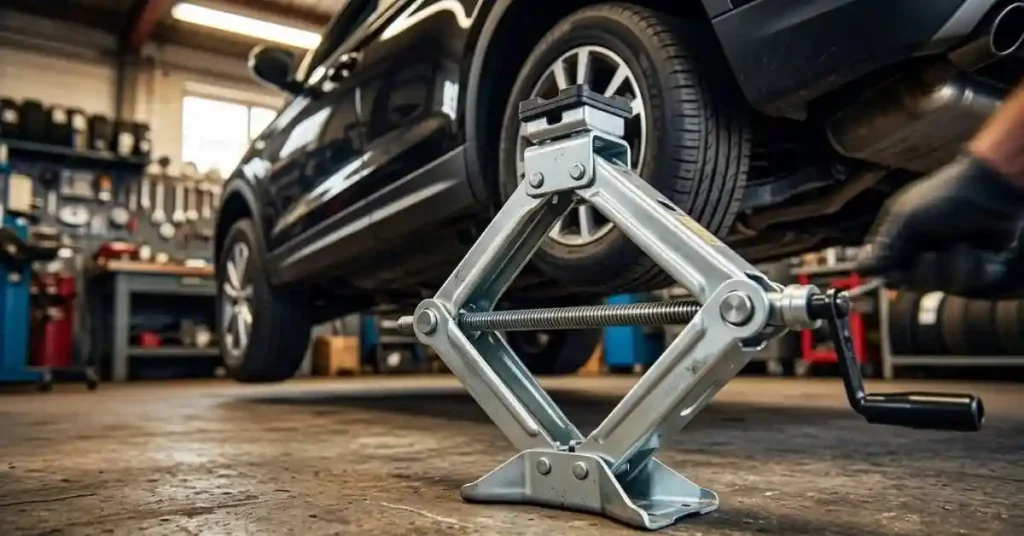
A scissor jack is usually best understood as a compact lifting tool for situations where a vehicle needs to be raised within the limits of the equipment and the vehicle manufacturer’s instructions.
It is not the same thing as a workshop lift.
It is also not a replacement for proper support equipment when a person needs to work underneath a vehicle.
This distinction matters.
Toyota’s owner documentation explicitly warns against getting under a vehicle when it is supported by the jack alone.
| Situation | General lesson |
| Emergency wheel change | Follow vehicle and jack instructions |
| Vehicle inspection | Use the proper support method |
| Work under vehicle | A jack alone is not appropriate support |
| Damaged jack | Do not rely on it |
The most useful thing I learned from researching scissor jacks is that lifting and supporting are two different jobs.
A jack is designed to lift.
That does not automatically make it a safe long-term support.
Safety Lessons That Are Easy to Miss
The mechanism itself is fairly simple. The real risk comes from using a lifting device without respecting the load.
Vehicle manuals repeatedly stress correct positioning and controlled lifting.
A GM emergency-jack recall documented by NHTSA is a good reminder of why this matters. The recall involved certain vehicles where the emergency jack could fracture if it was not positioned as directed in the owner’s manual.
That does not mean every scissor jack has this problem. It shows why the instructions for a particular vehicle and jack matter.
I also think people sometimes make a simple mistake: they focus on whether the jack is rated for the vehicle and forget that correct placement is part of safe operation.
A capacity number by itself does not solve every problem.
How Much Weight Can a Scissor Jack Lift?
There is no single answer for every scissor jack.
Different models have different rated capacities. The correct rating is the one stated by the jack manufacturer and, where applicable, supplied with or specified for the vehicle.
Do not estimate capacity based on the jack’s size.
| What to check | Why |
| Rated capacity | Confirms the intended load |
| Vehicle specifications | Shows the vehicle’s relevant weight |
| Owner’s manual | Identifies the intended jack and lifting points |
The safest approach is to treat the rating as a specification, not a guess.
What I Would Check Before Trusting an Old Scissor Jack
Old emergency jacks can sit in a vehicle for years without being used.
That means they may be forgotten until the exact moment they are needed.
Before relying on one, I would pay attention to obvious signs of damage, severe corrosion, bent components, damaged threads, missing hardware, or unusual movement.
I would also make sure the jack’s markings and capacity are still readable.
A few minutes of checking is much better than discovering a problem when the equipment is carrying a heavy load.
The Simple Physics Behind a Scissor Jack
The whole mechanism can be reduced to three ideas:
Turn → move → lift.
The handle turns the screw.
The screw moves the linked mechanism.
The linked arms change shape and create upward movement.
That is why the scissor jack is such a neat example of basic mechanical engineering.
It combines the mechanical advantage of a screw with the geometry of linked arms. The result is a compact tool that can produce a large lifting force with relatively small input force.
The trade-off is speed.
You gain lifting force but give up fast movement.
That trade-off appears in many machines, not just car jacks.
Final Thoughts
After looking at how a scissor jack works, I think the design is easier to appreciate. It is not simply a metal frame that pushes a car upward. The threaded screw, pivoting arms, saddle, and base all work as one system.
The biggest lesson is that the mechanism is only one part of the picture. The correct jack, rated capacity, proper lifting point, suitable surface, and vehicle instructions all matter. Manufacturer manuals also make clear that a jack alone should not be treated as support for getting underneath a vehicle.
If you remember one thing, remember this: a scissor jack works by using a screw to change the shape of its arms, turning slow rotational movement into controlled lifting force. It is a simple idea, but a clever one.
Frequently Asked Questions
How does a scissor jack work?
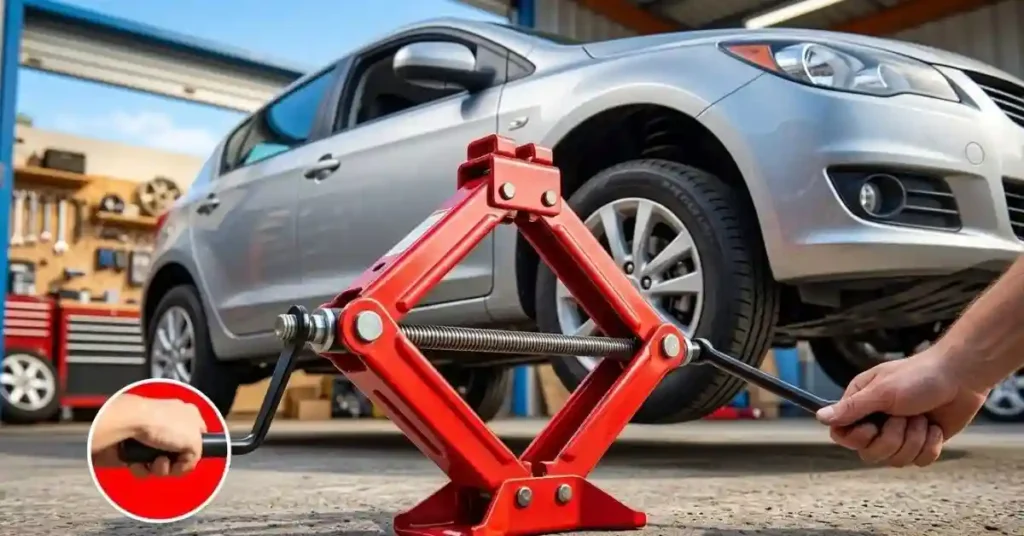
A scissor jack uses a threaded screw to move linked arms. As the arms close, they rise and lift the load. This gives high force with slow, steady motion.
What is the main part of a scissor jack?
The threaded screw is the key part. It moves the scissor arms as you turn it. The arms then change that motion into an upward lift.
Why does a scissor jack lift slowly?
A scissor jack moves slowly because its screw moves a small amount with each turn. This trades speed for mechanical advantage and helps give steady control.
How much weight can a scissor jack lift?
A scissor jack can lift only up to its rated load. Check the jack label and car manual before use. Never guess the safe load from its size.
Is a scissor jack safe to use under a car?
A scissor jack must be used as the car maker directs. Use the correct jack point and a firm surface. Never rely on the jack alone to support a car.
To Get More About Home, Car Accessories Product You Can Visit Our Site. If You Found our Posts Helpful Leave a Comment Below