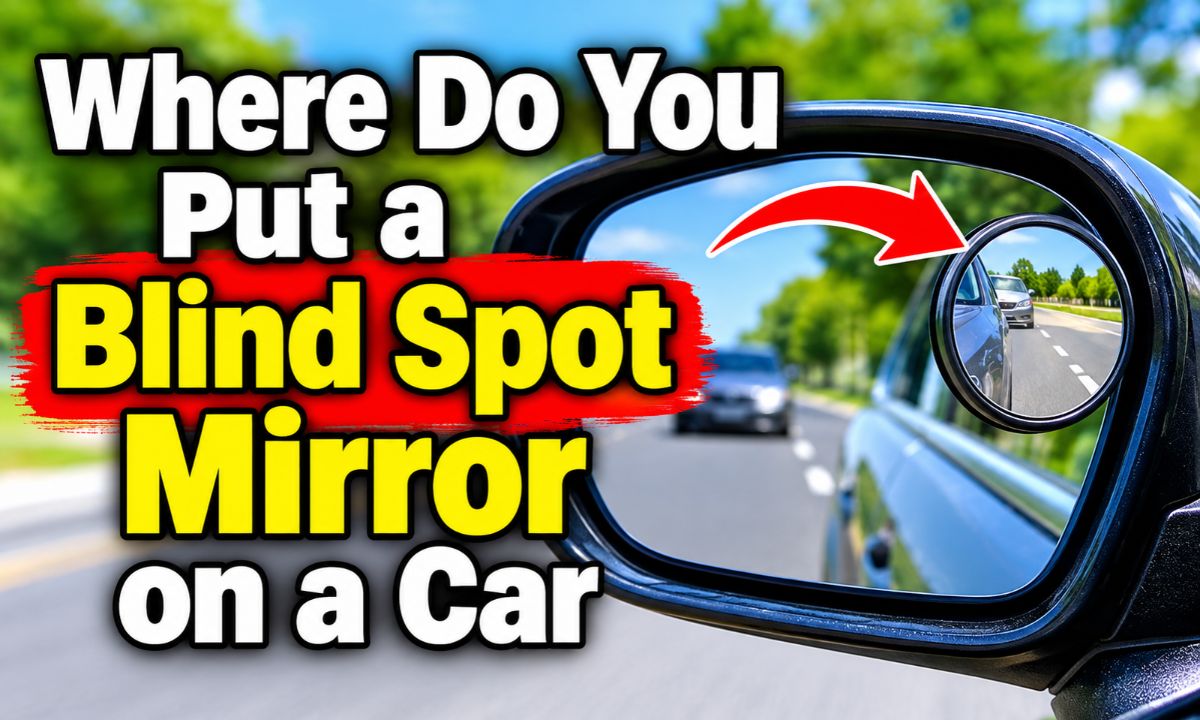
Place a blind spot mirror near the outer top corner of each side mirror, or the outer bottom corner if that position gives you a clearer view without blocking the main mirror.
Driving on American roads often means dealing with busy highways, crowded city streets, and vehicles that seem to appear beside you without warning. Whether you drive a small sedan through town, an SUV on the interstate, or a pickup truck on a country road, blind spots can make lane changes more difficult. A small blind spot mirror can help you see areas that your regular side mirrors may miss.
The best place for a blind spot mirror is usually the outer edge of the driver’s and passenger’s side mirrors. The upper outside corner is a common starting point because it can provide a wider view of the next lane. However, the lower outside corner can work just as well on some vehicles. Your seat position, mirror shape, and the angle of the small mirror all affect the final placement.
Before sticking anything to your car, take time to adjust your regular mirrors. Then hold the small mirror in a few possible positions and check the view from your normal driving seat. The goal is to see traffic beside your vehicle without covering useful parts of the factory mirror. A blind spot mirror is an extra viewing aid, not a replacement for looking over your shoulder.
The best starting position for a blind spot mirror is the outer top corner of your car’s side mirror. This location places the extra viewing area near the edge of your regular mirror, where traffic in the next lane may disappear from view. It also helps keep the center of the factory mirror available for normal driving.
You can also install a blind spot mirror in the outer bottom corner. This position may work better if your mirror has a curved shape, a narrow upper edge, or a design that makes top-corner mounting difficult. Some drivers also prefer the lower position because it can help them see nearby road space and curbs.
There is no single mounting point that works perfectly for every car. A compact sedan, a large SUV, and a pickup truck can have very different mirror shapes and viewing angles. Test the location from the driver’s seat rather than choosing a spot only because it looks good from outside the vehicle.
Source: m.media-amazon.com
Upper outside corner
A common first choice for viewing vehicles in the adjacent lane. It keeps the small mirror near the outer edge of the factory mirror.
Lower outside corner
A useful alternative when the upper corner is too crowded or the lower position gives a clearer view of nearby traffic.
Inside corners
Usually less useful because they can take up space needed for the regular rearward view. Avoid covering important factory mirror areas or warning indicators.
Should a Blind Spot Mirror Go on the Top or Bottom?
Both positions can work, but the upper outside corner is a sensible place to test first. It often provides a useful view toward the next lane while leaving much of the original mirror available. This can be helpful when you spend a lot of time merging onto highways or changing lanes.
The lower outside corner may suit drivers who need a wider view of nearby objects. It can also be easier to fit on certain mirror designs. However, the lower position is not automatically better for parking or lane changes. The result depends on the direction in which the small mirror points.
The best way to choose is to hold the mirror against both corners without removing the backing. Sit in your usual driving position and compare what each location shows. Pick the one that reveals useful traffic without hiding information you already get from the main mirror.
Choose the upper corner when
You want to test an additional view of traffic approaching in the adjacent lane.
Choose the lower corner when
Your mirror design makes the lower area easier to use or it provides a better viewing angle.
Should You Put Blind Spot Mirrors on Both Sides?
For balanced coverage, you can install one blind spot mirror on each side of the vehicle. The driver’s side and passenger’s side both have areas that may not appear in the regular mirrors. Adding an extra mirror to both sides gives you another viewing aid when checking traffic around the car.
The two small mirrors do not have to occupy exactly the same corner if the factory mirrors have different shapes. What matters is that each one gives you a useful view from the driver’s seat. The passenger-side mirror may need a different angle because it is farther from your eyes.
If you choose to install only one, start with the side where you have the greatest visibility concern. Still, do not assume the other side is free of blind spots. Your vehicle’s shape, seating position, and normal driving conditions should guide the decision.
Why Does Blind Spot Mirror Placement Matter?
Correct placement matters because a blind spot mirror is meant to show an area that your regular mirrors do not cover well. If you attach it in the wrong place, it may show much of the same area as your factory mirror. That adds another reflection without giving you much useful information.
A blind spot is an area around your vehicle that you cannot see clearly through your windows and mirrors from the driver’s seat. It can include space beside and slightly behind your car. A vehicle traveling in that area may briefly disappear from your normal mirror view.
The National Highway Traffic Safety Administration explains that outside and inside mirrors help drivers see traffic around their vehicles, but they do not show everything. Its mirror guidance also recommends adjusting outside mirrors to reduce side blind spots and checking over your shoulder before changing lanes. A small extra mirror should support this process, not replace it. Source: NHTSA, Keeping an Eye on Blind Spots.
A properly aimed convex mirror gives you a wider field of view. The curved surface lets you see more of the area beside your car than a similar-sized flat mirror. The trade-off is that objects look smaller, and judging their distance can be harder.
Source: i.ytimg.com
Better side awareness
You may see a vehicle that is moving alongside your rear quarter panel before it becomes visible in your main side mirror.
More useful mirror coverage
Correct placement helps the extra mirror show an area that the factory mirror does not already display.
Less visual overlap
Keeping the small mirror near the outer edge can help preserve the main mirror’s normal rearward view.
Additional parking awareness
Depending on its angle, a small mirror may help you see nearby objects and road space when parking.
How Does a Convex Blind Spot Mirror Work?
A convex mirror curves outward. This shape spreads reflected light over a wider viewing area than a flat mirror. As a result, you can see more of the space beside your vehicle in one glance.
The wider view comes with a change in how objects appear. A car in a convex mirror may look smaller than it does in your regular mirror. It may also seem farther away than it really is.
This is why you should never judge a vehicle’s distance using only the small mirror. Use your main mirrors, check the traffic around you, and look over your shoulder when needed. Give yourself enough time and space before moving into another lane.
Wider field of view
The curved surface reflects a broader area beside the vehicle.
Smaller reflected objects
Vehicles may look smaller, so their distance and speed can be harder to judge.
How to Install a Blind Spot Mirror Correctly
Installing a stick-on blind spot mirror is usually a simple job. You do not need to remove the factory side mirror or change the car’s wiring. The most important parts are choosing a useful position, cleaning the glass, and checking the viewing angle before attaching the mirror.
Read the instructions that come with your mirror first. Some models use a fixed adhesive base, while others have a small adjustable joint. The installation steps can differ, so follow the instructions for your exact product.
Choose a dry place where the car can remain parked while you work. A clean surface and suitable temperature help the adhesive attach as intended. Avoid rushing the process, especially if you are installing a mirror with a small adhesive pad.
Source: know-your-car.com
What you need
A blind spot mirror, a clean microfiber cloth, a suitable mirror-safe glass cleaner, and any cleaning wipe supplied with the product.
Before you start
Park on level ground, switch off the engine, and make sure you can reach the side mirror safely.
Step 1: Adjust Your Factory Side Mirrors
Start by setting your driver’s seat to the position you normally use. Adjust the seat, steering wheel, and headrest before setting the mirrors. You should be sitting comfortably with a clear view through the windshield.
Next, adjust the driver’s side mirror. NHTSA recommends placing your head against the driver’s side window and setting the mirror so you can just see the left side of your vehicle. For the passenger mirror, position your head near the middle of the vehicle and adjust it so you can just see the right side.
These positions help move the side mirrors outward and show more of the road. Your car’s owner manual may provide model-specific guidance, so check it if the adjustment controls or mirror design are unusual.
Driver’s mirror
Adjust it from the normal seat position after using the window-side reference described by NHTSA.
Passenger mirror
Use the center-of-vehicle reference to set the passenger mirror before checking its view.
Step 2: Test the Best Mounting Position
Hold the blind spot mirror near the upper outside corner of the factory mirror. Do not remove the protective film from the adhesive yet. Look at the reflection from your normal driving position.
Check whether the small mirror shows a useful area beside and slightly behind your car. You should not see only the same road area that already appears in your regular mirror. If the reflection overlaps too much, try moving the small mirror toward the lower outside corner.
Move it a little at a time. A small change in position can alter the viewing angle. If your product has an adjustable joint, you can also test different angles before deciding where to mount its base.
Good placement
The small mirror shows additional traffic beside your vehicle without blocking the main mirror.
Poor placement
The small mirror shows mostly the same area as the factory mirror or hides useful information.
Step 3: Clean the Side Mirror Glass
Once you have selected a position, clean the area where the adhesive will attach. Dust, road film, fingerprints, wax, and oil can weaken the bond. Use a mirror-safe cleaner and a clean microfiber cloth.
If the product includes an alcohol wipe, follow its instructions. Let the glass dry fully before attaching the mirror. Avoid using rough materials that could scratch the factory mirror.
Do not apply adhesive over cracks, loose mirror glass, or a damaged surface. If the main mirror is damaged, have it repaired before adding an accessory.
Remove dirt
Clean away dust, grease, and road residue from the mounting area.
Dry the surface
Make sure no moisture or cleaner remains under the adhesive.
Step 4: Attach the Blind Spot Mirror
After the surface is dry, remove the protective backing from the adhesive. Carefully line up the mirror with the position you tested. Avoid touching the exposed adhesive with your fingers.
Press the base firmly against the glass as directed by the manufacturer. Apply even pressure rather than pushing hard on one small part of the mirror. If the product has an adjustable head, hold the base in place while securing it.
Do not move the mirror repeatedly after attaching it. Some adhesives need time to bond fully. Follow the product instructions for pressure, temperature, and any waiting period before driving or washing the vehicle.
Align before sticking
Make sure the mirror is in the correct position before removing the adhesive backing.
Follow the product instructions
Use the recommended attachment method and allow the adhesive to set for the stated time.
Step 5: Adjust the Small Mirror
Sit in the driver’s seat again and look at the new reflection. If the mirror can swivel or rotate, adjust it until it shows the intended side area. Keep your head in the same position you use while driving.
The reflection should add useful information rather than simply enlarge the view of the road behind you. Check both sides if you have installed a pair. The passenger-side mirror may need a slightly different angle.
If the mirror cannot be adjusted and the view is poor, you may need to reposition it. Do not accept a bad angle just because the adhesive is already attached. Follow the manufacturer’s removal instructions and use a suitable replacement adhesive if required.
Check the view
Make sure the mirror shows the intended area beside your car.
Check the main mirror
Confirm that the extra mirror does not cover your normal rearward view.
How to Check Whether Your Blind Spot Mirror Is in the Right Place
A correctly placed blind spot mirror should show an area that is useful to your driving. You should be able to glance at it and understand whether another vehicle may be traveling beside your car. The reflection should also remain clear from your normal driving position.
You can check the setup while the vehicle is parked. Ask another adult to stand at a safe distance beside the vehicle and move slowly through areas around the side and rear, while you observe the reflections from the driver’s seat. Do not use a moving vehicle for this test, and keep the helper away from traffic.
This basic check can help you spot obvious gaps or excessive overlap. It cannot prove that every possible blind spot has disappeared. Different vehicle sizes, road positions, and driver movements can change what you see.
Source: i.ytimg.com
A useful extra view
The mirror shows part of the adjacent lane that is not clearly visible in the main side mirror.
Clear reflection
Objects appear stable and easy to recognize, without excessive distortion or glare.
No blocked warning light
Any factory blind spot monitoring indicator remains visible and unobstructed.
Secure attachment
The mirror does not wobble, slide, or lift away from the mounting surface.
A Simple Parked-Vehicle Visibility Test
Park your car on level ground in a safe, private area. Set the parking brake and keep the vehicle stationary. Sit in your normal driving position and look at the main side mirror first.
Have a helper stand several feet away from the side of the vehicle. Ask the helper to move slowly through the area beside and behind the car while remaining clear of moving traffic. Watch when the person appears in the main mirror and when the person appears in the blind spot mirror.
The goal is to understand how the two reflections work together. If the small mirror shows only an area already covered by the main mirror, try another position or angle. If you notice a gap, adjust the setup and repeat the check.
Test the driver’s side
Check the area beside the driver’s rear quarter and the adjoining lane.
Test the passenger’s side
Repeat the check on the opposite side because the mirror angle and distance differ.
Signs That You Need to Reposition the Mirror
A blind spot mirror may need adjustment if you cannot see the area it was intended to cover. You may also notice that the small reflection overlaps too much with the main mirror. Both problems can reduce the value of the extra mirror.
Another warning sign is a view that makes it difficult to recognize nearby vehicles. A distorted, dirty, cracked, or loose mirror should not be relied on. Clean it, inspect its mounting, and replace it if the reflection remains unclear.
If the mirror blocks a factory warning light or an important part of the main mirror, move it. Preserving the original mirror’s useful view should always come first.
Too much overlap
The small mirror repeats the factory mirror’s view instead of showing additional space.
Poor visibility
The reflection is blurry, distorted, or difficult to understand.
Loose adhesive
The mirror shifts or begins to separate from the glass.
Best Blind Spot Mirror Placement for Different Vehicles
The best mounting position can change with the type of vehicle you drive. A small car may have narrow side mirrors, while an SUV or pickup truck may have larger mirrors with different shapes. These differences affect where an extra mirror can fit and what it can show.
Do not assume that a mirror position recommended for another vehicle will work on yours. Even two cars from the same brand can have different mirror designs. Test the view from your own driver’s seat before making the installation permanent.
The following table gives practical starting points. These are not fixed manufacturer rules. Use them as a guide, then adjust the mirror based on the actual view.
Source: bryansgarage.com
Sedans
Start with the upper outside corner and compare it with the lower outside corner if the factory mirror is small.
SUVs
Check the upper and lower outside corners, especially if the mirror housing has a broad or curved shape.
Pickup trucks
Consider the mirror’s height and size. Make sure the extra mirror does not interfere with towing or other factory mirror functions.
Vans
Check the full side view carefully because the vehicle’s size and body shape may create larger areas that are difficult to see.
Where to Put a Blind Spot Mirror on a Sedan
Most sedan drivers can begin by testing the upper outside corner of each side mirror. This area is often easy to reach and can provide an extra view of the next lane. A small round or oval mirror may fit better than a large rectangular model.
If the factory mirror has a narrow upper edge, test the lower outside corner. Make sure the added mirror does not cover the main reflection or any built-in warning indicator. The smaller mirror should add useful coverage without taking over the factory mirror.
Where to Put a Blind Spot Mirror on an SUV
SUVs often have larger side mirrors than compact cars, giving you more room to test different positions. Start near the outer upper edge, then compare the lower edge. A larger mirror may be useful if the factory glass offers a wide mounting area.
However, do not choose a large accessory simply because the vehicle is large. The mirror should fit without blocking the normal reflection. Check the angle from the driver’s seat and make sure the added mirror remains easy to read.
Where to Put a Blind Spot Mirror on a Pickup Truck
Pickup trucks can have different mirror designs, including wide towing mirrors and mirrors with separate reflective sections. The correct position depends on the exact design. A small mirror may fit on the outer section, but you should first check the manufacturer’s instructions.
If you tow a trailer, preserve the viewing areas you need for trailer awareness. Do not cover a factory convex section or move a factory mirror out of its intended position just to make room for an accessory. The extra mirror should support the existing setup.
Where to Put a Blind Spot Mirror on a Van
Vans may have larger side blind spots because of their height, body length, and window layout. A blind spot mirror can provide another view of nearby traffic, but a small accessory cannot show every area around a large vehicle.
Check the vehicle’s owner manual and any towing or commercial vehicle guidance that applies. Make sure the added mirror does not interfere with factory mirrors, cameras, or warning systems. Drivers of larger vans should also use careful head checks and follow the vehicle’s approved mirror setup.
Common Blind Spot Mirror Installation Mistakes to Avoid
A blind spot mirror is a small accessory, but a poor installation can make it less useful. The biggest mistake is attaching it without checking the view from the driver’s seat. A mirror that looks well placed from outside the car may point in the wrong direction when you are driving.
Another common mistake is covering too much of the factory mirror. Your original mirror provides an important view of traffic behind and beside the vehicle. The extra mirror should add information, not remove useful visibility.
Take time to check the mirror’s position, angle, and attachment. If something looks wrong, correct it while the vehicle is parked. Never try to adjust or repair a loose mirror while driving.
Source: slickmotorz.com
Installing it too close to the center
This may cause the small mirror to repeat the normal rearward view and reduce useful space on the factory mirror.
Skipping surface cleaning
Dirt, oil, and moisture can weaken the adhesive and allow the mirror to loosen.
Removing the adhesive too early
Peeling the backing before choosing the final position can make installation harder.
Choosing an oversized mirror
A large accessory may cover too much of the original mirror, especially on compact cars.
Ignoring the viewing angle
A poorly aimed mirror may show the road, bodywork, or an area that is already visible.
Forgetting to check the attachment
A loose accessory can move or fall off, so inspect it as part of normal vehicle care.
Can You Put a Blind Spot Mirror Over the Factory Mirror’s Warning Light?
No. Do not cover a factory blind spot warning indicator with an extra mirror. Many newer cars place a small warning light or symbol in the side mirror glass. Covering it can make the warning harder to see.
The warning light and the small mirror serve different purposes. The factory system may use sensors to detect traffic in a nearby area, while the extra mirror provides a reflected view. Neither should interfere with the other.
If the warning indicator is near the outer corner, test another mounting position. You may also need a smaller accessory or a different mirror design. Check the owner manual if you are unsure where the warning system is located.
What If the Adhesive Does Not Hold?
If the mirror starts to come loose, park the vehicle and inspect the adhesive. Dust, moisture, old glue, wax, and an unsuitable surface can all affect how well it attaches. Extreme temperatures may also affect some adhesive products.
Do not simply press a dirty or loose mirror back into place and assume the problem is fixed. Remove it according to the manufacturer’s instructions, clean the surface, and use a suitable replacement adhesive if the product allows it.
If the mirror base or glass is damaged, replace the accessory or have the factory mirror checked. Avoid using a loose mirror while driving because it may move out of position or fall away.
Check the surface
Make sure the glass is clean, dry, and suitable for the adhesive.
Check the adhesive
Use the replacement material recommended for the mirror rather than an unsuitable household glue.
Check the temperature
Follow the manufacturer’s temperature limits for installation and adhesive setting.
Blind Spot Mirrors vs. Regular Side Mirrors and Blind Spot Monitoring
A blind spot mirror, a regular side mirror, and an electronic blind spot monitoring system all help you understand what is happening around your vehicle. However, they work in different ways. Knowing the difference helps you use each one correctly.
Your regular side mirror gives you a view of traffic behind and beside your car. A small convex mirror adds a wider reflection of a nearby area. An electronic blind spot monitoring system may use sensors to detect a vehicle and warn you with a light, sound, or other alert.
Some vehicles have all three features, while others have only standard mirrors. No matter which setup your car has, you still need to observe traffic and check the area beside your vehicle before moving into another lane.
Source: m.media-amazon.com
Regular side mirror
Provides the main rearward and side view used during normal driving.
Blind spot mirror
Uses a convex reflective surface to show a wider area beside the vehicle.
Electronic blind spot monitoring
Uses vehicle sensors to detect certain nearby objects and provide a warning when the system identifies a potential hazard.
Do Blind Spot Mirrors Replace Blind Spot Monitoring?
No. A small mirror does not replace an electronic blind spot monitoring system, and an electronic system does not replace your mirrors. The mirror provides a visual reflection, while the electronic system uses sensors and software to identify certain nearby vehicles or objects.
The two features may complement each other. A driver can use the regular mirror, extra mirror, and warning indicator to build a clearer picture of nearby traffic. However, each system has limits, including viewing angles and possible detection restrictions.
Read your owner’s manual to understand what your factory warning system can and cannot detect. Some systems may not detect every vehicle, pedestrian, cyclist, or object in every situation.
Do You Still Need to Look Over Your Shoulder?
Yes. A blind spot mirror does not remove the need for a shoulder check. Mirrors show reflected areas, but they cannot guarantee that you can see everything around the vehicle.
Before changing lanes, check the road ahead, use your turn signal, review your mirrors, and look over your shoulder when safe. Make sure the lane is clear before moving. Do not turn your head for so long that you lose awareness of the road ahead.
NHTSA’s blind spot guidance specifically advises drivers to look over their shoulder before changing lanes, even when mirrors are adjusted to reduce blind spots. This remains an important part of safe driving.
How to Use a Blind Spot Mirror When Changing Lanes
Use the small mirror as one part of a complete lane-change check. Do not look at it alone and move immediately. A vehicle can approach quickly, and a convex mirror can make its distance difficult to judge.
Start by checking the traffic ahead and behind. Look at your regular rearview and side mirrors, then glance at the blind spot mirror. If the lane appears clear, signal your intention and perform a quick shoulder check before moving when it is safe.
Keep your movements smooth and give other drivers enough space. If you cannot confirm that the lane is clear, wait. A few extra seconds are better than forcing a lane change when another vehicle may be beside you.
Source: i.ytimg.com
Look ahead
Check the road and traffic conditions before preparing to change lanes.
Check the main mirrors
Review the rearview and relevant side mirror to understand the traffic behind you.
Check the blind spot mirror
Look for vehicles in the additional area shown by the small convex mirror.
Signal and shoulder-check
Use your turn signal and look over your shoulder when safe before moving.
Move only when clear
Change lanes smoothly when you have enough space and time.
What Should You Do If a Vehicle Appears in the Blind Spot Mirror?
If you see a vehicle in the small mirror, assume the space may not be clear. Do not move into that lane until you have checked the vehicle’s position and confirmed that you have enough room.
Remember that the reflected image may make the vehicle look smaller or farther away. Check the main mirror and the surrounding traffic before deciding what to do. If the other vehicle is approaching quickly, allow it to pass.
Wait for a safe opening instead of trying to squeeze into a narrow gap. A blind spot mirror is most useful when it gives you extra time to recognize traffic and make a calm decision.
Can You Rely on a Blind Spot Mirror at Highway Speeds?
You can use a properly installed blind spot mirror as an additional viewing aid on highways. It may help you notice traffic traveling in the next lane. However, highway traffic can close gaps quickly, so a mirror glance alone is not enough.
Pay attention to vehicle speed, distance, and the direction of traffic. Check your mirrors early before preparing to merge or change lanes. If another vehicle is beside you, wait until there is a safe opening.
Do not make sudden steering movements based on a small reflection. Keep a safe following distance and use your turn signal well before moving.
How to Choose the Right Blind Spot Mirror Position and Size
The right blind spot mirror should fit your factory mirror and provide a useful reflection without creating a visual distraction. Size, shape, mounting style, and adjustability all affect how well it works. You do not need the largest mirror available.
Small round mirrors can fit compact side mirrors, while rectangular models may suit wider mirror glass. Adjustable models allow you to change the viewing angle after mounting. Fixed models are simpler, but their position must be chosen carefully before installation.
Check the product dimensions and mounting instructions before buying. Make sure the mirror is suitable for the exterior environment and that its adhesive is intended for the surface where you plan to attach it.
Source: koala.sh
Small round mirrors
Can fit narrow factory mirrors and take up less of the original reflective area.
Rectangular mirrors
May provide a wider viewing shape when the factory mirror has enough room.
Adjustable mirrors
Allow the driver to change the viewing angle after the base is attached.
Fixed mirrors
Have a simpler design but require careful position and angle selection before installation.
Should You Buy a Large or Small Blind Spot Mirror?
Choose a size that fits the available glass without blocking the factory mirror. A large mirror may show a broader area, but it can also cover too much of your normal view. A smaller model may fit neatly but provide less visible detail.
Consider your vehicle’s mirror dimensions first. A small sedan may need a compact accessory, while a wide truck mirror may have enough space for a larger model. The actual viewing result matters more than the size printed on the package.
If you are unsure, compare the mirror dimensions with the available mounting area before buying. Leave enough room for the mirror to sit securely without touching the housing or covering a warning light.
Are Adjustable Blind Spot Mirrors Worth Considering?
An adjustable blind spot mirror can be useful because drivers have different seating positions and vehicles have different mirror shapes. You can change its angle to show the area that matters most from your normal driving position.
A fixed mirror can still work well if you select the right mounting point and angle. It may be a simpler option for drivers who do not need to change the viewing direction after installation.
Whichever design you choose, check that the adjustment joint stays in place. A mirror that moves from road vibration or ordinary use will need attention before you rely on it.
Safety Tips for Using Blind Spot Mirrors
A blind spot mirror can improve your awareness, but safe driving still depends on how you use the entire mirror system. Keep the factory mirrors clean and correctly adjusted. Make sure the extra mirror stays secure and provides a clear reflection.
Do not use the small mirror as your only source of information when changing lanes. Its curved surface changes the size and appearance of reflected objects. A vehicle that looks small may be closer than you think.
Pay attention to pedestrians, cyclists, and motorcycles as well as cars. These road users can be harder to notice because of their size and position. Check the areas around your vehicle before turning, merging, or moving away from a curb.
Keep all mirrors clean
Remove dirt, water spots, and road film that may make reflections difficult to read.
Inspect the adhesive
Check for loose edges, movement, or damage during routine vehicle care.
Avoid sudden lane changes
Take time to confirm that the next lane is clear before moving.
Respect convex mirror distortion
Remember that nearby vehicles may look smaller or farther away.
Follow the owner’s manual
Preserve factory mirror functions and follow any model-specific instructions.
Do not adjust while driving
Park safely before moving or repairing a blind spot mirror.
Can a Blind Spot Mirror Cause Problems?
A poorly placed blind spot mirror can create confusion if it blocks part of the main mirror or shows a reflection that overlaps too much with the factory view. A damaged or loose mirror can also produce an unclear image.
Some drivers may find it distracting to look at several reflections. This is one reason to choose a sensible position and practice using the new mirror while parked. You should be able to understand its reflection without taking too much attention away from the road.
If the extra mirror makes it harder to see traffic, remove or reposition it. More mirrors do not always mean better visibility. The goal is a clear, useful view that works with your original mirror setup.
Do Blind Spot Mirrors Work in Rain and at Night?
A properly attached blind spot mirror can still provide a useful reflection in rain and at night. However, water droplets, dirt, glare, and low light can make the image harder to see. The small mirror does not remove these visibility limits.
Keep the mirror clean and check that it is not damaged. At night, avoid staring at bright reflections or trying to judge distance from a convex image alone. Use the full mirror system and stay aware of traffic conditions.
If water or fog keeps collecting on the mirror, follow the manufacturer’s cleaning and care instructions. Do not apply a coating unless it is suitable for that particular mirror surface.
Frequently Asked Questions
Q
Where is the best place to put a blind spot mirror on a car?
The upper outside corner of the side mirror is a good starting point for most cars. This position can provide an additional view of traffic beside the vehicle while keeping much of the factory mirror clear. The lower outside corner is another option if it gives you a better view.
Q
Should blind spot mirrors be placed on the driver or passenger side?
You can install blind spot mirrors on both the driver’s and passenger’s side mirrors. Both sides of a vehicle can have areas that are difficult to see through regular mirrors. Adjust each small mirror separately because the viewing angles are different.
Q
Can I put a blind spot mirror on the bottom corner?
Yes. The lower outside corner can be a useful mounting position when it provides a clear view of the adjacent lane without blocking the factory mirror. Test the angle from your normal driving position before attaching the mirror permanently.
Q
Can I install a blind spot mirror without adhesive?
Yes, depending on the mirror design. Some models use clips or adjustable mounts instead of adhesive pads. Choose a mounting method that is compatible with your factory mirror and follow the product instructions. Make sure the accessory is secure before driving.
Q
Do blind spot mirrors make driving safer?
They can help drivers see additional areas beside their vehicles, which may improve awareness during lane changes and merging. However, they do not eliminate every blind spot or prevent every collision. Correct mirror adjustment, safe driving habits, and shoulder checks remain essential.
Q
Do blind spot mirrors work on curved side mirrors?
They can work on many curved side mirrors, provided the accessory can attach securely and does not block the factory mirror’s useful viewing area. Check the product’s compatibility and mounting instructions before installation. A curved mirror may require a different position or mounting style.
Q
Can I install a blind spot mirror over a factory convex mirror?
You should avoid covering a factory convex mirror section. Your vehicle may already use that area to provide a wider field of view. Adding another mirror over it can reduce useful visibility. Test another location that keeps the original reflective areas clear.
Q
How often should I check my blind spot mirrors?
Check them during routine vehicle cleaning and whenever you notice a change in the reflection. Look for loose adhesive, cracks, dirt, and movement. If the mirror becomes damaged or its reflection is unclear, repair or replace it before relying on it.
✦ Wrapping Up
Conclusion
The best place to put a blind spot mirror on a car is usually the upper outside corner of each side mirror. This position is a useful starting point because it can show traffic beside your vehicle while leaving the main mirror available for its normal purpose. The lower outside corner is also a good option when it provides a better view for your vehicle.
Before installing the mirror, adjust your factory side mirrors and test the extra mirror from your normal driving position. Clean the glass, attach the mirror according to its instructions, and check that it does not cover the main reflection or a factory warning indicator. A little care during installation can help you avoid a poor viewing angle.
Most importantly, treat a blind spot mirror as an extra safety aid rather than a complete solution. Convex mirrors can make vehicles look smaller and farther away, and no mirror can show every area around your car. Always check your regular mirrors, use your turn signal, and look over your shoulder before changing lanes.
💡 Key Takeaway
Start by testing the upper outside corner of both side mirrors. Compare it with the lower outside corner, choose the position that gives you the clearest additional view, and secure the mirror only after checking it from your normal driving seat.